Titanium Mesh Saves Time, Not Bone
A retrospective comparison of customised CAD/CAM titanium mesh and screw tent-pole grafting found comparable ridge gain, stable 5-year peri-implant marginal bone levels, and 100% implant survival, with the titanium mesh workflow shortening mean operative time by about 10 minutes.
Mesh saves ten minutes
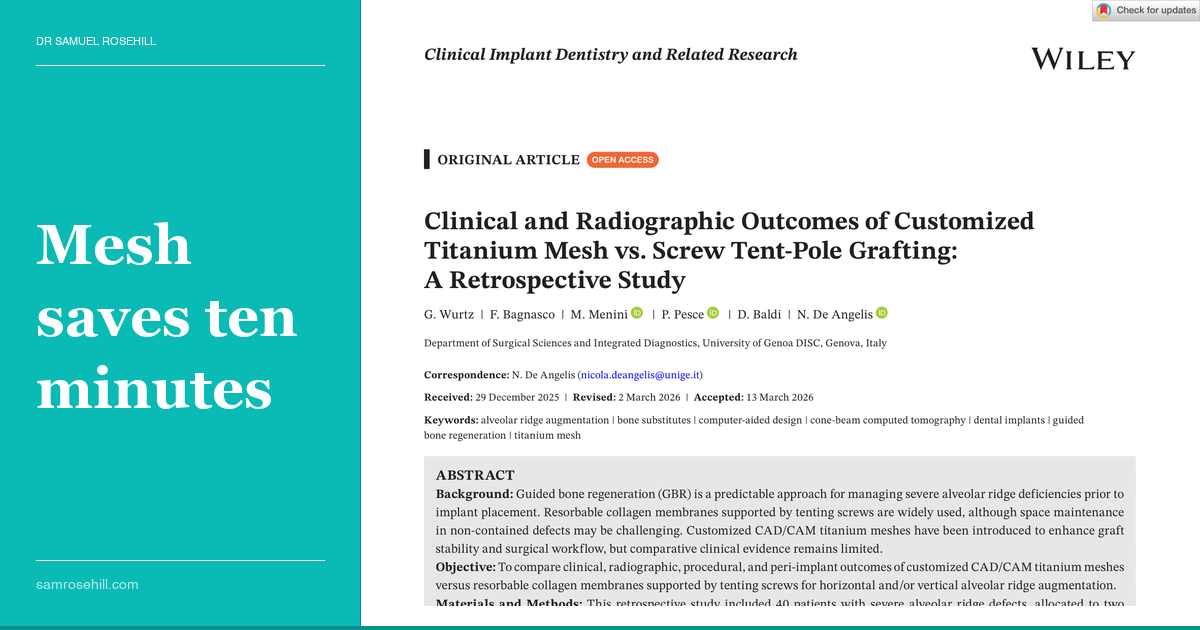
Source Paper
Clinical and Radiographic Outcomes of Customized Titanium Mesh vs. Screw Tent-Pole Grafting: A Retrospective Study
Some surgical innovations arrive dressed as biology but turn out, on closer inspection, to be logistics. This is not a criticism. In guided bone regeneration, where a few millimetres of ridge can demand a small engineering project under a flap, logistics are not decorative. They are the difference between a procedure that proceeds elegantly and one that requires three extra hands, two extra prayers, and a membrane that has developed opinions.
In Clinical and Radiographic Outcomes of Customized Titanium Mesh vs. Screw Tent-Pole Grafting: A Retrospective Study, Wurtz and colleagues compare two ways of holding space for severe ridge defects. One is familiar: tenting screws plus a resorbable collagen membrane. The other is digitally planned, patient-specific CAD/CAM titanium mesh. The question is whether the expensive-looking option regenerates more bone, or simply makes the same operation less fiddly.
The Data Anchor
The study included 40 patients with severe horizontal and/or vertical alveolar ridge defects, divided into two groups of 20. Both groups received particulate grafting. The tent-pole group used screws and a resorbable collagen membrane; the titanium-mesh group used a customised CAD/CAM barrier designed before surgery.
Cone beam CT scans at baseline and 6 months measured vertical and horizontal bone gain. The authors also recorded complications, pseudo-periosteum formation, operative time, implant survival, and marginal bone levels at prosthetic loading and 5-year follow-up.
Key Findings
- Bone gain was comparable. At 6 months, mean bone height reached 8.7-8.93 mm in the maxilla and 9.25-9.35 mm in the mandible, while ridge width ranged from 4.7 to 5.3 mm, with no significant intergroup differences.
- The mesh workflow was faster. Mean operative time was 72.7 minutes for tent-pole grafting and 62.4 minutes for titanium mesh, a significant reduction of about 10 minutes.
- Implant outcomes were reassuring. All 60 implants placed in the 40 augmented sites survived to 5 years, with no implant failures and no additional grafting procedures.
- Marginal bone stayed stable. At 5 years, mean marginal bone loss was 1.82 mm maxillary and 1.38 mm mandibular in the tent-pole group, versus 1.78 mm and 1.32 mm in the titanium-mesh group.
- Complications were limited. No major infections were observed, and pseudo-periosteum occurrence did not differ significantly between groups.
- Limitation: retrospective design, small sample size, and long-term follow-up focused on marginal bone levels rather than volumetric remodelling of the regenerated ridge.
💡 The Clinical Bottom Line
This paper does not crown customised titanium mesh as the biological superior. It suggests something more modest and probably more believable: when GBR principles are executed well, both approaches can create enough ridge to place implants predictably.
The titanium mesh advantage is workflow. Passive fit, predefined geometry, and less intraoperative improvisation appear to save time without sacrificing bone gain. That matters, especially in complex augmentations, but it is not the same as saying the mesh grows better bone. It may simply make the surgeon do less carpentry under pressure.
Dr Samuel Rosehill is a general dentist with a prosthodontic focus, practising at Ethical Dental in Coffs Harbour, NSW. He holds a BDSc (Hons) from the University of Queensland, an MBA, an MMktg, and an MClinDent in Fixed & Removable Prosthodontics (Distinction) from King’s College London.
Clinical Relevance
For horizontal or vertical ridge augmentation before implant placement, customised CAD/CAM titanium mesh and tenting screws with a collagen membrane produced similar measured bone gain and stable peri-implant bone levels in this retrospective cohort. The main advantage of the mesh workflow was practical rather than regenerative: shorter operative time and less intraoperative adaptation.
Disclosure: The author has no financial conflicts of interest related to the products or topics discussed in this review. This is an independent summary prepared for educational purposes.
Continue the conversation
This review is also published on Substack, where you can leave comments and join the discussion.
Read on Substack →