Can Your Phone Camera Replace a Spectrophotometer?
Kizilkaya and colleagues test whether standardised digital photography with colour-analysis software can match the spectrophotometer for shade matching — and the answer is complicated.
Gold standard holds
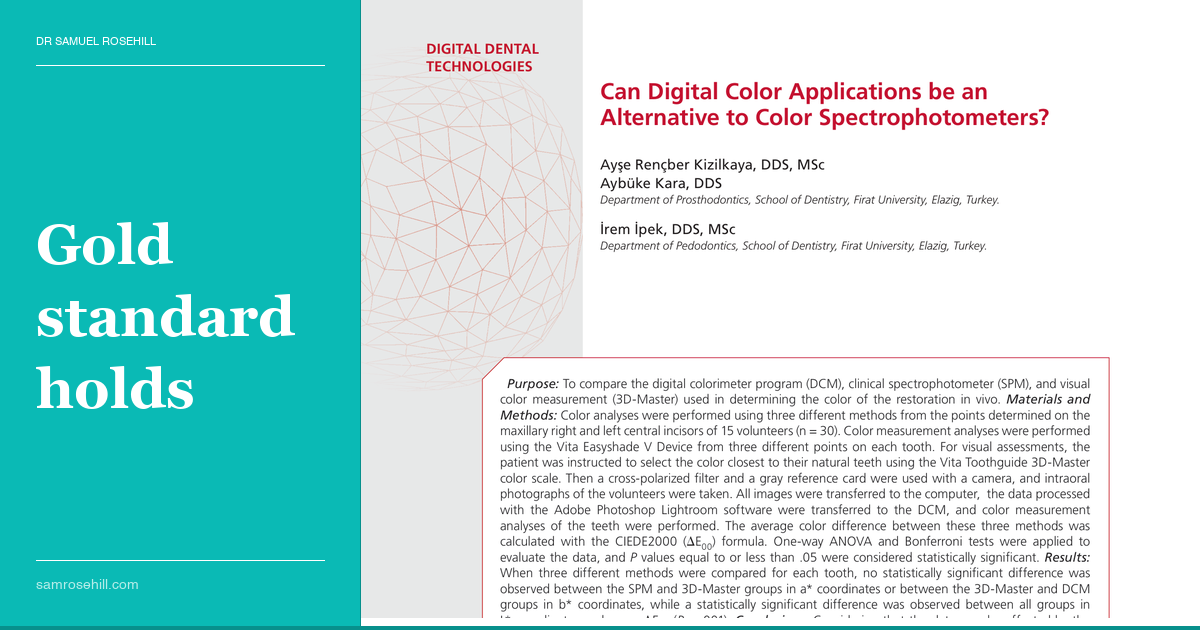
Source Paper
Can Digital Color Applications be an Alternative to Color Spectrophotometers?
There is a particular kind of professional crisis that strikes dentists at the colour-matching stage of a restoration: is this tooth 2M2 or 2L1.5? The patient sits there with a retractor wedged in their mouth, radiating the quiet desperation of someone who’d really rather not be asked to adjudicate. And fair enough — because getting tooth colour right is one of those deceptively simple tasks that turns out to be fiendishly difficult, with real consequences for how a restoration looks once it’s cemented in place and the patient starts smiling at people.
For decades, the spectrophotometer has been the gold standard — a tidy device that measures colour coordinates with the brisk confidence of someone who has never second-guessed a paint swatch. The trouble is, spectrophotometers are expensive, temperamental about curved surfaces, and require trained operators; which is to say, they are the dental equivalent of a really good espresso machine that only one person in the office knows how to use. So Kizilkaya and colleagues from Fırat University asked a sensible question: could a standardised digital photograph, processed through Adobe Lightroom and a colour meter app, do the job instead?
The data anchor: three methods, thirty teeth, one formula
They measured thirty maxillary central incisors using three methods — a Vita Easyshade spectrophotometer, the 3D-Master visual shade guide, and a digital colorimeter program fed by cross-polarised photographs — then compared every pairwise combination using the CIEDE2000 colour-difference formula, where anything below 1.8 is clinically acceptable and above 5.4 is, to use the technical term, a disaster.
Key findings
The spectrophotometer and 3D-Master visual guide agreed most closely, with a mean ΔE₀₀ of 4.70 — within the acceptable-to-moderately-unacceptable range. The digital colorimeter diverged further: mean ΔE₀₀ of 12.16 against the spectrophotometer and 10.10 against the 3D-Master.
All three methods differed significantly in L* (lightness) coordinates (P < .001), with the digital method consistently reading darker. In the a* and b* colour coordinates, the spectrophotometer and 3D-Master showed no significant difference from each other, but both diverged from the digital method.
One important caveat: no validated reference standard was used, meaning the observed differences reflect inter-method variability rather than proving which method is most accurate.
Why this matters
The spectrophotometer isn’t going anywhere — it remains the most internally consistent tool for shade matching. But this study reveals something quietly important: a standardised photograph with a cross-polarised filter, a grey reference card, and free colour-analysis software can produce quantitative, reproducible shade data from equipment most clinics already own.
The conclusion is less a coronation than a cautious audition — digital colour analysis isn’t ready to dethrone the spectrophotometer, but it’s warming up in the wings. One suspects the spectrophotometer manufacturers will not be sending thank-you cards.
Dr Samuel Rosehill is a general dentist with a prosthodontic focus, practising at Ethical Dental in Coffs Harbour, NSW. He holds a BDSc (Hons) from the University of Queensland, an MBA, an MMktg, and an MClinDent in Fixed & Removable Prosthodontics (Distinction) from King’s College London.
Clinical Relevance
The spectrophotometer remains the most internally consistent shade-matching tool. But a standardised photograph with a cross-polarised filter, a grey reference card, and free colour-analysis software can produce quantitative, reproducible shade data from equipment most clinics already own. In practices where the budget doesn't stretch to a dedicated instrument, or where colour communication between dentist and technician breaks down over subjective descriptions, digital photography offers a structured alternative that beats eyeballing it with a shade tab.
Disclosure: The author has no financial conflicts of interest related to the products or topics discussed in this review. This is an independent summary prepared for educational purposes.
Continue the conversation
This review is also published on Substack, where you can leave comments and join the discussion.
Read on Substack →