Innovation Is Lovely. Scrutiny Is Better.
In an IJOMI editorial, Clark Stanford argues that AI planning, 3D printing, smart implants and robotics should be treated as promising adjuncts rather than self-authenticating progress, especially when workflow errors and data governance are still unresolved.
Innovation needs scrutiny
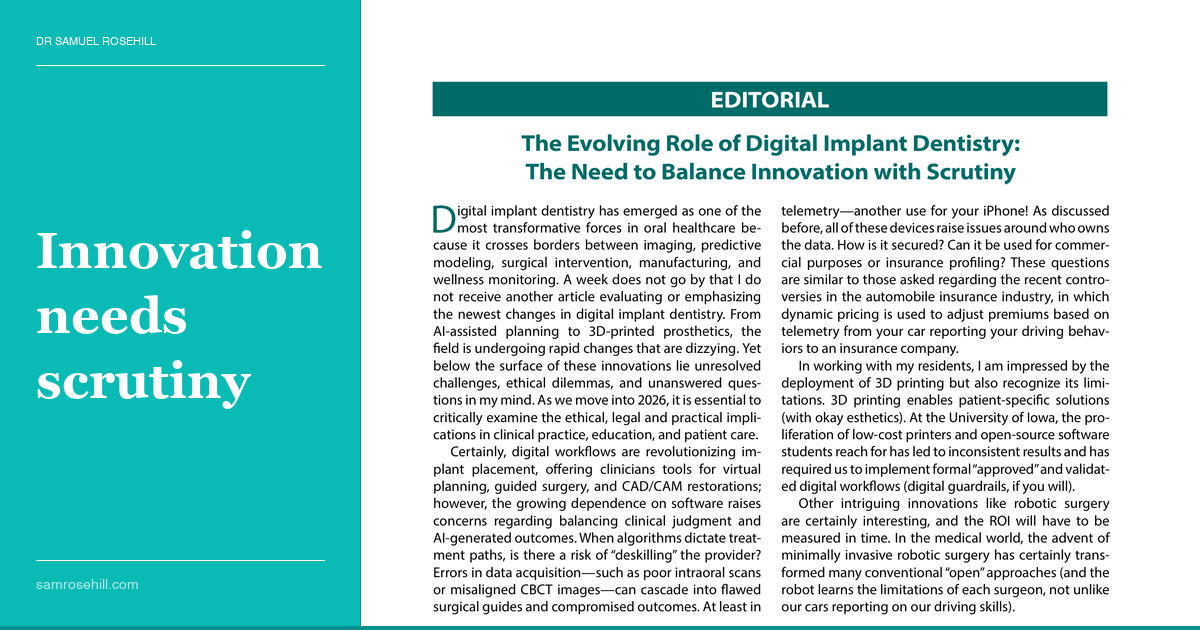
Source Paper
The Evolving Role of Digital Implant Dentistry: The Need to Balance Innovation with Scrutiny
The most modern sentence in implant dentistry may not be “the software can do that now” but “show me the validation”. Clark Stanford, in “The Evolving Role of Digital Implant Dentistry: The Need to Balance Innovation with Scrutiny,” makes the quietly unfashionable point that digital progress is not self-proving. It can be useful, dazzling, efficient, commercially irresistible, and still in need of adult supervision.
That is not anti-technology. It is, if anything, pro-outcome. Stanford’s argument is that artificial intelligence, guided surgery, smart implants, 3D printing, and robotics are now mature enough to influence clinical decisions, but not so mature that we can hand them the car keys and retire to the passenger seat with a latte and a vague sense of optimism.
The Data Anchor
This paper is an editorial rather than a clinical trial, which matters because its job is not to present a new dataset but to synthesise the anxieties and opportunities circling digital implant dentistry in 2025. Writing as Editor-in-Chief of the International Journal of Oral & Maxillofacial Implants, Stanford moves through several linked domains: AI-assisted diagnostics and planning, the downstream consequences of poor data acquisition, sensor-enabled “smart” implants, low-cost 3D printing, robotic surgery, and the increasingly awkward question of who owns the data once our devices start talking.
The piece is strongest when it follows the workflow from glamorous promise back to ordinary failure points. A poor intraoral scan or a misaligned CBCT does not remain a small digital blemish. It can cascade into a flawed guide and a compromised surgical outcome. Likewise, the spread of inexpensive printers and open-source software can be democratising, but only if clinics and teaching institutions build the validation guardrails that stop affordability from becoming a synonym for variability.
Key Findings
- The editorial’s central warning is not “do less digital”. It is “do not confuse novelty with evidence”, which is a much more inconvenient instruction for the rest of us.
- AI remains an adjunct, not a licence transfer. Stanford notes that, at least in the United States, these systems are considered ancillary to clinician judgement; the algorithm still does not have a dental licence, no matter how confidently it colours inside the lines.
- Errors at the capture stage are not minor clerical issues. A weak scan or misregistered CBCT can travel all the way through planning and guide fabrication, turning a digital workflow into a very expensive mechanism for preserving the original mistake.
- The 3D-printing point is admirably practical. Low-cost hardware and open software expand access, but without approved and validated workflows they also expand inconsistency, which is less glamorous and considerably more relevant.
- Patient education may be the least controversial digital win. Before-and-after imaging and visual planning tools can make treatment explanations clearer, especially when grafting, tissue augmentation, or staged procedures need to be justified.
- The caveat is built into the genre. This is an editorial, not an evidence synthesis, so it should sharpen clinical judgement rather than be mistaken for outcome data in its own right.
💡 The Clinical Bottom Line
The Monday-morning use of this piece is straightforward: treat digital implant tools the way you would treat a new biomaterial or impression protocol. Ask what has been validated, where the weak links are, how the data are handled, and whether the clinician can still explain the plan without hiding behind the software’s self-confidence.
Digital dentistry is not suffering from a shortage of invention. It is suffering, now and then, from a shortage of raised eyebrows. That is not cynicism. It is quality control in a nicer jacket.
Dr Samuel Rosehill is a general dentist with a prosthodontic focus, practising at Ethical Dental in Coffs Harbour, NSW. He holds a BDSc (Hons) from the University of Queensland, an MBA, an MMktg, and an MClinDent in Fixed & Removable Prosthodontics (Distinction) from King’s College London.
Clinical Relevance
Digital workflows are useful when they are validated and when the clinician remains responsible for the judgement call. The practical message is to audit scanning, guide design, printer validation, consent language, and data handling with the same seriousness as the glamorous part of the workflow.
Disclosure: The author has no financial conflicts of interest related to the products or topics discussed in this review. This is an independent summary prepared for educational purposes.
Continue the conversation
This review is also published on Substack, where you can leave comments and join the discussion.
Read on Substack →