A Browser-Based Tool That Finally Brings RPD Design into the Digital Workflow
The AiDENTAL RPD Surveyor and Designer is a lightweight web app that digitises diagnostic surveying, automates framework design, and closes the last major gap in the removable partial denture digital workflow.
RPDs go fully digital
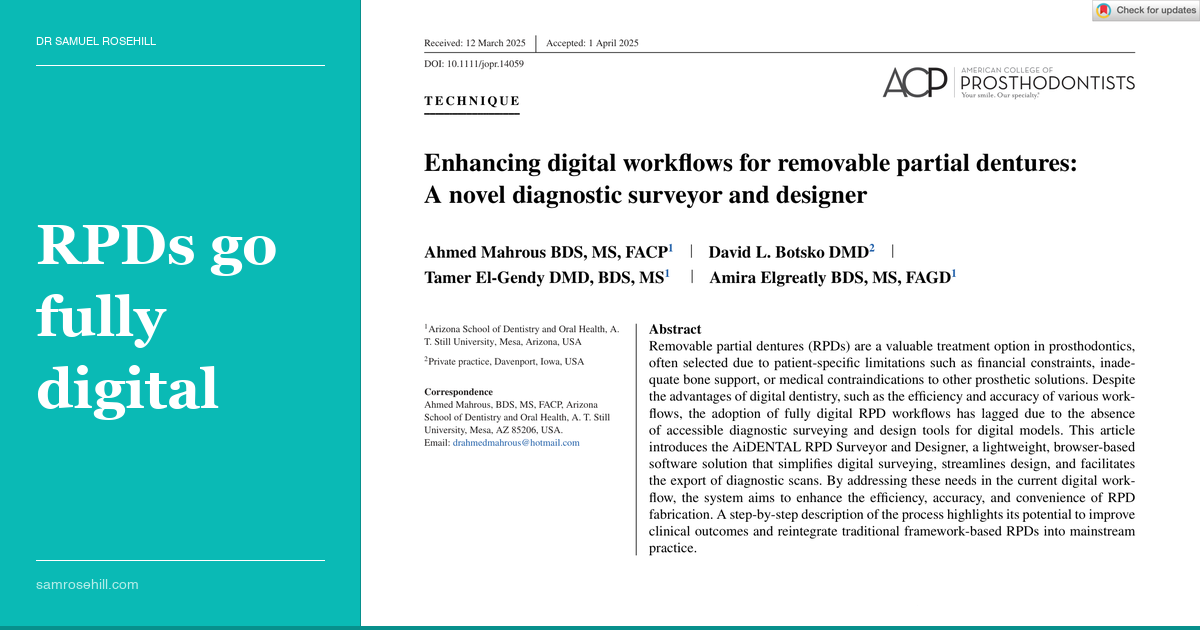
Source Paper
Enhancing digital workflows for removable partial dentures: A novel diagnostic surveyor and designer
‘We’ve gone fully digital,’ announces the practice website, next to a photograph of a gleaming intraoral scanner and a bank of monitors displaying implant planning software. Somewhere in the back office, a dentist is drawing an RPD framework design on a piece of paper with a pencil, photographing it with their phone, and emailing it to the laboratory. The removable partial denture has been the stubborn analogue holdout in an otherwise digital profession, not because the technology was impossible but because nobody had built the diagnostic surveying and design tools that would make the transition worthwhile. Mahrous and colleagues, in “Enhancing digital workflows for removable partial dentures: A novel diagnostic surveyor and designer” (Journal of Prosthodontics, 2025), have now built exactly that: a browser-based application called the AiDENTAL RPD Surveyor and Designer that handles digital surveying, automated framework design, and laboratory communication in a single lightweight interface.
The Data Anchor
This is a technique paper describing a software tool, so the evidence base is the workflow itself rather than clinical outcome data. The AiDENTAL RPD Surveyor and Designer is a web-based application accessible through any internet browser. Users upload an STL file from any intraoral scanner, orient the model, level the occlusal plane, and tilt the cast to determine the optimal path of insertion. The software automatically identifies edentulous segments, abutment teeth, and favourable retentive undercuts. This data feeds into an integrated design module that generates an algorithm-driven framework based on established prosthodontic principles. The entire process takes between 2 and 5 minutes, and the software exports the surveyed model with saved tilt positions, survey lines, and the generated design for digital laboratory communication.
Key Findings
- The tool addresses a genuine gap: while digital impressions, CAD/CAM frameworks, and digital articulation have all matured, diagnostic RPD surveying has remained stubbornly manual, forcing clinicians to draw designs on paper and scan them for digital lab communication
- Automated undercut identification and design generation reduce the technique sensitivity of RPD planning, potentially lowering the barrier for general practitioners who find traditional surveying time-consuming
- Browser-based architecture means no software installation, no platform restrictions, and immediate accessibility from any device with internet access
- The 2–5 minute workflow compresses what traditionally involves a physical surveyor, wax blockout, and hand-drawn framework design into a single digital session
- Digital laboratory communication is integrated, allowing the design, survey lines, and annotated model to be exported directly alongside the digital impression, eliminating the paper-sketch-to-photo workaround
- Critical limitation: there is no clinical validation data. The paper describes the software and demonstrates its workflow, but does not compare design accuracy against expert manual surveying, nor report clinical fit or patient outcomes for prostheses designed using the tool
The RPD has been digital dentistry’s orphan child — everyone knows it needs attention, nobody quite gets around to providing it. What makes this tool interesting is not sophistication but accessibility: it meets clinicians exactly where they are, in a browser, with an STL file they already have.
💡 The Clinical Bottom Line
If you prescribe RPDs with any regularity and have been frustrated by the disconnect between your otherwise digital workflow and the pencil-and-paper reality of framework design, this tool deserves your attention. Upload an STL, survey digitally, generate a design, and send it to the lab — all in the time it used to take to find the surveyor in the back cupboard. Whether the algorithm-driven designs match the nuance of an experienced prosthodontist’s hand remains to be demonstrated, but as a starting point for digital RPD planning, the workflow is sound and the price of entry is a web browser.
Dr Samuel Rosehill is a general dentist with a prosthodontic focus, practising at Ethical Dental in Coffs Harbour, NSW. He holds a BDSc (Hons) from the University of Queensland, an MBA, an MMktg, and an MClinDent in Fixed & Removable Prosthodontics (Distinction) from King’s College London.
Reference: Mahrous A, et al. Enhancing digital workflows for removable partial dentures: A novel diagnostic surveyor and designer. J Prosthodont. 2026;35:102–107. DOI: 10.1111/jopr.14059
Clinical Relevance
Clinicians can now perform diagnostic surveying and RPD framework design digitally in 2–5 minutes using a free browser-based tool, eliminating the need for a physical surveyor and enabling seamless digital laboratory communication.
Disclosure: The author has no financial conflicts of interest related to the products or topics discussed in this review. This is an independent summary prepared for educational purposes.
Continue the conversation
This review is also published on Substack, where you can leave comments and join the discussion.
Read on Substack →