The Cavity Base Shade Nobody Was Watching
An in vitro study finds that the shade of composite resin cavity bases in endocrown preparations significantly affects intraoral scanner accuracy — with lighter shades (A1 and B1) producing higher RMS trueness errors than darker shades (A2 and A3), a finding with direct workflow implications for clinicians planning digital impressions after root canal treatment.
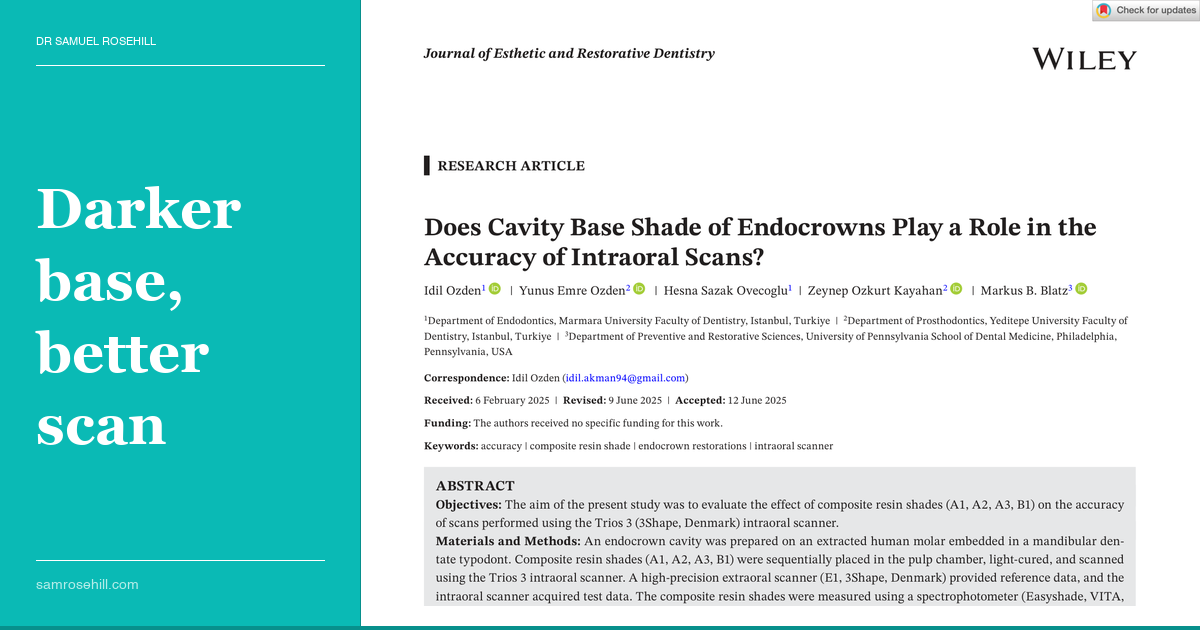
Darker base, better scan
Source Paper
Does Cavity Base Shade of Endocrowns Play a Role in the Accuracy of Intraoral Scans?
Most of us, if we’re honest, choose the shade of a posterior composite base the way we choose the Spotify playlist in an op: reflexively, without particular deliberation, and with complete confidence that it doesn’t really matter. The cavity is going underground. Nobody will see it. The endocrown will sit on top of it. The scanner will handle the rest.
Except, apparently, the scanner notices.
“Does Cavity Base Shade of Endocrowns Play a Role in the Accuracy of Intraoral Scans?” by Ozden, Ozden, Sazak Ovecoglu, Ozkurt Kayahan, and Blatz, published in the Journal of Esthetic and Restorative Dentistry in 2025, asks a question that has somehow escaped systematic investigation until now: does the shade of the resin you place in the pulp chamber before taking that digital impression actually change what the scanner sees?
The answer is yes. And the mechanism is less mysterious than the oversight.
The Data Anchor
The study is in vitro and compact by design. A single extracted human molar was prepared with a standardised endocrown cavity (5 mm depth, 1.5 mm wall thickness) and mounted in a typodont. Four groups were created by placing 2 mm of composite resin (Grandio, VOCO) in shades A1, A2, A3, and B1 sequentially into the cavity base. Each configuration received 10 scans using the Trios 3 (3Shape, Denmark). A high-precision extraoral desktop scanner (E1, 3Shape) provided the reference data, and Geomagic Design X calculated root mean square (RMS) values for trueness and interquartile range (IQR) for precision.
The spectrophotometric L*, a*, and b* values of each shade were also measured using a Vita Easyshade to confirm what was already visible: B1 and A1 are the lighter shades; A2 and A3 are darker.
Key Findings
- A2 and A3 produced the lowest RMS trueness errors (both 0.024 ± 0.002 mm), with no significant difference between them; effectively equal performance.
- A1 returned an RMS of 0.033 ± 0.002 mm, and B1 returned 0.031 ± 0.003 mm, both statistically worse than the darker shades (one-way ANOVA, p < 0.001).
- Precision followed the same pattern: B1 recorded the highest IQR (0.0047), meaning the scatter around individual measurements was widest for the lightest shade; A3 had the tightest IQR (0.0020).
- The authors note that higher L values (brightness) correlate with reduced scanner accuracy: more light reflected from a pale surface disrupts the Trios 3’s confocal-based imaging. This aligns with prior work showing that translucent and light-coloured surfaces are notoriously difficult for optical scanners.
- Study limitation: single tooth, single operator, single scanner (Trios 3 only), and molar-specific geometry; findings may not generalise across scanner brands or tooth types.
💡 The Clinical Bottom Line
The instruction from this study is both simple and slightly inconvenient: when placing a composite resin cavity base before a digital impression for an endocrown, choose A2 or A3 over A1 or B1 where the final restoration shade permits.
The shade you choose for the cavity base is not a cosmetic decision in a digital workflow — it is an optical one.
This is not a revelation about material strength, or sealing ability, or biocompatibility. It is about the optical reality that intraoral scanners are not indifferent to what they are photographing. Light bounces differently off a pale surface than a darker one, and the Trios 3 is measurably worse at reading that pale surface. The difference in RMS between best and worst groups in this study (0.024 versus 0.033 mm) is not catastrophic in isolation; but in the context of a restoration that relies entirely on digital impression accuracy for its fit, starting with a scanning handicap seems an avoidable courtesy to extend to yourself.
The shade choice happens at the endodontic appointment, before the prosthodontic workflow begins. That makes it the kind of decision that disappears from the clinical record almost immediately — yet it quietly shapes everything that follows.
Dr Samuel Rosehill is a general dentist with a prosthodontic focus, practising at Ethical Dental in Coffs Harbour, NSW. He holds a BDSc (Hons) from the University of Queensland, an MBA, an MMktg, and an MClinDent in Fixed & Removable Prosthodontics (Distinction) from King’s College London.
Clinical Relevance
When placing a composite resin cavity base prior to an endocrown digital impression, shade selection materially affects scan accuracy. A2 and A3 shades produced significantly lower RMS trueness errors with the Trios 3 than A1 and B1, which have higher lightness (L) values and reflect more light into the scanner. The practical implication is straightforward: where the final restoration permits, choose a darker shade for the base. This is a decision made at the filling appointment, not at the scanning appointment — and the data now give it clinical weight.
Disclosure: The author has no financial conflicts of interest related to the products or topics discussed in this review. This is an independent summary prepared for educational purposes.
Continue the conversation
This review is also published on Substack, where you can leave comments and join the discussion.
Read on Substack →