Patients Notice the Scanner First.
Altuhafy and colleagues reviewed 12 randomised clinical trials and found that digital workflows for single implant crowns usually make impressions faster and more comfortable, even when the downstream differences in crown adjustment and overall satisfaction are less dramatic.
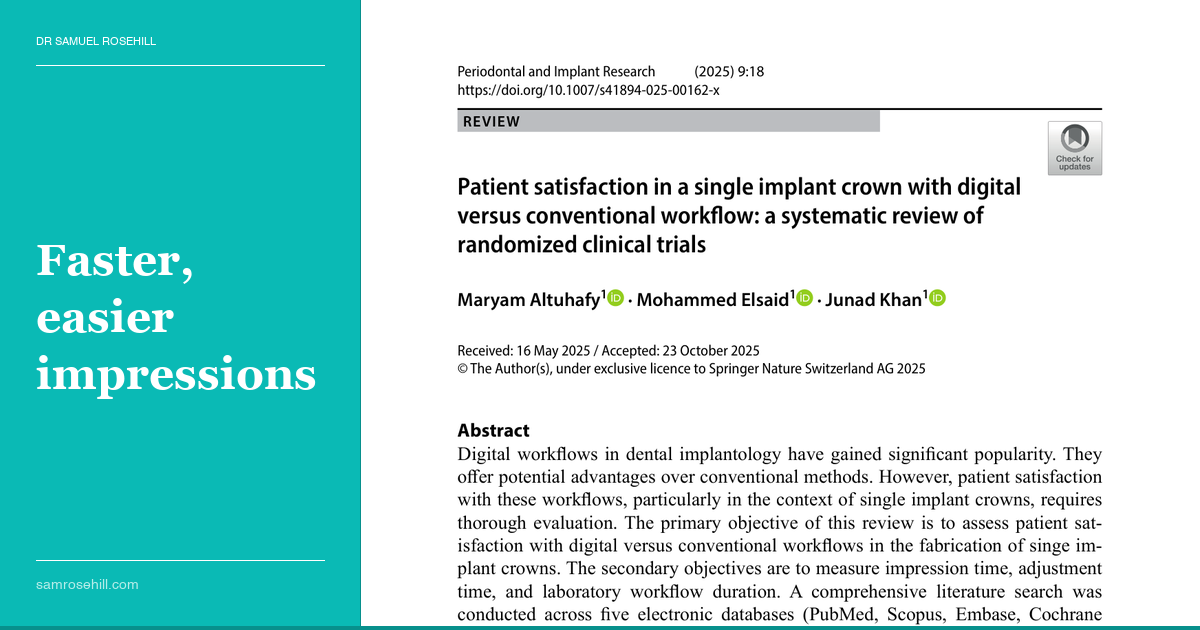
Faster, easier impressions
Source Paper
Patient satisfaction in a single implant crown with digital versus conventional workflow: a systematic review of randomized clinical trials
Digital dentistry has spent the last decade being marketed with the evangelical certainty usually reserved for kitchen gadgets and election slogans. In Patient satisfaction in a single implant crown with digital versus conventional workflow: a systematic review of randomized clinical trials, Maryam Altuhafy and colleagues offer the calmer version: for single implant crowns, patients generally like the scanner more and the clock certainly does, even if the crown at the end of the story still depends on operator judgement rather than technological destiny.
This is useful because the discomfort of an impression is one of those small clinical indignities patients remember with suspicious clarity. They may not recall the occlusal scheme, but they will remember the tray, the taste, the gag reflex, and the slightly affronted expression of the clinician trying to keep everything civil. A workflow that trims that part of the ritual matters, even before it proves anything heroic about precision.
The Data Anchor
Altuhafy’s review searched five databases up to September 2024 and included 12 randomised clinical trials involving 455 patients, using parallel and crossover designs to compare digital and conventional workflows for single implant crowns. The authors did not run a meta-analysis because the studies measured satisfaction, chairside time, adjustments, and laboratory workflow in too many different ways, which is sensible. You cannot pool apples, oranges, and one extremely enthusiastic intraoral scanner and call it clarity.
Still, a few signals came through clearly. In one trial, 82% of 50 participants preferred the digital impression method. In another, 80% preferred digital, 2% preferred conventional, and 18% had no preference. Corsalini’s fully digital workflow reduced impression time to 101.58 seconds, compared with 361.71 seconds for the combined analogue-digital route and 363 seconds for full analogue. Schepke reported 6 minutes 39 seconds for digital versus 12 minutes 13 seconds for analogue. Capparé, meanwhile, found better comfort during impression acquisition with digital (VAS 96.8 ± 6.42 versus 72.8 ± 16.57, P = .007), even though overall satisfaction at the end was much closer (94.32 ± 8.61 versus 92.02 ± 8.87, P = .363). The catch is that eight of the 12 trials were judged high risk of bias, with only two low-risk studies in the lot.
Key Findings
- If your immediate aim is to make impressions quicker and less miserable, digital workflows look convincingly better. Across several trials, digital impressions were markedly faster, from roughly half the time in Schepke’s study to 101.58 seconds versus 361.71 seconds in Corsalini’s.
- Patients tended to prefer the digital part of the journey, especially during impression taking. One study found 82% preferred digital; another reported an 80% preference, with conventional impressions attracting almost no affection at all.
- The grander promise, that digital automatically solves every restorative nuisance, is less secure. Some studies reported fewer occlusal or interproximal adjustments, but others found no significant difference in overall clinical adjustments or final satisfaction once the crown was delivered.
- This is encouraging evidence, not spotless evidence. Heterogeneity was substantial enough to prevent meta-analysis, and the review’s evidence base leaned heavily on trials with either high risk of bias or methodological concerns.
💡 The Clinical Bottom Line
On Monday morning, this paper does not tell you to fling every impression tray into the sea. It does suggest that for single implant crowns, a digital workflow buys something patients feel immediately: less discomfort, less chairside time, and a generally more civilised start to the restoration. That is not trivial. In dentistry, the technology that survives is often the one that makes the awkward bit shorter without making the important bit worse.
Dr Samuel Rosehill is a general dentist with a prosthodontic focus, practising at Ethical Dental in Coffs Harbour, NSW. He holds a BDSc (Hons) from the University of Queensland, an MBA, an MMktg, and an MClinDent in Fixed & Removable Prosthodontics (Distinction) from King’s College London.
Clinical Relevance
If you are considering digital workflows for single implant crowns, the cleanest immediate benefit appears to be a better impression experience and less chairside time rather than a guaranteed miracle in every downstream adjustment. The scanner improves the part patients remember most, but it still needs a sound restorative protocol behind it.
Disclosure: The author has no financial conflicts of interest related to the products or topics discussed in this review. This is an independent summary prepared for educational purposes.
Continue the conversation
This review is also published on Substack, where you can leave comments and join the discussion.
Read on Substack →