The Year Prosthodontics Stopped Flirting With Digital.
Irena Sailer's editorial digest of the International Journal of Prosthodontics argues that digital workflows have crossed into ordinary clinical infrastructure, reliable ceramics have consolidated their place, and the profession's next arguments are increasingly about protocol discipline, patient factors, and data governance.
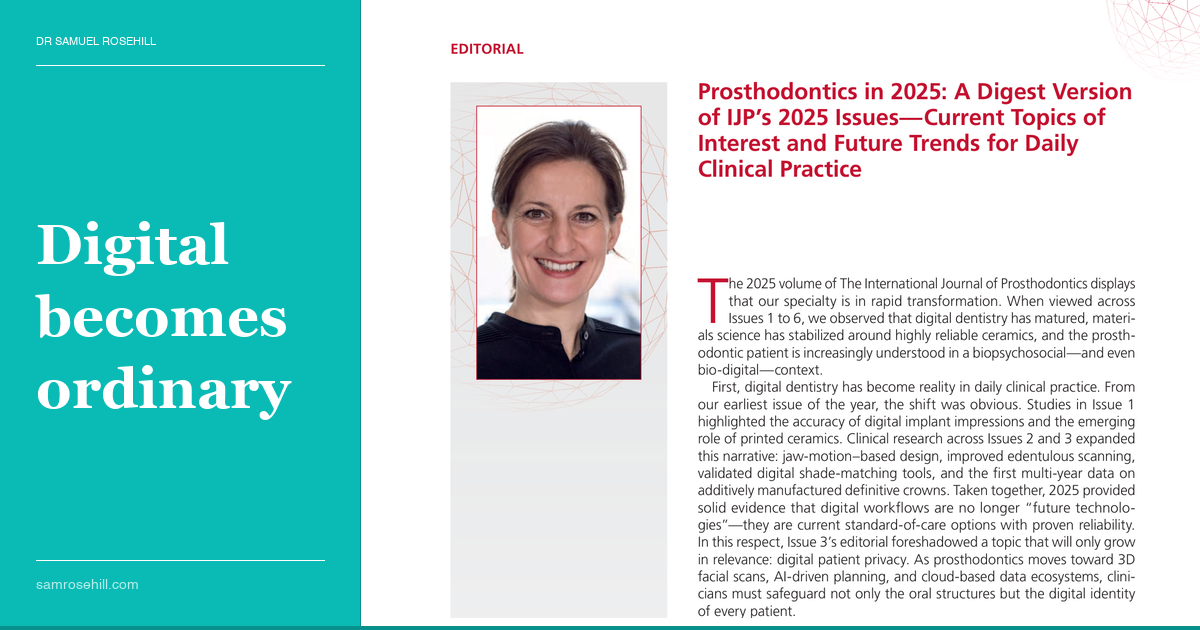
Digital becomes ordinary
Source Paper
Prosthodontics in 2025: A Digest Version of IJP’s 2025 Issues—Current Topics of Interest and Future Trends for Daily Clinical Practice
“So where is all this actually going?” asked somebody in the conference coffee queue, which is close to the profession’s native language. In Prosthodontics in 2025: A Digest Version of IJP’s 2025 Issues—Current Topics of Interest and Future Trends for Daily Clinical Practice, Irena Sailer offers a crisp answer. Digital workflows have largely crossed from intriguing option to ordinary clinical infrastructure, ceramics have settled into a calmer sort of authority, and the next uncomfortable questions concern privacy, protocol discipline, and the patient variables no scanner can charm away.
This is, to be clear, an editorial digest rather than a systematic review. It does not arrive with a pooled sample, a search strategy, or the sort of statistical machinery that makes clinicians sit up straight. What it does provide is something the field often needs just as badly: a map of where the literature spent 2025, where the excitement has become evidence, and where the profession still seems to be negotiating with itself.
The Data Anchor
Sailer synthesises the themes running across Issues 1 to 6 of the International Journal of Prosthodontics in 2025. There is no formal sample size because the unit of analysis is the year’s editorial terrain rather than a single experiment. That matters. This paper is not trying to settle one narrow clinical question; it is trying to tell you which clusters of questions are maturing, and which ones have begun misbehaving in more interesting ways.
The editorial’s evidence trail is broad rather than deep. Sailer points to digital implant impressions, printed ceramics, jaw-motion-based design, improved edentulous scanning, validated digital shade-matching tools, and the first multi-year data on additively manufactured definitive crowns as signs that digital prosthodontics has moved into routine usefulness. On the materials front, she highlights stable peri-implant soft tissues, predictable occlusion in zirconia-based prostheses, a 4-year posterior FDP randomised trial with no chipping events, and a 10-year chairside lithium disilicate study as markers of a literature that is becoming less theatrical and more dependable.
Key Findings
- Digital is no longer the interesting bit. Sailer’s central claim is that digital workflows are now clinically validated options for ordinary practice, not futuristic side projects for the well-sponsored.
- Ceramics have moved from bravado to reliability. Zirconia continues to look mechanically and biologically reassuring, while chairside lithium disilicate now has the sort of long-term backing that makes same-day enthusiasm less of a personality trait.
- 3D printing remains promising, but temperamental. The year’s literature linked performance to build angle, post-processing, ageing, and acidic exposure, which is another way of saying the printer is not the protocol.
- The patient has re-entered the room. Sailer notes work linking bruxism with stress, bowel symptoms, and masticatory pain, as well as evidence that personality profiles help predict prosthodontic satisfaction.
- The limitation is built into the genre. Because this is an editorial digest, it can identify where the field is settling without grading the underlying evidence as rigorously as a formal review.
💡 The Clinical Bottom Line
The Monday-morning value of this paper is strategic rather than procedural. It suggests clinicians can stop talking about digital workflows as though they require ideological commitment and start judging them on the less glamorous criteria that actually matter: calibration, indication discipline, data handling, and whether the patient suits the workflow rather than the other way round.
The future described here is not a glitterier scanner trolley. It is a more mature prosthodontics in which reliable ceramics, functional digital tools, psychological realism, and digital privacy all sit at the same table. Which is mildly inconvenient, of course. It is much easier to buy a machine than to think.
Dr Samuel Rosehill is a general dentist with a prosthodontic focus, practising at Ethical Dental in Coffs Harbour, NSW. He holds a BDSc (Hons) from the University of Queensland, an MBA, an MMktg, and an MClinDent in Fixed & Removable Prosthodontics (Distinction) from King’s College London.
Clinical Relevance
This paper does not tell you how to adjust a crown on Monday morning; it tells you which arguments the profession can stop having in quite the same tone. Digital workflows now need to be judged on calibration, indication, privacy, and protocol discipline rather than novelty alone.
Disclosure: The author has no financial conflicts of interest related to the products or topics discussed in this review. This is an independent summary prepared for educational purposes.
Continue the conversation
This review is also published on Substack, where you can leave comments and join the discussion.
Read on Substack →