The Gap Nobody Warned You About: Proximal Contact Loss After 10 Years of Implant Function
A Korean retrospective study finds proximal contact loss in more than half of implants functioning for over a decade. Here is what the data means for how you monitor long-term implant patients.
Over half lose contact
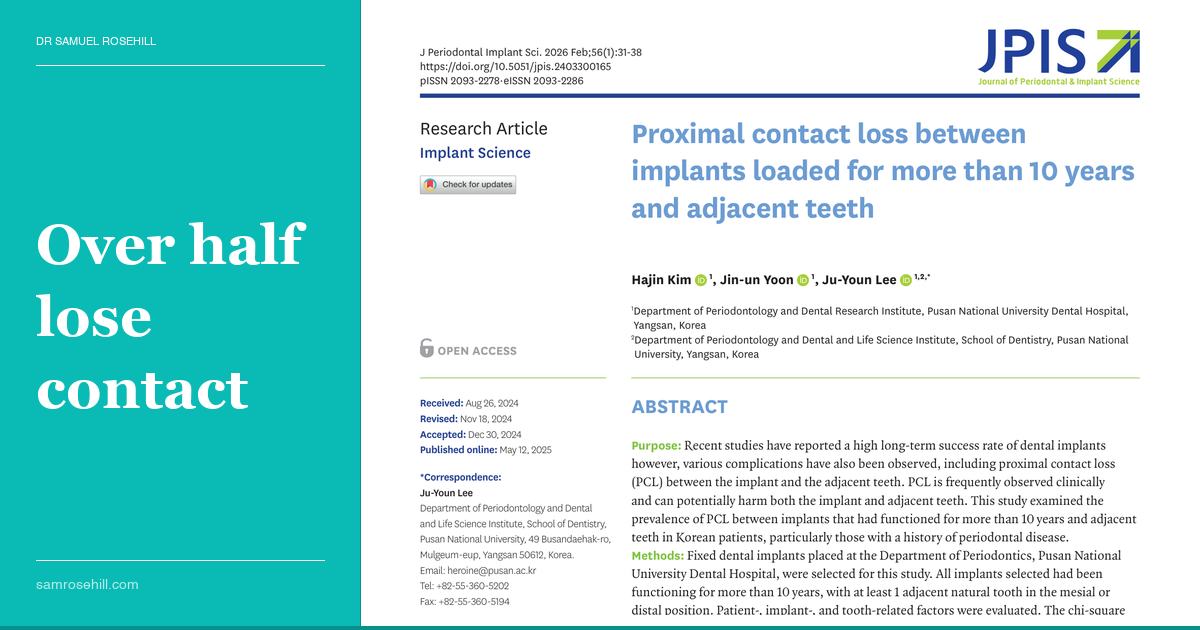
Source Paper
Proximal contact loss between implants loaded for more than 10 years and adjacent teeth
Think of a well-fitted bookshelf: built carefully, filled with books, and left. Come back ten years later and there are gaps where there were none. Nothing broke. But things have moved, and the gaps are now causing problems. This is what happens to the proximal contacts around dental implants over the long term: not a dramatic failure, but a slow architectural drift that quietly opens space where space should not be. Kim, Yoon, and Lee’s paper published in the Journal of Periodontal and Implant Science (2026) puts hard numbers on how common this drift really is, and which patients are most at risk.
The Data Anchor
This retrospective study drew from implants placed between 2006 and 2011 at the Department of Periodontics, Pusan National University Dental Hospital. All included implants had functioned for more than 10 years with at least one adjacent natural tooth. Patients had received non-surgical or surgical periodontal treatment before implant placement and were maintained on a structured supportive periodontal programme thereafter. None of the prostheses showed proximal contact loss (PCL) at completion, confirmed by dental charts and radiographs.
The final sample comprised 142 implants and 188 proximal surfaces from 101 patients (48 men, 53 women; mean age 59.23 years). All implants were external-type with resorbable blasting media surfaces. Contact was assessed using wax-coated dental floss (70 micron wax layer), with PCL defined as floss passing without resistance or visible separation between tooth and implant. Chi-square and Fisher exact tests were applied across patient, implant, and adjacent tooth variables using SPSS 29.0, with significance set at P < 0.05.
Key Findings
- PCL was present in 101 of 188 proximal surfaces: an overall rate of 53.7%. More than half of implants functioning for over a decade have lost contact with at least one adjacent tooth.
- The mesial side is far more vulnerable: 65.6% of mesial surfaces showed PCL, compared to 28.3% on the distal side (P < 0.001). Natural teeth drift mesially under occlusal load; implants, lacking a periodontal ligament, simply stay put.
- Posterior implant placement was the only implant-related factor to reach significance, with a PCL rate of 61% posteriorly versus 13.8% anteriorly (P = 0.003). Increased occlusal forces in the posterior region are the likely driver.
- Adjacent tooth periodontal condition was strongly predictive. Plaque accumulation (P < 0.001), bleeding on probing (P < 0.001), and pocket depth of 4 mm or greater (P < 0.001) were all significantly associated with PCL. Tooth mobility also reached significance (P = 0.014).
- Teeth with pocket depths of 4 mm or greater showed a PCL rate of 79.3%, compared to 42.3% in teeth with shallower pockets. This is the single most striking number in the dataset.
- Patient factors including sex, age, smoking, hypertension, and diabetes showed no statistically significant association with PCL, though age trended in the expected direction.
💡 The Clinical Bottom Line
The long-term implant review appointment needs to include a floss-test of proximal contacts as standard, not just a probe around the implant sulcus. When adjacent teeth are showing plaque, bleeding, or pockets at or above 4 mm, the probability of PCL climbs above 78%, meaning food impaction, hygiene compromise, and elevated peri-implant disease risk are already in play.
The practical implication is pointed: periodontal health of the neighbouring dentition is not a separate concern from implant maintenance. They are the same concern.
The case for aggressive supportive periodontal therapy around implant-adjacent teeth, particularly in the posterior segments, has rarely looked this clear.
Dr Samuel Rosehill is a general dentist with a prosthodontic focus, practising at Ethical Dental in Coffs Harbour, NSW. He holds a BDSc (Hons) from the University of Queensland, an MBA, an MMktg, and an MClinDent in Fixed & Removable Prosthodontics (Distinction) from King’s College London.
Reference: Kim H et al. “Proximal contact loss between implants loaded for more than 10 years and adjacent teeth.” Journal of Periodontal and Implant Science, 2026. DOI: 10.5051/jpis.2403300165
Clinical Relevance
With proximal contact loss occurring in more than half of implants at the ten-year mark, clinicians need a structured approach to monitoring contact integrity and adjacent tooth periodontal health at every maintenance visit.
Disclosure: The author has no financial conflicts of interest related to the products or topics discussed in this review. This is an independent summary prepared for educational purposes.
Continue the conversation
This review is also published on Substack, where you can leave comments and join the discussion.
Read on Substack →