AI Plans Implants Like a Very Consistent Colleague
Elgarba and colleagues test an AI-driven tool for posterior mandibular implant planning and find expert-level acceptability, faster planning, and far less variability than human planning.
AI plans twice as fast
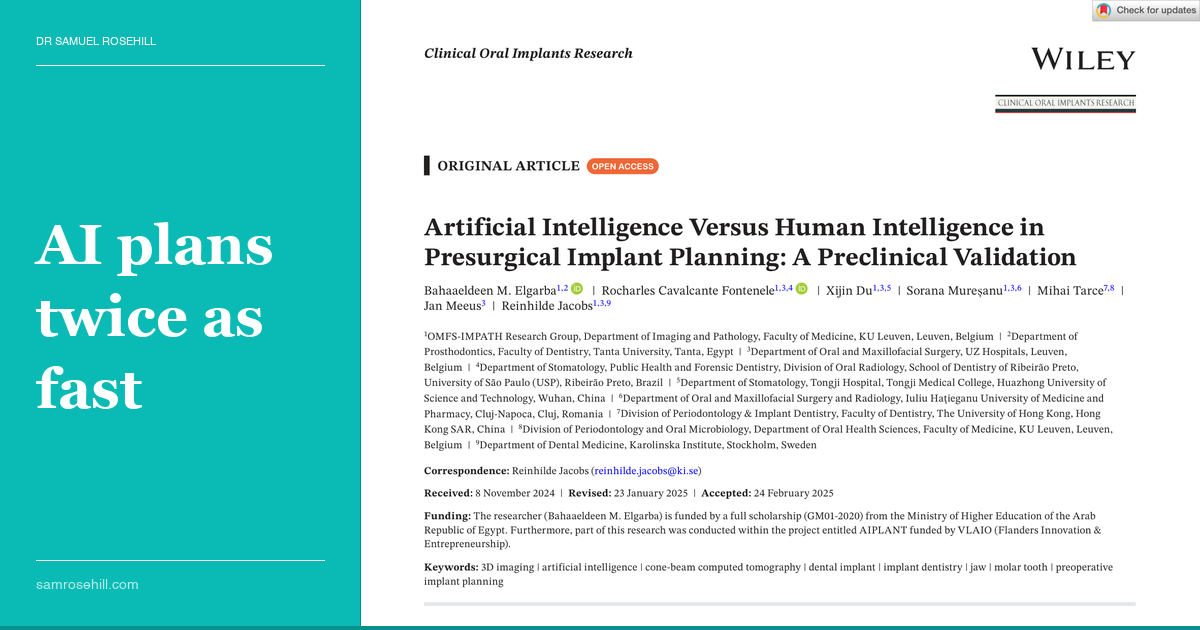
Source Paper
Artificial Intelligence Versus Human Intelligence in Presurgical Implant Planning: A Preclinical Validation
The implant planning meeting has a way of turning everyone into a philosopher with a mouse. How much buccal bone is enough? Is that diameter sensible, or merely optimistic? At what point does prosthetically driven planning become anatomically negotiated surrender? Elgarba and colleagues’ Artificial Intelligence Versus Human Intelligence in Presurgical Implant Planning: A Preclinical Validation asks whether artificial intelligence (AI) can sit at that meeting and choose posterior mandibular implant position and dimensions with human-level judgement.
The answer is not that the machine gets a lanyard and a clinic room. It is that, in this controlled setting, AI produced plans specialists usually found clinically acceptable, in less than half the time, with the unnerving consistency of something that has never had a bad coffee.
The Data Anchor
The study used 50 time-matched CBCT and intraoral scan cases, each involving a single missing mandibular premolar or molar. An AI-driven tool planned implant position and dimensions, and the results were compared with two human operators using quantitative deviation metrics, specialist visual analogue scale scoring, a Turing test, planning time, and consistency checks.
The AI plans were judged clinically acceptable, meaning no or only minor adjustments were required, in 88.7% of cases. Human plans reached 93.3%. That gap was statistically detectable in the overall specialist ratings (P < 0.0001), but clinically it reads less like a collapse and more like a colleague who is good enough to be annoying.
Mean implant length was almost identical: 11.7 ± 1.3 mm for AI and 11.5 ± 1.3 mm for HI. Diameter selection differed, with AI choosing 4.0 ± 0.3 mm and HI choosing 4.2 ± 0.4 mm (P < 0.0001). Planning time was where the machine became rather smug: 187 ± 34 seconds for AI versus 406 ± 36 seconds for humans.
Key Findings
- AI planning was usually clinically acceptable. Specialists judged 88.7% of AI plans acceptable, compared with 93.3% of human plans.
- The machine was faster. AI completed planning in less than half the human time, 187 seconds versus 406 seconds.
- Consistency was the obvious machine advantage. AI produced identical plans when given the same data, while humans varied within and between operators.
- Experts could not always tell who planned it. In the Turing test, specialists failed to identify 58% of AI-planned cases as AI-driven.
- The caveat sits in the dataset. This was retrospective, preclinical, and limited to mandibular posterior single-tooth cases with adequate bone volume.
💡 The Clinical Bottom Line
The gold standard is not AI autonomy. It is prosthetically driven implant planning, checked against anatomy, restorability, and the patient’s actual mouth.
This paper suggests AI may soon do the first draft of posterior implant planning quickly and consistently. The clinician’s job then becomes less like drawing the map from scratch and more like asking whether the map knows where the cliffs are.
Dr Samuel Rosehill is a general dentist with a prosthodontic focus, practising at Ethical Dental in Coffs Harbour, NSW. He holds a BDSc (Hons) from the University of Queensland, an MBA, an MMktg, and an MClinDent in Fixed & Removable Prosthodontics (Distinction) from King’s College London.
Clinical Relevance
This preclinical validation suggests that AI can produce posterior mandibular implant plans that specialists often judge clinically acceptable, while cutting planning time by more than half. The result supports AI as a planning assistant rather than an unsupervised clinician, especially because the study used controlled scans, one anatomical region, and retrospective data.
Disclosure: The author has no financial conflicts of interest related to the products or topics discussed in this review. This is an independent summary prepared for educational purposes.
Continue the conversation
This review is also published on Substack, where you can leave comments and join the discussion.
Read on Substack →