What German Implant Surgeons Actually Do — A 276-Clinician Survey
Pabst et al. survey 276 oral and maxillofacial surgeons in Germany, revealing the gap between evidence-based ideals and real-world implant practice patterns.
What surgeons actually do
Source Paper
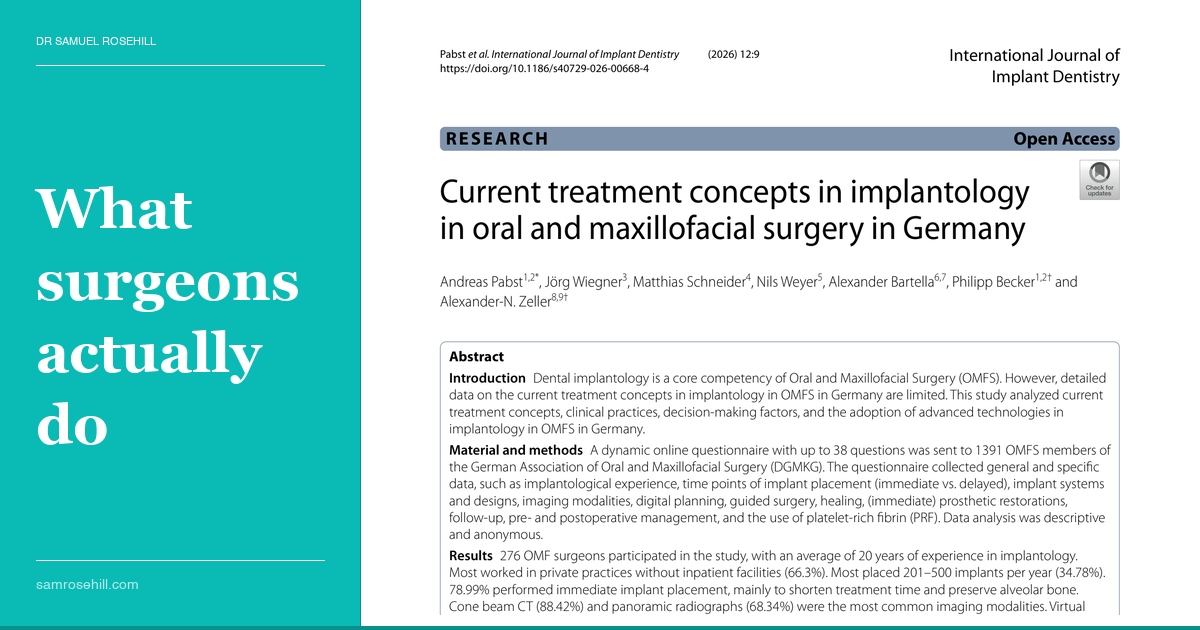
Current treatment concepts in implantology in oral and maxillofacial surgery in Germany
Every implant clinician has a private protocol. Not the one presented at conferences or described in the consent form, but the one that actually runs when the flap is open and the bone looks different from the CBCT. Pabst and colleagues, in “Current treatment concepts in implantology in oral and maxillofacial surgery in Germany,” published in the International Journal of Implant Dentistry (2026), have done something genuinely useful: they asked 276 experienced surgeons what they actually do, rather than what the guidelines say they should.
The Data Anchor
The survey reached 1,391 members of the German Association of Oral and Maxillofacial Surgery (DGMKG); 276 responded (19.84% response rate). These were not juniors finding their feet. Average implantological experience was 20 years. Most worked in private practice without inpatient facilities (66.3%), and the largest group placed between 201 and 500 implants per year (34.78%), with a further 20.29% placing 501 to 1,000. This is a cohort that has seen enough complications to have opinions; the data represents those opinions at scale.
CBCT was near-universal for preoperative imaging (88.42%), panoramic radiographs remained common (68.34%), and intraoral scanners were used by just 19.69%. Virtual planning had reached 73.08% of respondents, though nearly half of those (44.09%) reserved it for complex cases only. Guided surgery sat at 66.54%, with the clear majority relying on externally produced guides (68.05% of guide users) rather than in-house printing.
Key Findings
- 78.99% performed immediate implant placement, primarily to shorten treatment time and preserve alveolar bone
- 88.42% used CBCT as their primary preoperative imaging modality
- 73.08% used virtual planning, though most only in complex cases (44.09% of planners)
- 66.54% used guided surgery, predominantly with externally produced guides
- 83.53% preferred closed (submerged) healing when given the choice
- 57.83% never performed immediate prosthetic restorations; 70.92% did not carry out definitive prosthetic restorations themselves (77.40% citing work in a purely surgical referral practice)
- Top risk factors for implant failure: poor oral hygiene (84.72%), limited surgical experience (76.39%), and smoking (75%)
- PRF use was selective at best: 45.83% used it in specific situations, 44.44% not at all, and only 9.72% routinely
- Limitations: the 19.84% response rate introduces selection bias (engaged, high-volume surgeons likely over-represented), and all data is self-reported
💡 The Clinical Bottom Line
The survey reveals a profession caught between two eras. Digital planning and guided surgery have reached solid majority adoption, but immediate loading remains rare and most OMFS surgeons still hand off prosthetic restorations entirely. The gap between what the literature now supports (immediate protocols, in-house digital workflows) and what experienced surgeons routinely do is wider than any conference programme would suggest. Perhaps the most honest finding is the simplest one: when 276 surgeons with two decades of experience each rank the top risk factors for implant failure, they put oral hygiene first and the implant system barely anywhere. The profession knows, even if it does not always say so, that the biology matters more than the brand.
Dr Samuel Rosehill is a general dentist with a prosthodontic focus, practising at Ethical Dental in Coffs Harbour, NSW. He holds a BDSc (Hons) from the University of Queensland, an MBA, an MMktg, and an MClinDent in Fixed & Removable Prosthodontics (Distinction) from King’s College London.
Reference: Pabst A et al. “Current treatment concepts in implantology in oral and maxillofacial surgery in Germany.” International Journal of Implant Dentistry (2026). DOI: 10.1186/s40729-026-00668-4
Clinical Relevance
Maps real-world implant practice patterns among experienced surgeons, revealing significant gaps between digital workflow adoption and evidence-based recommendations
Disclosure: The author has no financial conflicts of interest related to the products or topics discussed in this review. This is an independent summary prepared for educational purposes.
Continue the conversation
This review is also published on Substack, where you can leave comments and join the discussion.
Read on Substack →