Antidepressants Complicate Early Osseointegration, In Rats
A 2025 rat tibia study finds that amitriptyline and sertraline reduce removal torque and bone area around titanium implants during early healing, while nanohydroxyapatite coating partially preserves bone-implant contact without restoring mechanical stability.
NANO cushions, not cures
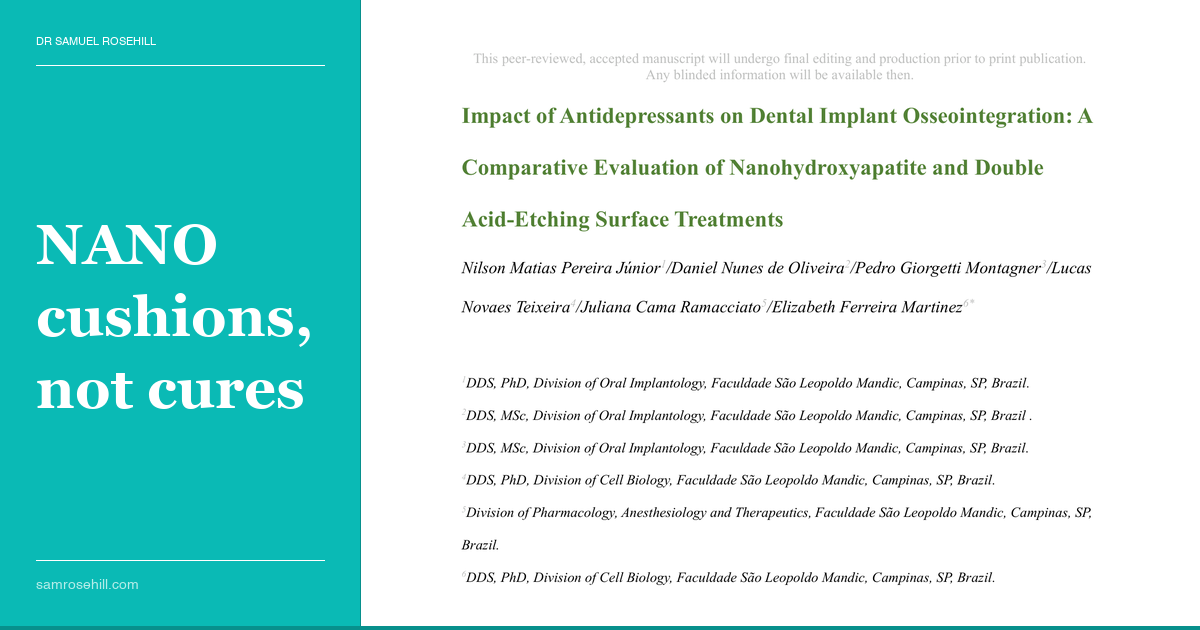
Source Paper
Impact of Antidepressants on Dental Implant Osseointegration: A Comparative Evaluation of Nanohydroxyapatite and Double Acid-Etching Surface Treatments
Most implant risk assessment begins with the medical history, which is dentistry’s least glamorous detective novel: smoking, diabetes, bisphosphonates, radiotherapy, and the medication list that keeps quietly expanding while everyone pretends the form still has enough lines. “Impact of Antidepressants on Dental Implant Osseointegration: A Comparative Evaluation of Nanohydroxyapatite and Double Acid-Etching Surface Treatments,” by Pereira Júnior and colleagues, asks whether two common antidepressants disturb early implant healing. The answer, in rats, is yes; nanohydroxyapatite helped one metric but did not rescue the whole story.
This is not a paper about stopping antidepressants. It is a paper about not treating bone biology as though the prescription list were background music.
The Data Anchor
Fifteen male Wistar rats received four titanium implants each, giving 60 implants in total. Every animal received both double acid-etched (DEA, Strong SW) and plasma-sprayed nanohydroxyapatite-coated (NANO, Unitite) surfaces. The rats were randomised into saline, amitriptyline, and sertraline groups, with medicated animals receiving 5 mg/kg/day for 14 days before surgery and 21 days after, until euthanasia.
The outcomes were removal torque, expressed in Ncm, plus histomorphometric bone-implant contact (BIC) and bone area (BA) around the first four implant threads. It is a tidy animal model, not a loading study, and that caveat deserves to stay in the room.
Key Findings
- Removal torque fell in both medicated groups. For DEA implants, median torque moved from 3 Ncm in controls to -2 Ncm with amitriptyline and -2 to -3 Ncm with sertraline (P = 0.0030). For NANO implants, the same adverse pattern appeared (P = 0.0022).
- DEA bone contact was strongly reduced. BIC fell from 76.89% in saline controls to 31.44% with amitriptyline and 46.61% with sertraline.
- NANO preserved BIC better, but unevenly. NANO BIC was 74.62% in controls, 66.61% with amitriptyline, and 51.68% with sertraline; in medicated groups, NANO outperformed DEA for BIC.
- Bone area still suffered. BA dropped from 55.47% in DEA controls to 20.26% and 22.77% in medicated groups; for NANO it fell from 52.01% to 32.84% and 22.36%.
- Limitation: this was a 21-day rat tibia model with n = 5 animals per group, no functional loading, and no clinical implant-failure endpoint.
💡 The Clinical Bottom Line
For clinicians, the useful conclusion is narrow but important: antidepressant exposure may interfere with early osseointegration biology, and surface chemistry may partly modify that response. That is not the same as saying an SSRI or tricyclic antidepressant causes implant failure in humans.
The Monday morning move is better risk literacy, not medication melodrama. Document the history, plan healing time thoughtfully, and remember that bone does not read the consent form; it reads the pharmacology.
Dr Samuel Rosehill is a general dentist with a prosthodontic focus, practising at Ethical Dental in Coffs Harbour, NSW. He holds a BDSc (Hons) from the University of Queensland, an MBA, an MMktg, and an MClinDent in Fixed & Removable Prosthodontics (Distinction) from King’s College London.
Clinical Relevance
In this preclinical rat model, amitriptyline and sertraline reduced removal torque and bone area around implants during early healing. Nanohydroxyapatite-coated implants preserved bone-implant contact better than double acid-etched surfaces in medicated groups, but did not restore bone area or mechanical integration to control levels. This should not change antidepressant prescribing, but it supports careful risk discussion and closer attention to early healing biology in implant patients taking long-term antidepressants.
Disclosure: The author has no financial conflicts of interest related to the products or topics discussed in this review. This is an independent summary prepared for educational purposes.
Continue the conversation
This review is also published on Substack, where you can leave comments and join the discussion.
Read on Substack →