Immediate Implant Research Has a Map, Not a Compass
Sen and colleagues map 2,031 Web of Science papers on immediate implant placement and loading, identifying topic clusters around aesthetic-zone provisionalisation, osseointegration, socket preservation, augmentation, complications, and quality of life.
Map, not verdict
Source Paper
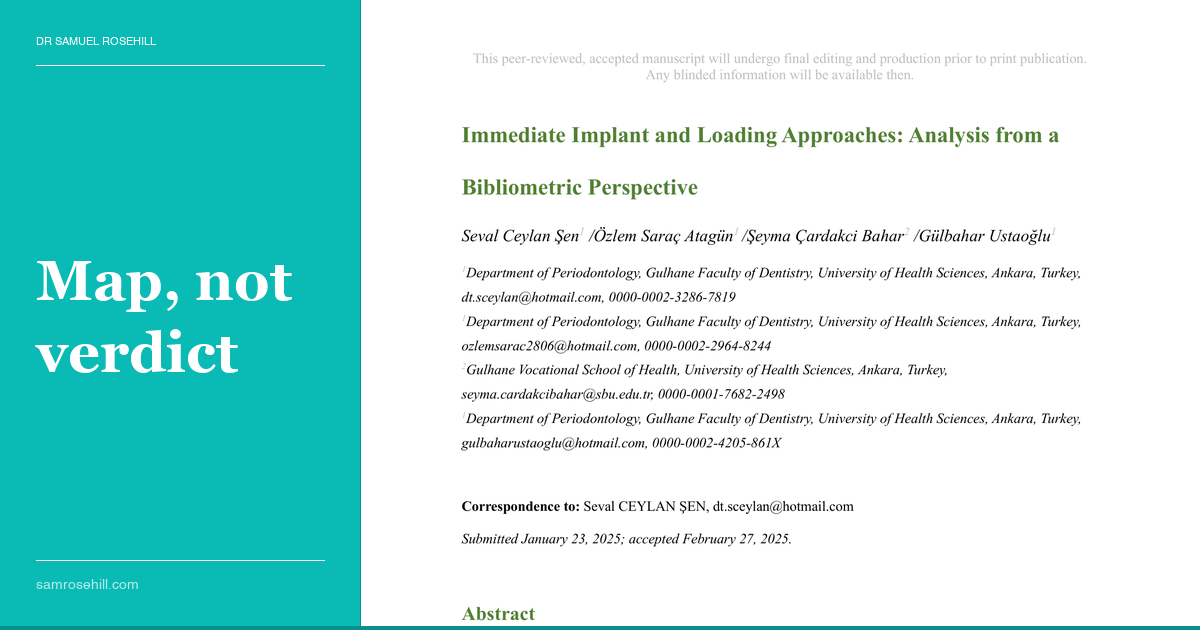
Immediate Implant and Loading Approaches: Analysis from a Bibliometric Perspective
A bibliography is a room full of footprints. It can tell you where everyone has been standing, who arrived early, and which corner became mysteriously crowded after 2010. It cannot tell you whether the patient in your chair should have an immediate implant today. Şen and colleagues’ Immediate Implant and Loading Approaches: Analysis from a Bibliometric Perspective is useful precisely because it shows what the immediate-implant literature is actually made of: not one tidy evidence stream, but several overlapping conversations about sockets, loading, aesthetics, grafting, complications, and edentulous rehabilitation.
This is not a clinical outcome paper. It is a map of attention. For immediate implant placement and loading, that matters, because a socket-shield citation, an immediate-loading trial, and a fresh-socket placement paper may all stand in the same crowd while answering different clinical questions.
The Data Anchor
The authors searched the Web of Science Core Collection using title terms including immediate implant, fresh extraction socket, simultaneous implant, simultaneous loading, immediate loading, immediate placement, immediate implantation, and socket-shield variants. The initial search retrieved 4,691 records. After filtering to articles and reviews, dentistry/oral surgery/medicine categories, English language, and excluding 2024 records, 2,031 articles were included.
The analysis covered 112 sources, 5,500 authors, and 21,268 references. Bibliometrix, WOSviewer, and CiteSpace were used for publication trends, citation patterns, author and country networks, keyword co-occurrence, co-citation timelines, and citation bursts. The average document age was 10.2 years, the average citation count was 29.01 per document, the annual growth rate was 12.16%, and the international collaboration rate was 29.04%.
Key Findings
- The map has four big neighbourhoods. Multiple correspondence analysis grouped the literature around immediate loading/provisional restoration/aesthetic zone, implant stability/osseointegration/follow-up, augmentation/guided bone regeneration/extraction socket, and fresh extraction socket/socket preservation/soft tissue.
- The themes changed over time. Early work centred on endosseous implants and clinical evaluation; 2009 to 2013 brought augmentation and rehabilitation; 2014 to 2016 foregrounded CBCT; 2017 to 2021 returned to overdentures and augmentation; 2022 to 2023 shifted toward failure, complications, and quality of life.
- Co-citation clusters show the intellectual anchors. The authors identified fresh extraction socket, edentulous mandible, systematic review, dehiscence defect, and edentulous patient clusters.
- Citation bursts name the papers the field kept returning to. Buser’s 2017 post-extraction placement paper had the strongest burst (25.83) continuing to 2023; Chen’s 2014 work and Cosyn’s 2016 aesthetic-zone immediate implant study also stood out.
💡 The Clinical Bottom Line
Use this paper the way you would use a conference floor plan. It helps identify the busy stands: aesthetic-zone provisionalisation, socket preservation, osseointegration, guided bone regeneration, edentulous mandibles, complications, and quality-of-life outcomes.
It should not decide treatment. Immediate implant placement still lives or dies by case selection, primary stability, socket anatomy, soft-tissue management, and the quality of the clinical evidence underneath the citation heat.
Dr Samuel Rosehill is a general dentist with a prosthodontic focus, practising at Ethical Dental in Coffs Harbour, NSW. He holds a BDSc (Hons) from the University of Queensland, an MBA, an MMktg, and an MClinDent in Fixed & Removable Prosthodontics (Distinction) from King’s College London.
Clinical Relevance
This bibliometric analysis is useful for understanding how immediate implant and immediate loading research has accumulated, but it should not be read as treatment evidence. It identifies clusters around immediate loading, provisional restoration, the aesthetic zone, osseointegration, guided bone regeneration, socket preservation, complications, and quality of life rather than estimating survival or patient outcomes. Clinicians should use it as a map of research attention, then return to controlled clinical evidence for chairside decisions.
Disclosure: The author has no financial conflicts of interest related to the products or topics discussed in this review. This is an independent summary prepared for educational purposes.
Continue the conversation
This review is also published on Substack, where you can leave comments and join the discussion.
Read on Substack →