The Edentulous Maxilla Finally Gets a Rulebook
The first global consensus on rehabilitating the edentulous maxilla produces 14 clinical recommendations — six reaching consensus, eight achieving strong consensus — covering every stage from patient selection to maintenance, for conventional dentures, implant overdentures, and fixed implant-supported prostheses.
First global rulebook agreed
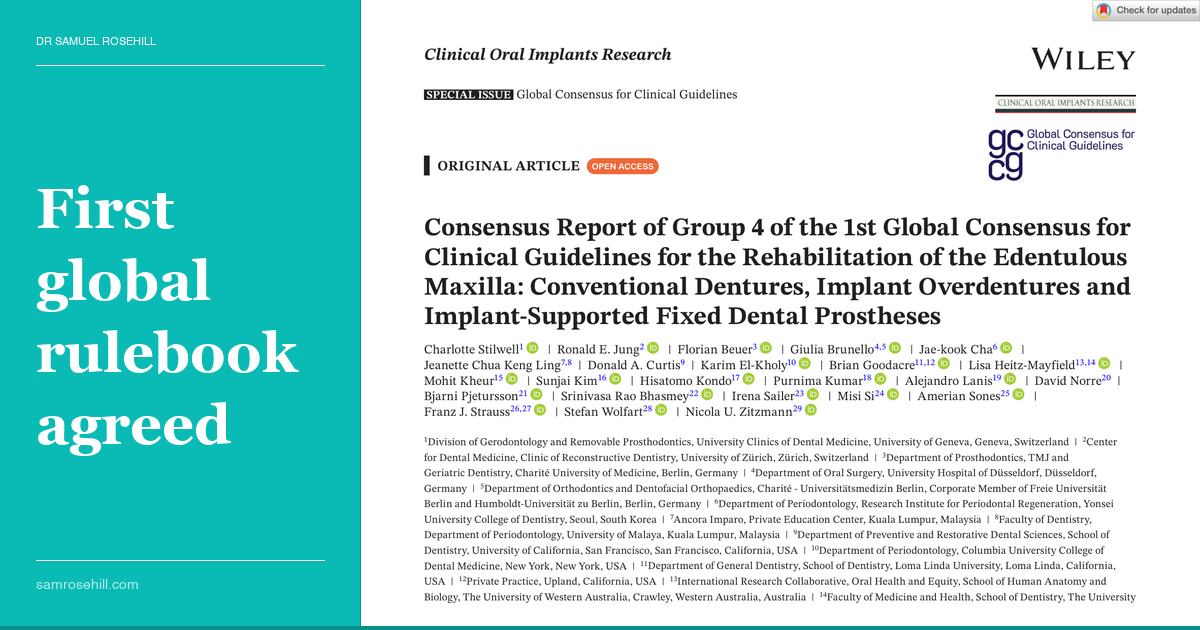
Source Paper
Consensus Report of Group 4 of the 1st Global Consensus for Clinical Guidelines for the Rehabilitation of the Edentulous Maxilla: Conventional Dentures, Implant Overdentures and Implant-Supported Fixed Dental Prostheses
One of the most frequently encountered and demanding clinical scenarios in implant dentistry has, for years, operated in something close to a consensus-free zone. Not because surgeons and prosthodontists lacked opinions; implant clinicians are constitutionally incapable of lacking opinions. The problem was agreement. The maxillary edentulous arch is harder to treat than its mandibular counterpart, the evidence base is thinner than it ought to be, and the prosthetic options carry trade-offs that resist tidy hierarchy.
Into this gap steps the Consensus Report of Group 4 of the 1st Global Consensus for Clinical Guidelines for the Rehabilitation of the Edentulous Maxilla: Conventional Dentures, Implant Overdentures and Implant-Supported Fixed Dental Prostheses. Charlotte Stilwell and 22 co-authors represent the prosthodontics, periodontics, and oral surgery specialists who convened in Boston in June 2025 to do what the literature, left to itself, had not managed: agree.
The Data Anchor
Working Group 4 comprised 24 members (15 prosthodontists, 7 periodontists, 2 oral surgeons) following the AWMF S2k-level guideline framework. A Nominal Group Technique processed two systematic reviews on patient and clinician-reported outcomes, plus surveys of 121 expert clinicians (41 countries), 41 patients (29 countries), and 21 cross-disciplinary experts (27 countries).
Final voting was anonymous and plenary. Strong consensus required above 95% agreement; consensus required 75% to 95%. Mean participation: 75 voters per recommendation.
The patient survey is the quietly destabilising part. Patients preferred fixed prostheses over removable options by 82.9%, yet the evidence base comparing outcomes between fixed and removable maxillary rehabilitations is, by the group’s own account, thin and heterogeneous. There is a gap between what patients want and what the literature can yet confirm they reliably get.
Key Findings
- 14 recommendations across five stages: patient selection, diagnostics, treatment planning, treatment procedures, and maintenance. Six reached consensus; eight achieved strong consensus.
- Conventional dentures are not automatically inferior. Recommendation 4 (97%, strong consensus) states that if a patient is satisfied with their complete denture and tissues are healthy, no further treatment is needed. This is evidence-based conservatism, not compromise. In one prospective study, 80 of 103 patients chose to continue with their conventional denture rather than progress to an overdenture.
- Prosthetically driven planning is non-negotiable. Diagnostic set-up, CBCT with radio-opaque markers, and prosthetically oriented surgical templates are all endorsed, insisting the prosthetic goal is established before any implant is planned.
- Screw-retained prostheses, by consensus at 93.4%. Retrievability and the ability to manage complications without demolishing the restoration are the stated drivers; residual cement risk to peri-implant health is explicit in the rationale.
- Metal reinforcement for overdentures, open palatal design preferred. Retention element selection (stud attachments, bar splints, or telescopic crowns) depends on implant position and interocclusal space.
- Maintenance protocols remain genuinely contested. No consensus on routine screw-retorquing intervals, prosthesis removal frequency, or hygiene visit numbers. Risk-stratified recall is the recommendation; a universal protocol does not exist.
- Standardised PROMs are the field’s outstanding debt. Heterogeneous patient-reported outcome measures prevent meaningful IOD-versus-IFCD comparisons, and the group identifies this as the most urgent research gap.
💡 The Clinical Bottom Line
For any practitioner managing full-arch maxillary cases, this consensus is worth reading in full rather than in summary — not something you often say about a consensus document. The recommendations on shared decision-making reflect evidence that patient preferences in this arch diverge from what clinical hierarchy might predict, and that treatment satisfaction does not reliably correlate with prosthesis sophistication.
The group’s acknowledgement of where the evidence runs out is, paradoxically, the most useful section. Knowing where the rulebook ends is as important as knowing what the rules say.
Dr Samuel Rosehill is a general dentist with a prosthodontic focus, practising at Ethical Dental in Coffs Harbour, NSW. He holds a BDSc (Hons) from the University of Queensland, an MBA, an MMktg, and an MClinDent in Fixed & Removable Prosthodontics (Distinction) from King’s College London.
Clinical Relevance
This is the first globally agreed clinical framework for rehabilitating the edentulous maxilla, covering conventional dentures, implant overdentures, and implant-supported fixed complete dentures across five treatment stages. The 14 recommendations reinforce prosthetically driven implant planning, screw-retained prosthesis design, metal-reinforced overdentures with open palatal coverage, and structured maintenance based on individual patient risk — with shared decision-making explicit at every stage.
Disclosure: The author has no financial conflicts of interest related to the products or topics discussed in this review. This is an independent summary prepared for educational purposes.
Continue the conversation
This review is also published on Substack, where you can leave comments and join the discussion.
Read on Substack →