Where the Global Consensus Ran Out of Answers
While the 1st Global Consensus for Clinical Guidelines (GCCG) reached clear agreement on surgical and augmentation questions for the edentulous maxilla — as covered in the companion Fiorellini consensus report — this companion survey by Schoenbaum and colleagues found that the prosthetic planning variables (implant number, timing, and loading) told a different story: 117 experts from 42 countries, and strong consensus on precisely nothing.
Consensus stops at the prosthetics
Source Paper
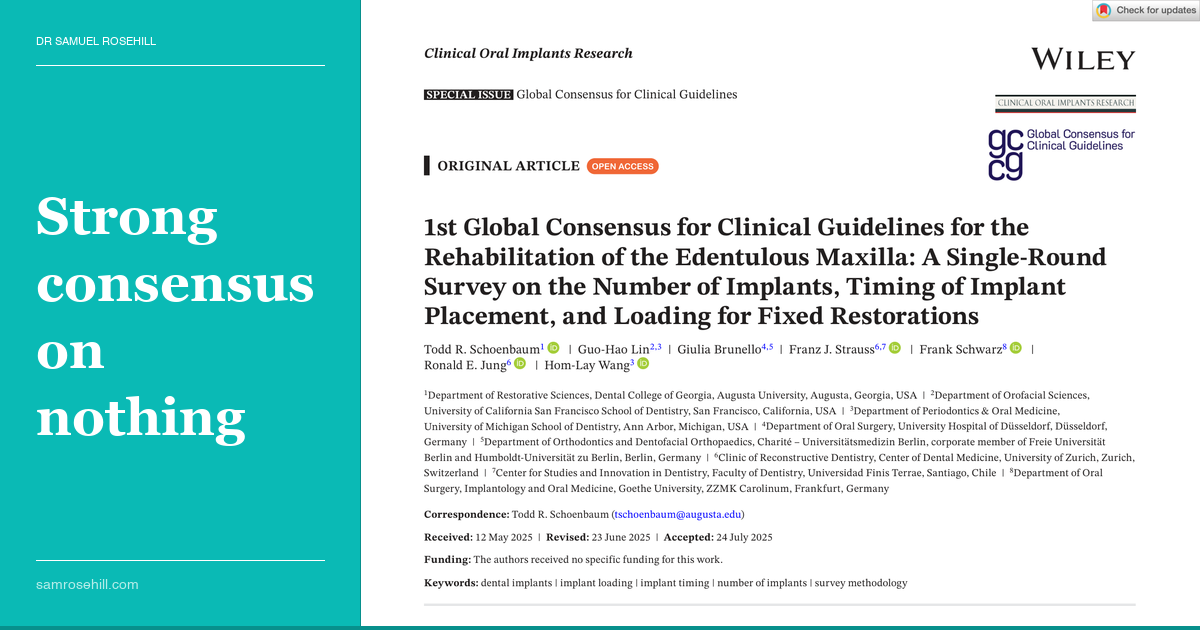
1st Global Consensus for Clinical Guidelines for the Rehabilitation of the Edentulous Maxilla: A Single-Round Survey on the Number of Implants, Timing of Implant Placement, and Loading for Fixed Restorations
The 1st Global Consensus for Clinical Guidelines (GCCG) had already delivered one verdict. The Fiorellini working group — covered in an earlier review on this site — reached clear agreement on CBCT, membrane fixation, soft tissue augmentation, and sinus membrane perforation management; between 80 and 95 per cent of the panel in agreement. The scaffolding of edentulous maxilla rehabilitation: formally settled.
Which makes this companion survey worth reading carefully. Schoenbaum, Lin, Brunello, Strauss, Schwarz, Jung, and Wang were working the same initiative, the same Boston workshop, the same international panel; but they were asking the prosthetic questions. How many implants? When do you place them? When do you load? Their “1st Global Consensus for Clinical Guidelines for the Rehabilitation of the Edentulous Maxilla: A Single-Round Survey on the Number of Implants, Timing of Implant Placement, and Loading for Fixed Restorations,” published in Clinical Oral Implants Research (2026), found something quite different: strong consensus on precisely nothing.
The Data Anchor
The survey ran alongside the GCCG 2025 Boston workshop. Of 202 invited experts from 42 countries, 117 completed it (57.9%), mainly periodontists (43%) and oral surgeons (32%), with prosthodontists at 18%. Consensus required > 75%; strong consensus required > 95%. Twenty-five questions covered the prosthetic arc: implant number, position, timing, loading, and provisional type.
Strong consensus was achieved on zero items. Regular consensus landed on four: always using CBCT for planning (83.8%), the first molar as distal-most site (80.3%), a lab-fabricated acrylic (PMMA) provisional over intraoral conversion (83.8%), and four implants for a removable maxillary overdenture (81.2%). For the fixed full-arch prosthesis, six implants was the plurality at 72.6%, with 14.5% favouring eight and 8.5% favouring four. Anterior site preferences split across lateral incisor (47.0%), canine (23.1%), and central incisor (17.9%).
The survey’s most striking finding is a negative one: in a field where six-implant full-arch cases are marketed as settled science, 27% of the world’s implant experts prefer a different number entirely.
Key Findings
- No item reached strong consensus (> 95%) across 25 questions — the field’s uniformity in prosthetic planning is largely informal convention
- CBCT always indicated per 83.8%: the closest thing to settled ground, consistent with the surgical group’s findings
- Six implants: plurality choice (72.6%) for fixed full-arch prostheses, but 27% prefer a different number entirely
- First molar as distal-most site (80.3%); no published trials demonstrate superiority of any position
- Lab-fabricated PMMA provisional favoured (83.8% vs 16.2% for intraoral conversion); no comparative fracture-toughness data exist
- Immediate loading split: 62.3% aim for same-day delivery; 23.2% wait for osseointegration
- RFA use divided: 41.0% do not use it; of those who do, ISQ > 65 was the predominant threshold (40.2%)
- Limitation: non-random expert sample; single-round design cannot iterate toward convergence as a Delphi process would
💡 The Clinical Bottom Line
The GCCG produced two kinds of knowledge. The surgical group’s paper documents what a field has genuinely worked out: membrane fixation, soft tissue augmentation, sinus perforation thresholds. This companion survey documents where that process stopped — the same experts, the same panel, could not extend consensus to the prosthetic questions. Implant number, position, timing, loading: individually held positions, not field-wide agreements.
For practice: six implants for a fixed full-arch remains a defensible default (72.6% is plurality, not nothing), CBCT is about as settled as this field gets, and four implants for a maxillary overdenture has expert majority support and systematic review data behind it. Beyond those anchors, many choices clinicians treat as received wisdom are simply well-practised preferences. The consensus ran out somewhere between the graft and the prosthesis.
Dr Samuel Rosehill is a general dentist with a prosthodontic focus, practising at Ethical Dental in Coffs Harbour, NSW. He holds a BDSc (Hons) from the University of Queensland, an MBA, an MMktg, and an MClinDent in Fixed & Removable Prosthodontics (Distinction) from King’s College London.
Clinical Relevance
A panel of 117 international implant experts reached strong consensus (> 95%) on no clinical variable relating to implant number, timing, or loading for the fixed edentulous maxilla. Regular consensus (> 75%) was reached on only four items: always using CBCT for planning, the first molar as the preferred distal implant site, lab-fabricated acrylic provisionals, and four implants for a removable maxillary overdenture. Six implants remained the plurality preference (72.6%) for a full-arch fixed prosthesis, but this did not reach strong consensus. Clinicians should continue to individualise treatment plans rather than assume any single protocol has expert backing.
Disclosure: The author has no financial conflicts of interest related to the products or topics discussed in this review. This is an independent summary prepared for educational purposes.
Continue the conversation
This review is also published on Substack, where you can leave comments and join the discussion.
Read on Substack →