More Data, Same Restoration: What Jaw Tracking Actually Changes in Occlusal Design
A two-part clinical study from Istanbul University finds that optical and electronic jaw tracking systems produce significantly different condylar inclination measurements, yet neither meaningfully outperforms a semi-adjustable articulator when it comes to the final occlusal shape of a posterior bridge or full-arch splint.
Premium tech, comparable outcome
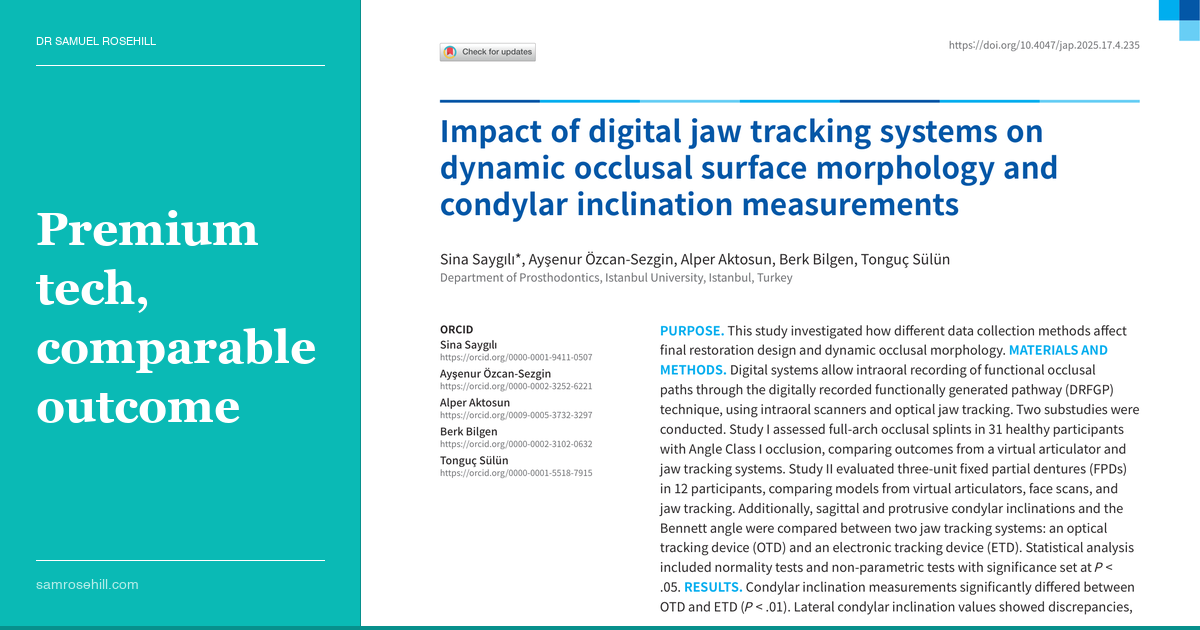
Source Paper
Impact of digital jaw tracking systems on dynamic occlusal surface morphology and condylar inclination measurements
The implicit promise of every jaw tracking device in dentistry is stated nowhere in the brochure: that richer data must produce better restorations. More sensors, finer temporal resolution, a faithful three-dimensional map of how a patient’s condyle traces its arc through space. Surely some of that precision survives into the final occlusal surface. It is a reasonable assumption. It may be wrong.
Saygılı, Özcan-Sezgin, and colleagues at Istanbul University have published “Impact of digital jaw tracking systems on dynamic occlusal surface morphology and condylar inclination measurements” (Journal of Advanced Prosthodontics, 2025), testing this assumption for the most common prosthodontic work, and the findings are quietly awkward for anyone selling jaw tracking hardware.
The Data Anchor
The study enrolled 31 healthy participants with Angle Class I occlusion across two substudies. Study I (n = 31) compared full-arch occlusal splint designs from four data sources: an optical tracking device (Modjaw, OTD), an electronic tracking device (JMAnalyser+, ETD), a digital facebow via face scanner (AFT Dental System), and a virtual articulator set to average condylar values.
Study II (n = 12) evaluated three-unit fixed partial dentures using ETD-derived values, face scan data, and patient-specific motion (PSM) recordings from a TRIOS 3 intraoral scanner. Designs were compared by surface deviation analysis in Rapidform 2006 and GOM Inspect; condylar inclination and Bennett angle values from both devices were compared across protrusion, lateroprotrusion, and chewing (P < .05).
Key Findings
- Condylar measurements differed significantly between devices. OTD and ETD produced significantly different protrusive and lateral condylar inclination values (P < .01 for all groups), excepting mediotrusion. The two systems calculate inclinations differently; neither manufacturer publishes the methodology.
- Those differences did not meaningfully propagate into splint design. The OTD group produced the highest surface deviations (mean distance 0.75 ± 0.19 mm vs 0.58–0.64 mm for all other groups, P < .01), but all deviations remained within the 0.3 mm clinical tolerance threshold. The average-value articulator matched the ETD and face-scan groups.
- For three-unit FPDs, tooth 1.6 (upper first molar) was the only site with a statistically significant intergroup difference. The PSM-based intraoral scanner workflow produced the lowest deviation there; other groups showed no significant differences from one another.
- Limitation: Study I used a 3 mm increased vertical dimension, altering condylar position and border movement patterns. OTD’s chewing-based recordings generated morphology genuinely different from border-movement recordings, a confound the authors acknowledge but could not fully control.
The OTD group’s higher surface deviations reflect chewing recordings at an increased vertical dimension, shifting condylar position in ways border movements do not. The device is faithfully recording a different jaw position, not failing.
💡 The Clinical Bottom Line
The study’s conclusion is worth quoting directly: “despite measurable differences in condylar inclination values, these variations did not translate into clinically significant discrepancies in the final prosthetic designs.” Semi-adjustable articulators and digital motion capture both delivered comparable reliability for the case types tested.
For these common case types, the PSM workflow from a TRIOS 3 you likely already own performed as well as dedicated ETD tracking for FPD design, suggesting the premium hardware may not be buying what it appears to buy. Caveats apply: healthy volunteers, one skeletal class, no clinical validation of delivered restorations.
Whether the findings hold for complex reconstructions or TMD patients remains open. For now, the data suggest the articulator loaded with average condylar parameters is producing occlusal outcomes that state-of-the-art jaw tracking cannot measurably improve upon. That is less a critique of the technology than a reminder that traditional tools endured for a reason.
Dr Samuel Rosehill is a general dentist with a prosthodontic focus, practising at Ethical Dental in Coffs Harbour, NSW. He holds a BDSc (Hons) from the University of Queensland, an MBA, an MMktg, and an MClinDent in Fixed & Removable Prosthodontics (Distinction) from King’s College London.
Clinical Relevance
For posterior three-unit FPDs and full-arch occlusal splints in Class I patients, semi-adjustable articulators produce occlusal morphology comparable to optical and electronic jaw tracking systems. Clinicians can adopt simpler intraoral-scanner-based workflows without measurable compromise in occlusal design accuracy for these common case types.
Disclosure: The author has no financial conflicts of interest related to the products or topics discussed in this review. This is an independent summary prepared for educational purposes.
Continue the conversation
This review is also published on Substack, where you can leave comments and join the discussion.
Read on Substack →