Jaw Trackers Are Genuinely Impressive — Just Ask Any Lab Technician Who's Never Met One
A 2026 PRISMA-registered systematic review of 20 studies finds that optical jaw tracking systems offer real precision advantages over mechanical articulators, but high risk of bias across the literature and the absence of standardised protocols mean this technology is further from routine adoption than the marketing suggests.
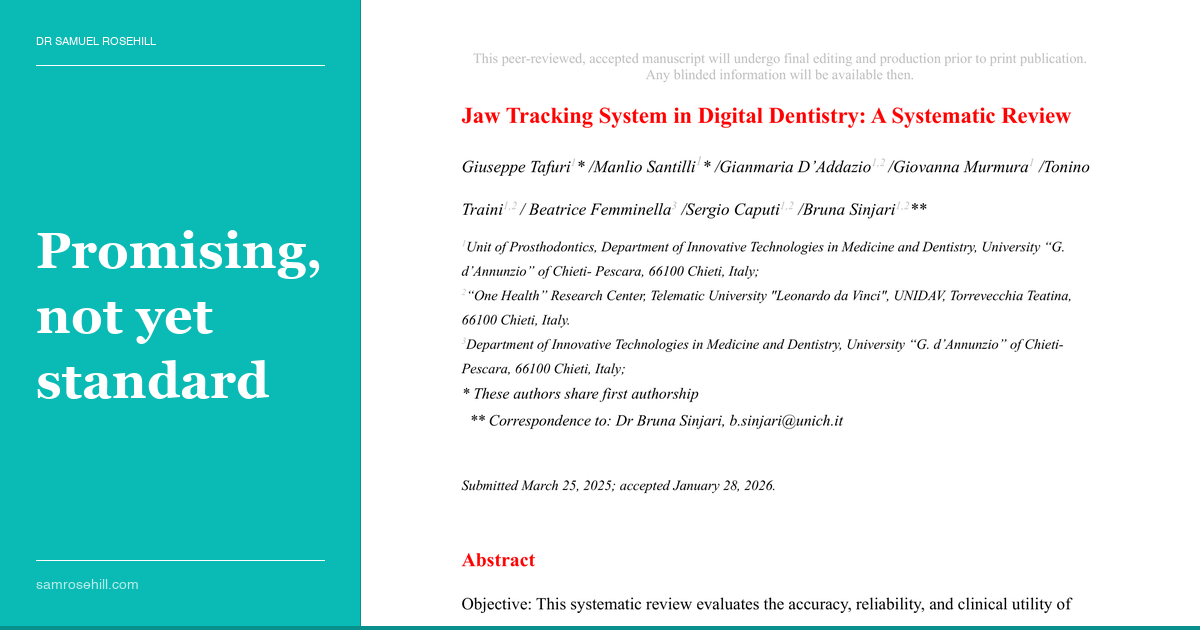
Promising, not yet standard
Source Paper
Jaw Tracking System in Digital Dentistry: A Systematic Review
We have built implants that integrate with living bone, printed zirconia frameworks accurate to within microns, and designed entire restorations from a digital scan taken in under three minutes. And yet, for capturing how a patient’s jaw actually moves, many prosthodontists are still mounting study models on a hinged metal box designed in the nineteenth century. Tafuri, Santilli, and colleagues at the University “G. d’Annunzio” of Chieti-Pescara have produced a timely reckoning with this situation: their 2026 systematic review, “Jaw Tracking System in Digital Dentistry: A Systematic Review,” synthesises twenty studies evaluating jaw motion tracking (JMT) devices against conventional occlusal assessment methods, and the verdict is more complicated than either the technology evangelists or the mechanical-articulator loyalists would like.
The Data Anchor
This PRISMA-compliant review (PROSPERO: CRD42024567619) searched PubMed, Scopus, Web of Science, and the Cochrane Library from January 2005 to December 2025. Of 755 initial records, 20 studies met inclusion criteria — clinical research (n = 3), in vitro studies (n = 2), comparative analyses (n = 4), observational studies (n = 1), and case reports or technique descriptions (n = 8). Methodological heterogeneity precluded meta-analysis; quality was assessed using QUADAS-2.
Modjaw was the most studied device (n = 13), followed by Cyclops JTS, KaVo ARCUSdigma, and SDiMatriX. In vitro work showed optical systems achieved accuracy within 200 μm for mandibular motion recording; Cyclops JTS demonstrated vertical movement error within 0.2% of reference values. Zhao et al. found Modjaw and ARCUSdigma exhibited high trueness and precision, while Proaxis (SDiMatriX) showed significant deviations. Discrepancies in sagittal condylar inclination and Bennett angle measurements between optical and conventional systems represent the kind of interoperability gap that matters when you are handing a digital record to a milling machine.
Key Findings
- Optical tracking outperformed conventional methods in repeatability (Woodfort et al., 2023), with advantages over both ultrasound and electromagnetic tracking.
- CAD integration reduced prosthesis adjustment chair time across multiple studies; direct visualisation of centric occlusion was enabled without mounting casts (Revilla-León et al., 2024).
- Measurement discrepancies persist between devices: Modjaw and Cadiax Compact 2 produced different condylar inclination and Bennett angle values in the same patients.
- Risk of bias was high in nearly every included study, driven by non-randomised samples, absent control groups, and inconsistent reference standards. The authors describe this as a fundamental limitation, not a minor caveat.
- Clinical validation has been confined almost entirely to healthy participants; applicability to patients with TMD or complex prosthetic needs remains untested.
- No standardised calibration protocol exists, and accuracy depends on operator expertise and patient cooperation — a learning-curve penalty the marketing literature rarely foregrounds.
The field’s honest position: optical jaw tracking is technically impressive and workflow-ready for digitally mature practices, but it is running ahead of the evidence needed to treat it as a validated standard of care.
💡 The Clinical Bottom Line
For practices already operating in a fully digital workflow, optical jaw tracking systems like Modjaw and KaVo ARCUSdigma are a logical and defensible addition. The precision data is real, chair-time savings are documented, and capturing dynamic mandibular movements addresses genuine limitations of the static mechanical articulator.
For everyone else, the message from Tafuri et al. is patient. The evidence does not yet justify wholesale replacement of conventional occlusal methods; and anyone who tells you otherwise is probably also selling you the device. The mechanical articulator has persisted for a hundred and fifty years not because dentistry is allergic to innovation, but because it produces acceptable outcomes at acceptable cost with no software updates required.
Dr Samuel Rosehill is a general dentist with a prosthodontic focus, practising at Ethical Dental in Coffs Harbour, NSW. He holds a BDSc (Hons) from the University of Queensland, an MBA, an MMktg, and an MClinDent in Fixed & Removable Prosthodontics (Distinction) from King’s College London.
Clinical Relevance
Optical jaw tracking systems such as Modjaw and KaVo ARCUSdigma offer measurable precision advantages over mechanical articulators in recording mandibular movements, and their integration with CAD software can reduce chair time for prosthesis adjustments. However, the evidence base carries a consistently high risk of bias, standardised calibration protocols do not yet exist, and most clinical studies were conducted exclusively on healthy participants — making these tools promising adjuncts rather than validated replacements for conventional occlusal workflows.
Disclosure: The author has no financial conflicts of interest related to the products or topics discussed in this review. This is an independent summary prepared for educational purposes.
Continue the conversation
This review is also published on Substack, where you can leave comments and join the discussion.
Read on Substack →