Static or Dynamic? Choosing Your Digital Guided Surgery Pathway
Static and dynamic computer-aided implant surgery show comparable accuracy — clinical context, not assumed superiority, should drive the choice between them.
Neither wins outright
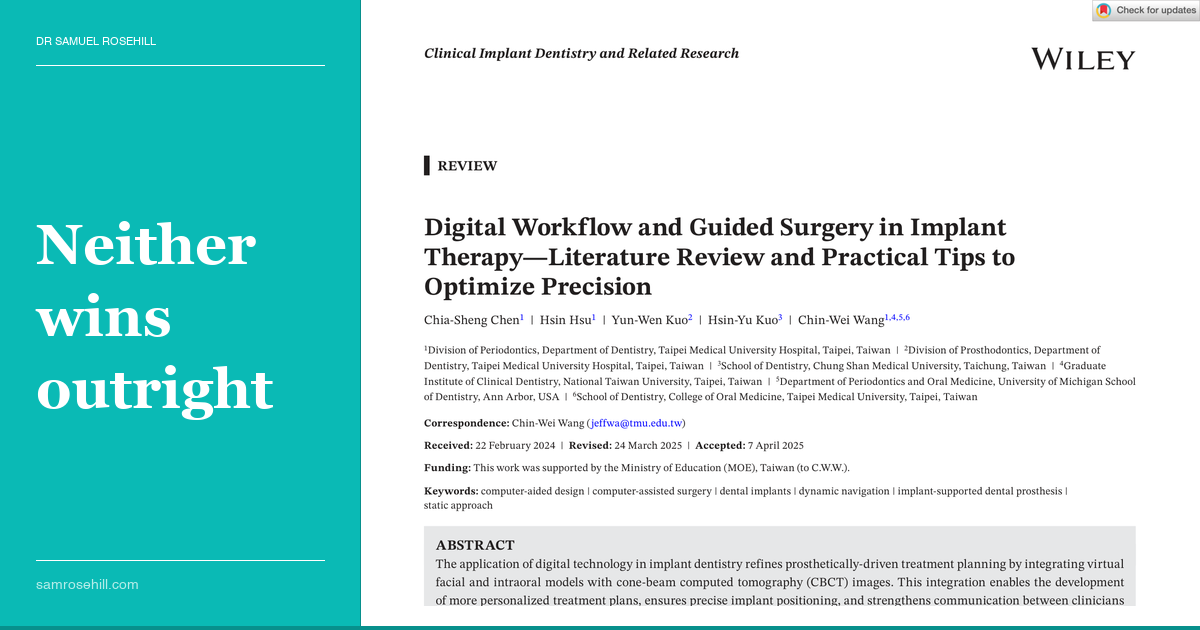
Source Paper
Digital Workflow and Guided Surgery in Implant Therapy—Literature Review and Practical Tips to Optimize Precision
You’ve spent forty-five minutes planning the implant in software — angulation perfect, depth optimised, prosthetic axis aligned like a small digital miracle — and now you’re standing over the patient with a 3D-printed stent that doesn’t quite seat. You press harder, which is precisely the moment your meticulous digital plan starts to unravel.
Chen and colleagues from Taipei Medical University have written the practical guide you needed before that moment: Digital Workflow and Guided Surgery in Implant Therapy—Literature Review and Practical Tips to Optimize Precision, a review that treats both static and dynamic approaches with the even-handedness of someone who’s clearly struggled with both.
The Data Anchor
This is a narrative literature review synthesising current evidence and clinical cases — not a primary study — so the data it marshals belongs to others.
The headline numbers are worth rehearsing. Fully guided static surgery reduced coronal deviation by −0.51 mm and apical deviation by −0.75 mm compared to half-guided approaches; angular deviation dropped by −3.63°. Against freehand? The gap widens further. Dynamic navigation showed angular deviations of approximately 3.4°, with horizontal deviations at neck and apex of 0.9 mm and 1.2 mm — statistically comparable to static. Long-term survival rates for digitally guided static surgery ranged from 94.5% to 100% over 5 years, matching the overall benchmark of 95.6%.
Key Findings
- Static and dynamic approaches show no significant differences in final accuracy — angular, vertical, and horizontal deviations are statistically comparable once the learning curve is surmounted (approximately 20 cases for dynamic navigation).
- Stent stability is the Achilles heel of static surgery — the number and location of anchor teeth materially influence accuracy; four supporting teeth provide comparable results to full-arch guides, but distal extensions and extraction sockets show higher deviations.
- Registration method choice is critical for dynamic navigation — impression-based, trace-based, and bone-screw registration each suit different clinical scenarios, with bone screws essential for fully edentulous cases lacking anatomical landmarks.
- Flapless computer-aided implant placement reduces angular deviation by −3.88° and apical 3D deviation by −0.75 mm versus flapped or freehand approaches, with lower postoperative discomfort and shorter surgical duration.
- The honest limitation: only 18% of included studies comparing static and dynamic were randomised clinical trials. The evidence base is dominated by retrospective analyses with substantial heterogeneity in protocols, making definitive head-to-head claims premature.
The real decision isn’t which system is more accurate — it’s which system fits your patient’s mouth, your surgical access, and your particular flavour of imperfection.
💡 The Clinical Bottom Line
Both digital pathways reliably outperform freehand placement, and the choice between static and dynamic reduces to clinical pragmatism rather than accuracy supremacy. Static suits restricted implant positions, flapless protocols, and immediate loading workflows; dynamic excels in limited mouth openings, complex anatomy near vital structures, and cases requiring intraoperative flexibility. The uncomfortable truth this review quietly confirms is that neither technology compensates for poor case selection or sloppy execution — the clinician’s diagnostic skill remains the rate-limiting step, even when the digital workflow is flawless.
Dr Samuel Rosehill is a general dentist with a prosthodontic focus, practising at Ethical Dental in Coffs Harbour, NSW. He holds a BDSc (Hons) from the University of Queensland, an MBA, an MMktg, and an MClinDent in Fixed & Removable Prosthodontics (Distinction) from King’s College London.
Reference: Chen, C-S. et al. Digital Workflow and Guided Surgery in Implant Therapy—Literature Review and Practical Tips to Optimize Precision. Clin Implant Dent Relat Res. 2025. https://doi.org/10.1111/cid.70038
Clinical Relevance
Static and dynamic guided approaches both significantly outperform freehand implant placement, with cumulative 5-year survival rates of 94.5–100%. The choice between them hinges on clinical context — mouth opening, bone condition, edentulous span — rather than on one system's inherent superiority over the other.
Disclosure: The author has no financial conflicts of interest related to the products or topics discussed in this review. This is an independent summary prepared for educational purposes.
Continue the conversation
This review is also published on Substack, where you can leave comments and join the discussion.
Read on Substack →