The Robot in the Room: Accuracy of Robot-Assisted Versus Freehand Implant Surgery
Younis et al. compare the Remebot robot-assisted system against freehand implant placement across 95 implants — and the accuracy gap is not marginal. It's threefold.
3x more accurate
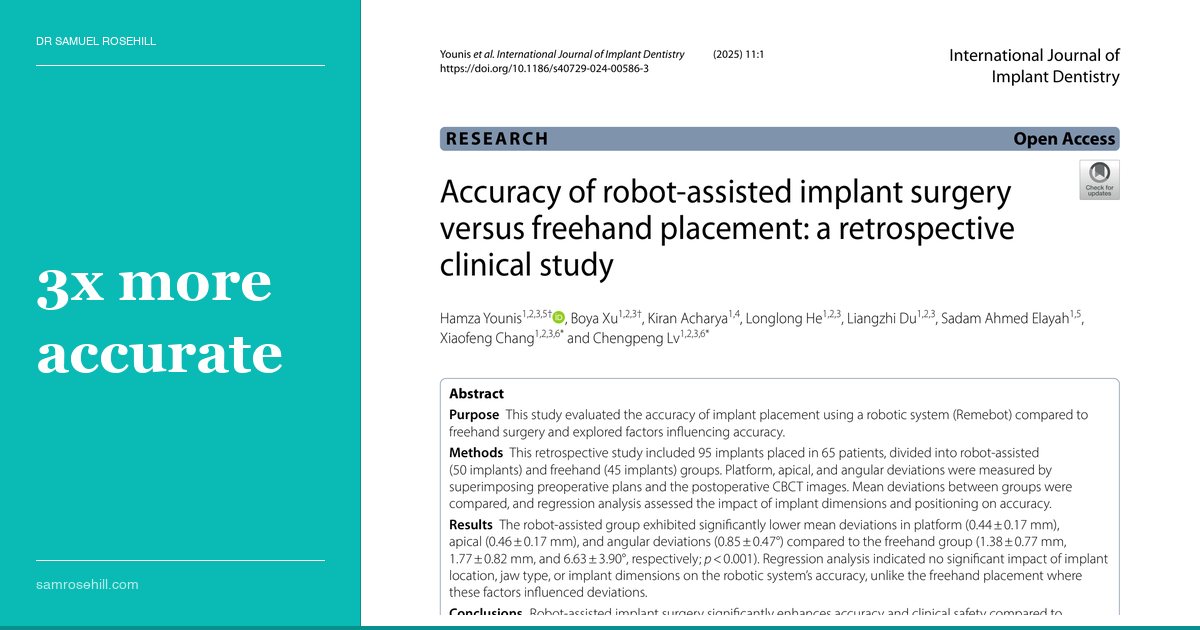
Source Paper
Accuracy of Robot-Assisted Implant Surgery Versus Freehand Implant Surgery: A Retrospective Study
A patient sits in your chair fidgeting with the consent form. They’ve read that robots can place implants now, and they want to know if you’re considering one. You laugh—the way clinicians do when confronted with technology they’ve been dodging at conferences—and promise them precision instead. Except here’s where it gets uncomfortable: Younis and colleagues from Xi’an Jiaotong University have evidence you might want to reconsider that promise.
Their retrospective study — Accuracy of Robot-Assisted Implant Surgery Versus Freehand Implant Surgery — compares the Remebot system against freehand placement across 95 implants in 65 patients. The findings are not ambiguous. They’re statistically sledgehammer-level unambiguous, and if you’re smugly confident in your own wrist steadiness after fifteen years of practice, they’re rather humbling.
The Data Anchor
Single-centre, retrospective analysis with a single surgical team controlling for surgeon experience variance: n=95 implants per group. The Remebot doesn’t fatigue during the seventh patient of the afternoon; it carries no tremor, no whisper of hesitation — just millimetre-perfect optical tracking and a robotic arm making incremental corrections in real time. The question is whether that mechanical steadiness actually shows up in the numbers. It does.
Platform deviation — the implant’s drift from plan at the alveolar crest — was 0.44 ± 0.17 mm with the robot versus 1.38 ± 0.77 mm freehand. Angular deviation dropped from 5.24 ± 3.05° to 1.88 ± 0.98°. At the apex, position error measured 0.67 ± 0.31 mm robotic versus 1.89 ± 0.93 mm freehand. All three differences: P < 0.001. Roughly threefold across every measure.
Key Findings
- Platform positioning accuracy improved by 68% — the implant platform ends up where you actually planned it, not approximately in that general vicinity. This is the clinical difference between reproducible execution and optimistic intention.
- Angular precision jumped threefold — 1.88° versus 5.24° is the gap between mechanical laser-focus and the modest human tremor that thirty years of steadying your hand can’t quite eliminate.
- Apex positioning accuracy improved by 65% — your pre-operative surgical plan survives contact with actual bone nearly intact instead of drifting millimetre by millimetre through trabecular resistance.
- Clinical cascades: Positioning accuracy this superior presumably improves bone-implant contact longevity, reduces peri-implantitis risk trajectories, and yields more predictable prosthetic load distribution.
- Caveat worth dwelling on: Single surgical team in one centre. A less skilled surgeon would likely show wider freehand deviations — making this less a human-versus-machine story and more a “good human versus machine” narrative.
The question nobody’s asking loudly enough: does the robot beat the best surgeons, or just flatten the variance between the best and the rest?
💡 The Clinical Bottom Line
The robot demonstrably, measurably beats human hands at positional accuracy — but whether that precision cascade translates into tangibly better implant survival or patient outcomes over ten years remains the unanswered question this study sidesteps. The harder decision isn’t whether machines excel at mechanical precision (they do, convincingly). It’s whether that precision buys your patient anything they’ll actually notice or benefit from in the long run.
Dr Samuel Rosehill is a general dentist with a prosthodontic focus, practising at Ethical Dental in Coffs Harbour, NSW. He holds a BDSc (Hons) from the University of Queensland, an MBA, an MMktg, and an MClinDent in Fixed & Removable Prosthodontics (Distinction) from King’s College London.
Reference: Younis et al. Accuracy of Robot-Assisted Implant Surgery Versus Freehand Implant Surgery: A Retrospective Study. Int J Implant Dent. 2025. https://doi.org/10.1186/s40729-024-00586-3
Clinical Relevance
Robotic systems achieve roughly threefold improvements in platform, angular, and apex positioning over freehand technique. Whether this precision cascade translates into better long-term implant survival remains an open question — but for cases where positional accuracy is clinically critical, the evidence for robotic assistance is now hard to dismiss.
Disclosure: The author has no financial conflicts of interest related to the products or topics discussed in this review. This is an independent summary prepared for educational purposes.
Continue the conversation
This review is also published on Substack, where you can leave comments and join the discussion.
Read on Substack →