Forty Degrees: The Emergence Angle Number Clinicians Actually Needed
A histological canine study from the University of Zurich finds that restorative emergence angles above 40° produce a sharp, dose-dependent rise in peri-implant inflammatory cell infiltration — providing the biological mechanism behind a threshold that clinicians can now design against.
40° is the line
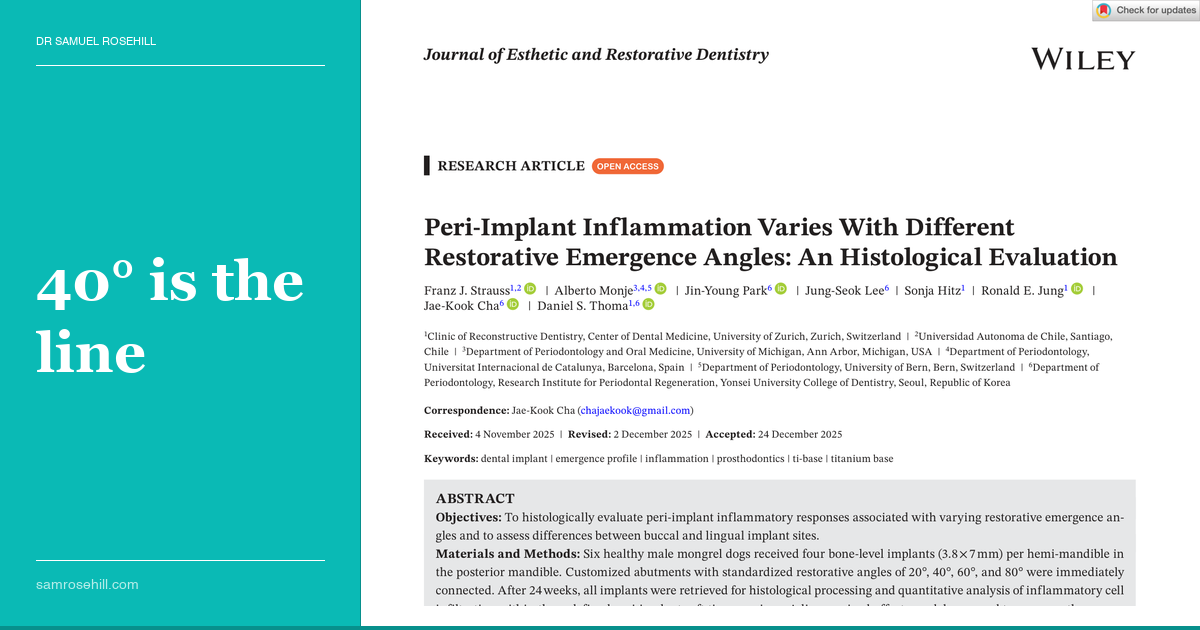
Source Paper
Peri-Implant Inflammation Varies With Different Restorative Emergence Angles: An Histological Evaluation
Forty degrees. Write it on a sticky note and put it somewhere clinical. The European Federation of Periodontology (EFP) has spent years telling prosthodontists to take emergence angle seriously as a peri-implantitis risk factor, and for years the guidance has floated in that productive but faintly unsatisfying zone of “favour narrower profiles where possible.”
The histological scaffolding behind that recommendation has been conspicuously absent. The paper Peri-Implant Inflammation Varies With Different Restorative Emergence Angles: An Histological Evaluation by Strauss, Monje, and colleagues provides it: a dose-response curve with 40° sitting unmistakably at the inflection point.
“Avoid wide profiles” and “keep it below 40°” are functionally different instructions. One is a direction; the other is a target.
The Data Anchor
Strauss and colleagues at the University of Zurich, with collaborators at Yonsei University, the University of Michigan, and the University of Bern, built their study around six healthy dogs, each receiving four bone-level implants (CONELOG SCREW-LINE, 3.8 × 7 mm, CAMLOG Biotechnologies) per hemi-mandible — 48 sites in total.
Each site was immediately restored with a customised abutment presenting one of four standardised emergence angles: 20°, 40°, 60°, or 80°. After 24 weeks, all implants were retrieved and sectioned for undecalcified histological processing, with inflammatory cell infiltration quantified across three defined regions of interest along the peri-implant soft tissue interface using a linear mixed-effects model.
The results are orderly in a way preclinical data rarely is. At buccal sites, inflammatory cell proportions sat low at 20° (3.2%) and 40° (6.1%), then jumped to 9.9% at 60° and 12.8% at 80° (p < 0.001). At lingual sites: 4.0% at 20°, a near-flat 3.1% at 40°, 6.9% at 60°, and 11.6% at 80°. The buccal side consistently carried more inflammatory burden, with angle-by-site interactions reaching significance at 40°, 60°, and 80°.
Key Findings
- The 40° threshold is histologically real. Below it, inflammatory infiltration was low and stable. Above it, the response increased sharply and dose-dependently. This is the first histological confirmation of a threshold that cross-sectional clinical studies had previously suggested.
- Buccal sites are more vulnerable. Buccal inflammation consistently outpaced lingual from 40° upward, likely reflecting reduced self-cleansability where the tongue cannot assist.
- The dose-response held across both surfaces (p < 0.001 at buccal and lingual sites). This is a biological gradient, not a measurement quirk.
- The EFP S3 clinical practice guidelines already list emergence angle as a primary prevention target for peri-implantitis. This paper provides the tissue-level explanation for why.
- Limitation: Animal model; direct extrapolation to human biology requires caution. The 24-week window captures a snapshot, not a trajectory. Oral hygiene was deliberately withheld, which amplifies plaque effects that compliant patients would partially mitigate.
The lingual advantage (lower inflammation, probably via tongue-mediated self-cleansing) is a small reminder that prosthetic design operates inside a biological environment that doesn’t stop at the abutment surface.
💡 The Clinical Bottom Line
If you are designing an implant-supported crown and you have a choice, keep the emergence angle at or below 40°. That is now a target with a histological address, not a general aspiration. Wide convex profiles that felt aesthetically convenient at cementation are doing something measurable and unfavourable in the tissue.
The paper doesn’t claim that 42° guarantees peri-implantitis. It shows that the inflammatory trajectory changes meaningfully beyond 40°, and that the buccal aspect is where the price of overcontouring is paid earliest. In a discipline that has too often argued from intuition and unreliable probing depths, having a number is useful. Use it.
Dr Samuel Rosehill is a general dentist with a prosthodontic focus, practising at Ethical Dental in Coffs Harbour, NSW. He holds a BDSc (Hons) from the University of Queensland, an MBA, an MMktg, and an MClinDent in Fixed & Removable Prosthodontics (Distinction) from King’s College London.
Clinical Relevance
Restorative emergence angles above 40° are associated with significantly increased peri-implant inflammatory cell infiltration, particularly at buccal sites, in a dose-dependent pattern confirmed by histological analysis. Clinicians should aim to keep the emergence angle at or below 40° when designing implant-supported prostheses. This is not a vague recommendation to 'avoid overcontouring' — it is a specific, measurable target with histological backing. The European Federation of Periodontology (EFP) clinical practice guidelines already list emergence angle as a primary prevention factor for peri-implantitis; this study provides the mechanistic scaffold behind that guidance.
Disclosure: The author has no financial conflicts of interest related to the products or topics discussed in this review. This is an independent summary prepared for educational purposes.
Continue the conversation
This review is also published on Substack, where you can leave comments and join the discussion.
Read on Substack →