The Emergence Angle Rule Gets a Custom-Abutment Caveat
Dellacasa and colleagues followed 112 implants for at least 5 years and found that wider prosthetic emergence angles were not significantly associated with marginal bone loss when customised abutments were used.
Angles aren't destiny
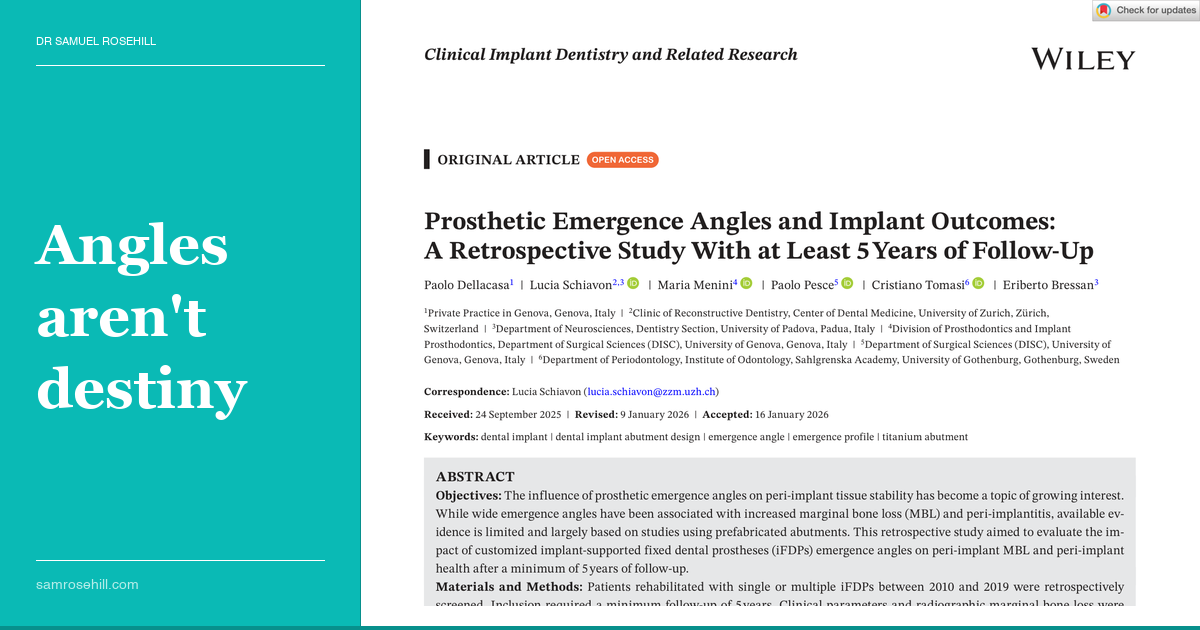
Source Paper
Prosthetic Emergence Angles and Implant Outcomes: A Retrospective Study With at Least 5 Years of Follow-Up
Most implant dentists carry around a small internal customs officer for prosthetic contours. Anything over 30 or 40 degrees approaches the border looking suspicious; anything convex enough to hide plaque is asked several firm questions. The useful discomfort in Prosthetic Emergence Angles and Implant Outcomes: A Retrospective Study With at Least 5 Years of Follow-Up is that Dellacasa and colleagues found no significant link between wider emergence angles and marginal bone loss when the restorations sat on customised abutments.
This does not mean emergence profile has been granted diplomatic immunity. It means the border check may need more than one stamp.
The Data Anchor
The study retrospectively screened patients restored with implant-supported fixed dental prostheses between 2010 and 2019, requiring at least 5 years of follow-up. The final cohort included 52 patients and 112 implants, followed for a mean of 6.6 years. Emergence angles were measured mesially, distally, buccally, and palatally or lingually, then grouped as < 40 degrees, 40-59 degrees, or >= 60 degrees.
Mean emergence angles were not especially shy: mesial 43.9 degrees, distal 40.6 degrees, buccal 49.5 degrees, and palatal or lingual 45.8 degrees. Mean bone loss remained modest, overall values stayed at or below 0.8 mm, and no significant correlation emerged between angle category and marginal bone loss.
Key Findings
- Customised abutments changed the contour story. Unlike prefabricated Ti-bases, which can carry the same emergence angle through the transmucosal zone, customised abutments allow a more graduated transition from implant to crown.
- Wide angles were not statistically tied to bone loss or peri-implantitis. The >= 60 degree group trended slightly higher for mean bone loss and probing depth, but subgroup size and variability limited inference.
- Pocket depth carried the stronger clinical signal. In healthy implants, each 1 mm increase in pocket depth corresponded to 0.79 mm of bone loss (P < .001, R² = 0.57).
- Disease changed the maths. Six implants were diagnosed with peri-implantitis; once disease was established, probing depth no longer predicted bone loss cleanly, which feels clinically familiar because inflammation rarely respects tidy geometry.
- The limitation is important. This is retrospective, modestly sized, and specific to customised abutments; it should not be recycled as permission for bulky, uncleansable prosthetic design.
💡 The Clinical Bottom Line
The practical takeaway is not to abandon emergence-angle discipline, but to stop treating the angle as an isolated moral failing. A 50-degree contour on a customised, cleansable, platform-switched abutment is not the same biological object as the same number on a stock Ti-base with a convex plaque shelter.
Tomorrow morning, measure the angle, but also interrogate the architecture: how the contour starts, whether the patient can clean it, what the pocket depths are doing, and whether the soft tissue is already complaining. Geometry matters; it just appears to have accomplices.
Dr Samuel Rosehill is a general dentist with a prosthodontic focus, practising at Ethical Dental in Coffs Harbour, NSW. He holds a BDSc (Hons) from the University of Queensland, an MBA, an MMktg, and an MClinDent in Fixed & Removable Prosthodontics (Distinction) from King’s College London.
Clinical Relevance
Wide emergence angles should not be treated as a single-number verdict when customised abutments and platform switching are involved. This retrospective study suggests that cleansability, pocket depth, tissue response, and abutment architecture may matter more than an isolated angle threshold.
Disclosure: The author has no financial conflicts of interest related to the products or topics discussed in this review. This is an independent summary prepared for educational purposes.
Continue the conversation
This review is also published on Substack, where you can leave comments and join the discussion.
Read on Substack →