Implant Evidence Has a Map Problem
Robert and colleagues review 45 bibliometric studies on dental implantology and show why publication trends can orient clinical thinking, but should not be mistaken for clinical evidence.
Map before trusting trends
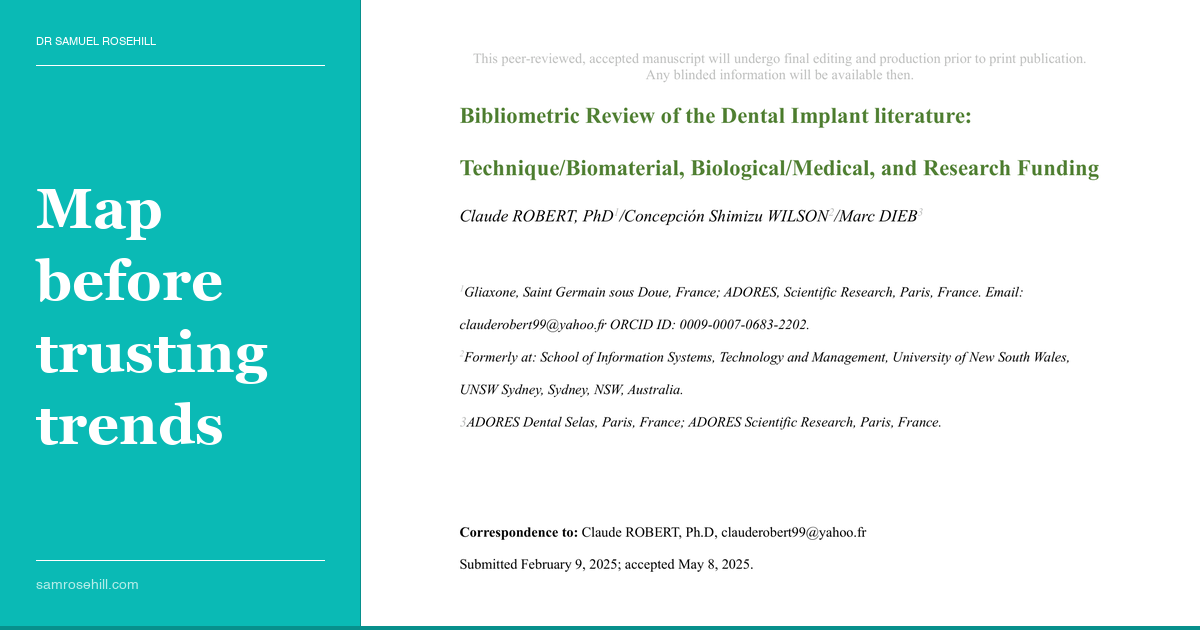
Source Paper
Bibliometric Review of the Dental Implant literature: Technique/Biomaterial, Biological/Medical, and Research Funding
There comes a point in every large literature when it stops resembling a tidy bookshelf and starts behaving like a storage unit after a rushed house move. Bibliometric Review of the Dental Implant literature: Technique/Biomaterial, Biological/Medical, and Research Funding is Robert, Wilson, and Dieb’s attempt to label the boxes. Their point is not that bibliometrics tells us which implant protocol to use on Monday. It tells us where the profession has been pointing its torch, and where the shadows may be.
That distinction matters. Implant dentistry now produces enough papers that publication volume can begin to look like authority, which is a very human mistake and a deeply unhelpful one.
The Data Anchor
The authors collected 74 bibliometric dental implant papers, then retained 45 for analysis after applying their selection criteria. They grouped the literature into three broad territories: technique and biomaterial papers, biological and medical condition papers, and research funding papers. This was a review of bibliometric studies, not a review of implant survival, peri-implantitis therapy, guided surgery accuracy, or prosthetic complications themselves.
One number explains why this sort of paper exists at all. A PubMed search cited by the authors found that dental implant literature grew from 20 papers in 1964-1968 to 5,668 papers in 2019-2023. That is not a literature stream. That is a weather system.
Key Findings
- The implant literature is intensely uneven. The 45 included papers covered everything from zirconia implants and CBCT to peri-implantitis, overdentures, zygomatic implants, microRNA, soft tissue integration, and funding patterns.
- Database choice changes the map. Some studies used PubMed, others Scopus, Web of Science, Google Scholar, or multiple databases, which makes direct comparison surprisingly fragile.
- Funding is a major sub-plot. The authors identified 22 bibliometric papers that used funding parameters, including eight where research funding was the central theme.
- Clinical translation is indirect. A bibliometric spike around digital implant dentistry or zirconia tells us that researchers are interested; it does not tell us that a given workflow is better for a patient.
- The authors’ own caveat is important. They note that some papers may have escaped retrieval and that the quality of bibliometric studies was heterogeneous.
💡 The Clinical Bottom Line
The practical use of this paper is not chairside decision-making; it is intellectual hygiene. Before accepting that a field is “settled” because it has many papers, ask whether those papers are clinical trials, in-vitro studies, citation maps, funding analyses, or the scholarly equivalent of everyone standing in the same corner of the room because the lighting is good.
For clinicians, the lesson is modest but useful: publication heat is not the same as clinical light. Bibliometrics can show where implantology is looking. It cannot, by itself, tell you what to do with the next ridge.
Dr Samuel Rosehill is a general dentist with a prosthodontic focus, practising at Ethical Dental in Coffs Harbour, NSW. He holds a BDSc (Hons) from the University of Queensland, an MBA, an MMktg, and an MClinDent in Fixed & Removable Prosthodontics (Distinction) from King’s College London.
Clinical Relevance
Bibliometric reviews are useful for understanding where implant research attention, funding, and publication volume have accumulated. They should not be read as treatment guidance; they are maps of the literature, not trials of clinical effectiveness.
Disclosure: The author has no financial conflicts of interest related to the products or topics discussed in this review. This is an independent summary prepared for educational purposes.
Continue the conversation
This review is also published on Substack, where you can leave comments and join the discussion.
Read on Substack →