Twenty Years of Laser-Lok: A Private-Practice Audit That Actually Earns the Adjective
Guarnieri and colleagues followed 730 Laser-Lok implants in 312 private-practice patients for up to 20.9 years, recording a cumulative survival rate of 95.3% at 20 years and identifying seven factors — including smoking, male sex, D4 bone, and insertion torque ≥ 35 Ncm — independently associated with late failure.
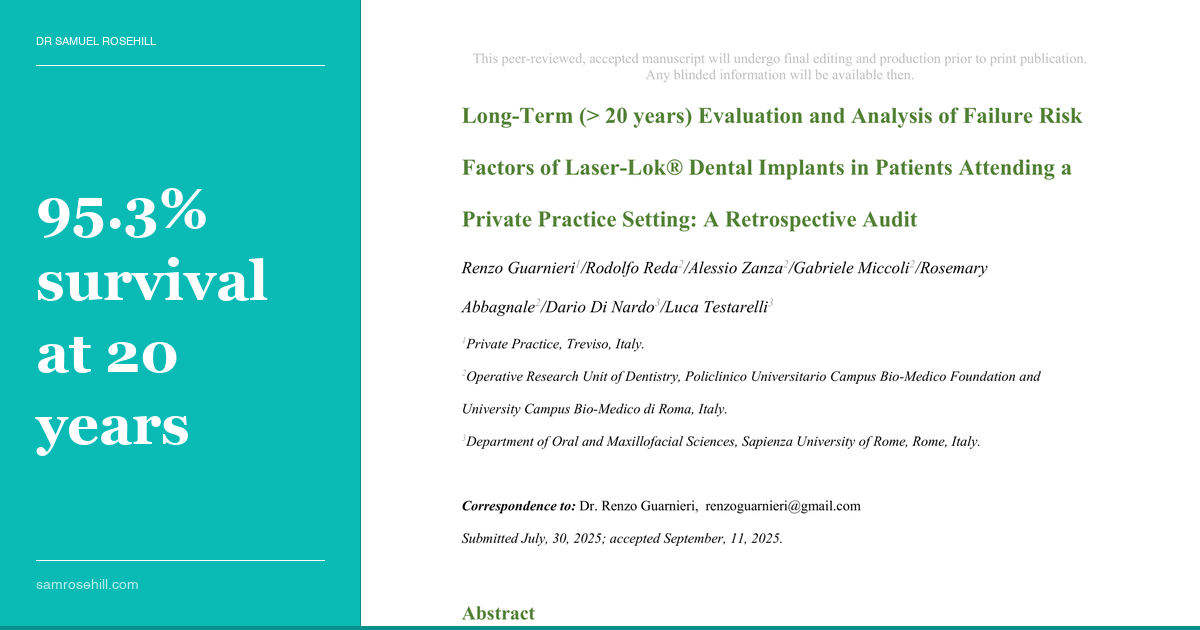
95.3% survival at 20 years
Source Paper
Long-Term (> 20 years) Evaluation and Analysis of Failure Risk Factors of Laser-Lok® Dental Implants in Patients Attending a Private Practice Setting: A Retrospective Audit
Most implant survival literature is written at a ten-year horizon — which is, on one level, perfectly reasonable: follow-up is expensive, logistically difficult, and a meaningful professional commitment. On another level, it is a polite mismatch with the actual proposition being made to patients, who are typically in their forties or fifties at placement and are betting the next two or three decades of chewing on a device whose evidence base covers about a third of that distance.
“Long-Term (> 20 years) Evaluation and Analysis of Failure Risk Factors of Laser-Lok® Dental Implants in Patients Attending a Private Practice Setting: A Retrospective Audit” by Guarnieri, Reda, Zanza and colleagues is therefore a somewhat unusual document: it actually delivers the follow-up the original sales pitch always implied existed.
The Data Anchor
Between January 2000 and December 2005, Renzo Guarnieri placed 730 Laser-Lok® tapered implants (BioHorizons, Birmingham, Alabama) in 312 patients at a single private practice in Treviso, Italy. The cohort was unselected in the way that genuinely matters: smokers (16%), patients with a history of periodontitis (23.7%), and patients with systemic conditions including diabetes, hypertension and a history of radiotherapy were all included alongside their healthier counterparts.
Patients attended six-monthly recall visits; 11,980 such contacts were recorded over an average follow-up of 16.8 years, the longest reaching 20.9 years. Drop-out was a modest 4%. Cumulative survival was calculated by Kaplan-Meier analysis; a binary generalised estimating equation (GEE) model adjusted for clustering and confounders was used to identify independent predictors of late failure.
Key Findings
- The headline number holds up. Kaplan-Meier cumulative survival rates were 98.2% at 5 years, 97.1% at 10 years, 95.8% at 15 years, and 95.3% at 20 years: a gradual, predictable attrition rather than a cliff.
- Six independent risk factors for late failure emerged from GEE analysis: male sex, smoking, posterior maxillary location, combined immediate placement with immediate loading, D4 (soft) bone quality, and insertion torque ≥ 35 Ncm. That last finding deserves attention: implants placed at ≥ 35 Ncm had a 20-year CSR of only 96.8%, against 99.8% for the 25–35 Ncm group (P < .05), suggesting high insertion torque may not be the stability asset it is routinely presented as.
- Marginal bone loss was contained. At 20 years, 92.3% of implants showed mean marginal bone loss of less than 1 mm; 4.1% showed 1–2 mm; 3.6% exceeded 2 mm. Soft-tissue recession was absent in 85.4% of implants.
- Peri-implantitis occurred in only 6% of implants across two decades, against a published weighted mean prevalence of approximately 22%. The authors attribute this partly to the Laser-Lok micro-grooved collar (documented to promote perpendicular connective tissue attachment) and partly to intensive maintenance.
- The paper’s honest limitation: single-centre, single-operator, retrospective design. The data cannot be fully disentangled from this surgeon’s technique and recall discipline.
The six-monthly recall programme produced 11,980 patient contacts over two decades. That figure is not incidental to the peri-implantitis rate; it may be the most important variable in the study.
💡 The Clinical Bottom Line
For a patient asking how long a BioHorizons Laser-Lok implant can reasonably be expected to survive, this study offers a more honest answer than most of the literature: 95.3% at 20 years, in a real private-practice population with all its attendant complexity. The risk factor profile is clinically actionable; placing in a male smoker with D4 bone in the posterior maxilla now comes with quantified grounds for a careful preoperative conversation rather than a breezy one.
The low peri-implantitis rate, while plausibly linked to collar surface characteristics, should not be cleanly separated from an extraordinary maintenance commitment that most patients and many practices cannot replicate. Both explanations are likely true; the implant may be contributing something protective, but so is the clinician who kept detailed records across two decades and called every patient every six months to prove it.
Dr Samuel Rosehill is a general dentist with a prosthodontic focus, practising at Ethical Dental in Coffs Harbour, NSW. He holds a BDSc (Hons) from the University of Queensland, an MBA, an MMktg, and an MClinDent in Fixed & Removable Prosthodontics (Distinction) from King’s College London.
Clinical Relevance
This 20-year private-practice cohort of 730 Laser-Lok implants achieved a 95.3% cumulative survival rate, broadly in line with RCT benchmarks despite an unselected patient population including smokers and medically compromised individuals. Clinicians should note that male sex, smoking, D4 bone quality, combined immediate placement and immediate loading, posterior maxillary location, and insertion torque ≥ 35 Ncm each independently predicted late failure in multivariate analysis. The strikingly low peri-implantitis rate of 6% at 20 years — against a literature benchmark of approximately 22% — is plausibly attributable to both the Laser-Lok micro-grooved collar and a rigorous six-monthly maintenance programme.
Disclosure: The author has no financial conflicts of interest related to the products or topics discussed in this review. This is an independent summary prepared for educational purposes.
Continue the conversation
This review is also published on Substack, where you can leave comments and join the discussion.
Read on Substack →