The Molar Socket Fights Back: Customised Healing Abutments Halve Bone Loss in Immediate Implants
A randomised controlled trial by Ragucci and colleagues found that customised healing abutments reduced mean marginal bone loss to 0.51 mm at 12 months compared to 1.34 mm with conventional cylindrical abutments in immediately placed molar implants — a statistically significant difference that points to a comparatively simple modification with meaningful biological consequences.
Customised abutment halves bone loss
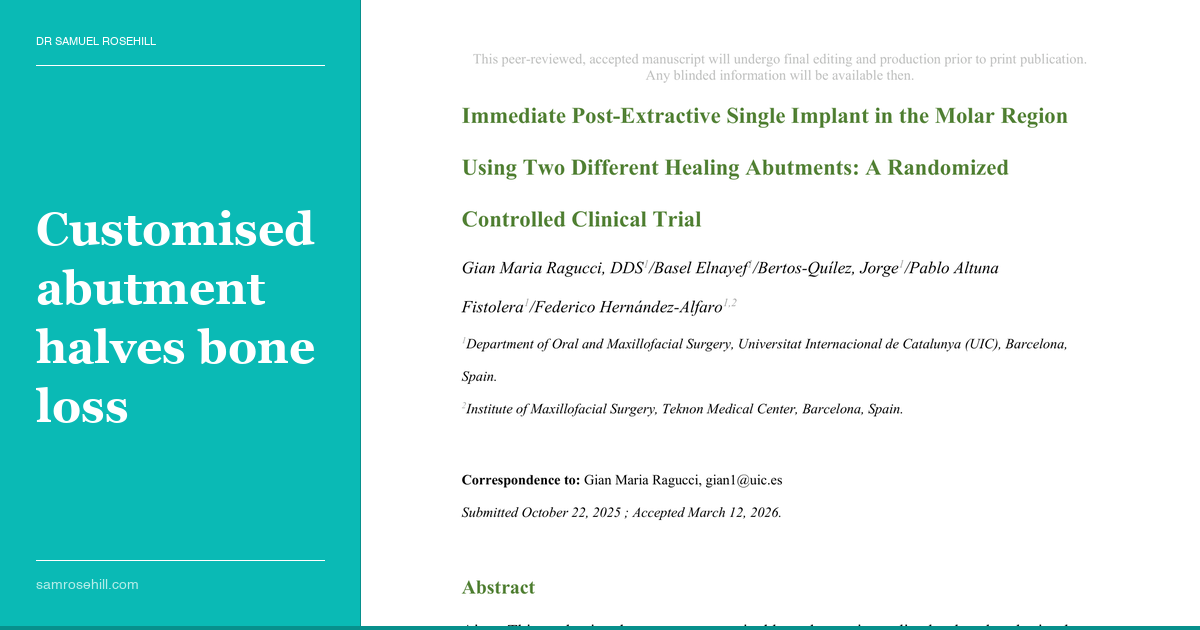
Source Paper
Immediate Post-Extractive Single Implant in the Molar Region Using Two Different Healing Abutments: A Randomized Controlled Clinical Trial
The molar socket is one of implantology’s genuinely difficult sites. Wide and multi-rooted where the implant is round and single, it yawns open after extraction with a gap between bone and implant platform that requires grafting, and a geometry that no off-the-shelf abutment was specifically designed to address. Primary closure is not expected; soft tissue collapse is. And unlike the aesthetic zone, where the profession has obsessed over soft-tissue management for two decades, the molar region is sometimes treated as a place where the rules are slightly looser: bigger gap, bigger abutment, close enough.
Immediate Post-Extractive Single Implant in the Molar Region Using Two Different Healing Abutments: A Randomized Controlled Clinical Trial by Ragucci, Elnayef, Bertos-Quílez and colleagues at Universitat Internacional de Catalunya in Barcelona argues, with a randomised controlled trial (RCT) and twelve months of radiographic follow-up, that the choice of healing abutment at this site is not a minor detail. A customised healing abutment (CHA) shaped to match the socket preserved significantly more crestal bone than the standard cylindrical option.
The Data Anchor
Thirty-six patients were randomised equally: 18 received a CHA (Group A) and 18 a conventional healing abutment (Group B). CHAs were fabricated chairside using a polyetheretherketone (PEEK) temporary abutment and flow composite, shaped to mirror the socket. The control was a 5.5 × 3 mm titanium cylindrical abutment. All implants were Klockner VEGA fixtures placed flapless, the gap filled with demineralised bovine bone (Cerabone, Botiss). Every implant achieved primary stability greater than 30 Ncm; crowns were delivered four months later.
Two patients were lost to follow-up (one per group), leaving 17 in each arm at 12 months. Two implant failures occurred, one per group, giving a cumulative survival rate of 94.11% in both groups. Marginal bone level (MBL) change was assessed from standardised periapical radiographs at baseline and one year using ImageJ software.
Key Findings
- Mean MBL was 0.51 ± 0.42 mm in the CHA group versus 1.34 ± 0.75 mm in the conventional group (β = -0.83, p < 0.001). For a site already fighting against remodelling pressure, that 0.83 mm difference is clinically meaningful.
- None of the anatomical covariates predicted bone loss. Keratinised mucosa width, buccal plate thickness, soft tissue thickness at 2 mm and 3 mm, vertical soft tissue thickness, and gap distance all failed to reach statistical significance. The abutment design overwhelmed every anatomical variable the trial assessed.
- Equal survival at 12 months. Neither abutment type influenced osseointegration; the difference appeared in the surrounding bone during healing and loading.
- Limitation: Thirty-four completers is a modest cohort. Maxillary and mandibular molars were pooled, and one year is a brief window for conclusions about long-term crestal stability.
The CHA fabrication here requires no digital workflow: a PEEK blank, flow composite, and a chairside impression of the socket before final polishing. Materials most implant practices already carry.
💡 The Clinical Bottom Line
The conventional healing abutment is cylindrical because cylinders are practical; they are not cylindrical because the molar socket is. That geometrical mismatch, the authors suggest, allows soft tissue to collapse inward during healing, with consequences for the mucosal architecture that eventually translate to crestal bone remodelling. Filling the socket with a contoured abutment appears to interrupt that sequence.
For surgeons placing immediate molar implants, this trial offers a pragmatic modification requiring no additional technology: adapt the healing abutment to the socket at surgery. The result, at one year, is roughly half the crestal bone loss.
The molar socket will still fight you. This particular fight, at least, is one you can now prepare for.
Dr Samuel Rosehill is a general dentist with a prosthodontic focus, practising at Ethical Dental in Coffs Harbour, NSW. He holds a BDSc (Hons) from the University of Queensland, an MBA, an MMktg, and an MClinDent in Fixed & Removable Prosthodontics (Distinction) from King’s College London.
Clinical Relevance
This randomised controlled trial of 36 patients compared immediately placed molar implants with either a customised healing abutment (shaped to fill the socket) or a conventional cylindrical healing abutment. At 12 months, marginal bone level change was 0.51 ± 0.42 mm in the customised group versus 1.34 ± 0.75 mm in the conventional group (β = -0.83, p < 0.001). None of the anatomical covariates — keratinised mucosa, buccal plate thickness, soft tissue thickness, or gap distance — significantly influenced bone loss. Surgeons placing immediate molar implants should consider chairside customisation of the healing abutment to match socket anatomy as a low-complexity modification with meaningful crestal bone preservation outcomes at one year.
Disclosure: The author has no financial conflicts of interest related to the products or topics discussed in this review. This is an independent summary prepared for educational purposes.
Continue the conversation
This review is also published on Substack, where you can leave comments and join the discussion.
Read on Substack →