The Steeper-Taper Upgrade That Wasn't: Morse Implant Wall Angle vs. Stress Reality
A photoelastic study by Corte et al. finds that increasing Morse taper internal wall angle from 11.5° to 16° produces no measurable difference in peri-implant stress distribution — suggesting the marketing distinction between these two popular implant geometries may outrun the biomechanics.
Wider taper, same result
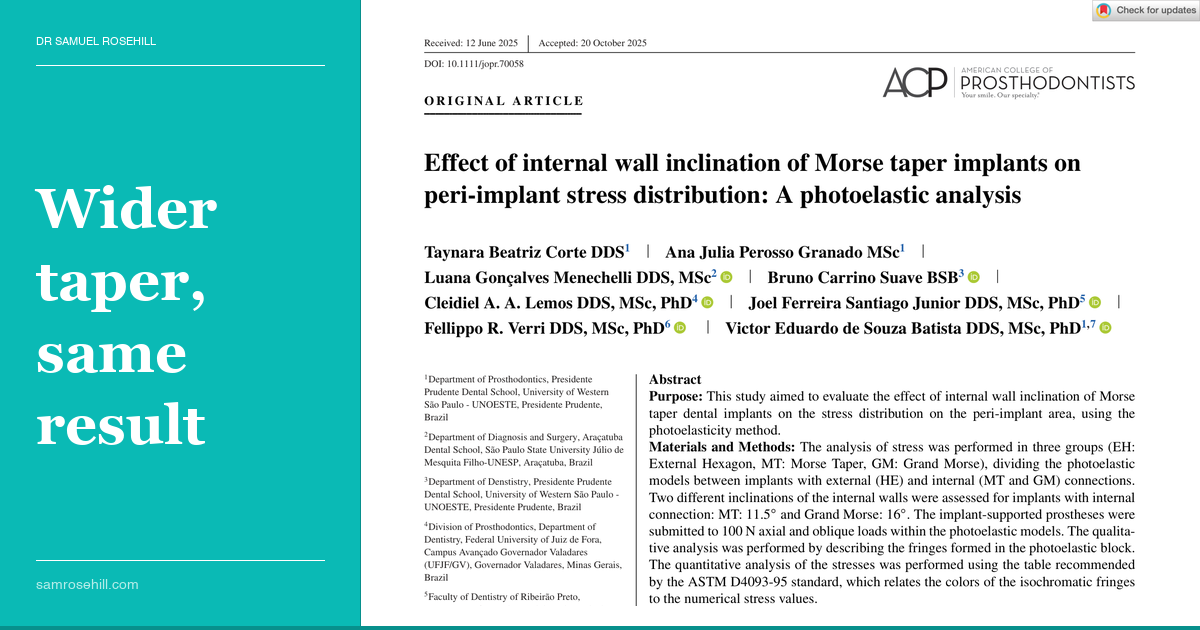
Source Paper
Effect of internal wall inclination of Morse taper implants on peri-implant stress distribution: A photoelastic analysis
The implant industry has developed a refined talent for making incremental geometry look like a paradigm shift. A half-degree here, a widened inner diameter there, a new name (Grand, Premium, Evolution) — and before long the catalogue contains a dozen internal connection variants, each positioned as an improvement on the last. It is also, as Corte et al. demonstrate in the Journal of Prosthodontics, occasionally ahead of the evidence.
Their paper, “Effect of internal wall inclination of Morse taper implants on peri-implant stress distribution: A photoelastic analysis,” set out to test whether two commercially popular Neodent internal connection designs (the standard Morse taper (MT) at 11.5° and the Grand Morse (GM) at 16°) produce any meaningful difference in how stress distributes through a peri-implant resin model. The answer, tidily, is no.
The Data Anchor
Three photoelastic resin models were fabricated, one per group: an external hexagon (EH) as the control, the Morse Taper (MT) at 11.5° internal wall inclination, and the Grand Morse (GM) at 16°. Implants were standardised at Ø4 mm × 13 mm and loaded at 100 N axially and obliquely (45°). Fringe analysis followed the ASTM D4093-95 standard, with quantitative stress values derived from isochromatic fringe colour sequences at six measurement points per implant.
Reliability was robust: both intra-examiner and inter-examiner intraclass correlation coefficients (ICC) reached 1.00 (p < 0.001).
Under axial loading, EH produced a mean stress of 2.08 MPa. MT and GM returned identical values of 1.42 MPa each. Under oblique loading, EH reached 2.31 MPa, concentrated in the cervical contralateral region; MT and GM were again indistinguishable at 1.67 MPa each. The external hexagon also showed disproportionate stress in the apical threads, consistent with the micromovement and saucerisation risk long attributed to this design.
Key Findings
- EH showed greater apical stress than both internal connection designs under both loading conditions, consistent with the established literature on external hexagon mechanical limitations
- MT (11.5°) and GM (16°) produced identical stress patterns under axial and oblique loading; the wider wall angle conferred no additional biomechanical benefit
- Oblique loading increased overall stress in all groups, with EH showing the steepest rise, amplifying the comparative disadvantage of external connection geometry
- Limitation: N = 1 model per group; photoelastic resin contacts the full implant surface uniformly, unlike real osseointegration, and cannot distinguish cortical from trabecular bone compliance. No inferential statistics were used.
💡 The Clinical Bottom Line
For clinicians selecting between Morse taper variants on biomechanical grounds, this photoelastic study adds a quiet note of caution: the 4.5-degree difference in internal wall inclination between the 11.5° and 16° designs does not translate into a detectably different stress signature in resin. The internal-versus-external hierarchy holds (both Morse configurations outperform the external hexagon here), but the hierarchy within the internal connection family, at least by this method, remains flat.
Clinical reality is messier than a photoelastic block. Other parameters — abutment fit, screw torque, bone density, crown height — will likely dominate the biomechanical outcome long before wall angle matters. The study cannot tell us these designs are equivalent; it can only tell us that this method found no signal of difference. That is a narrower but still useful finding.
The next time a catalogue positions a 16° taper as a biomechanical advance over the 11.5°, it is reasonable to ask for the data. This paper suggests you may have a wait.
Dr Samuel Rosehill is a general dentist with a prosthodontic focus, practising at Ethical Dental in Coffs Harbour, NSW. He holds a BDSc (Hons) from the University of Queensland, an MBA, an MMktg, and an MClinDent in Fixed & Removable Prosthodontics (Distinction) from King’s College London.
Clinical Relevance
The 11.5° standard Morse taper and 16° Grand Morse designs produce essentially identical photoelastic stress patterns in resin models. For clinicians choosing between these internal connection geometries on purely biomechanical grounds, current in vitro evidence does not support the premise that the wider angle offers any advantage. The external hexagon, however, showed consistently greater apical stress concentration under both loading conditions.
Disclosure: The author has no financial conflicts of interest related to the products or topics discussed in this review. This is an independent summary prepared for educational purposes.
Continue the conversation
This review is also published on Substack, where you can leave comments and join the discussion.
Read on Substack →