The Real Barrier to Tooth Replacement Isn't the Fee Quote
A cross-sectional Japanese study of 4,616 adults aged 65 and over finds that depressive symptoms — not clinical need or quoted treatment costs — is the strongest single predictor of whether an older patient is even willing to pay for missing tooth replacement, while accumulated wealth dominates how much they are willing to pay.
Depression trumps cost
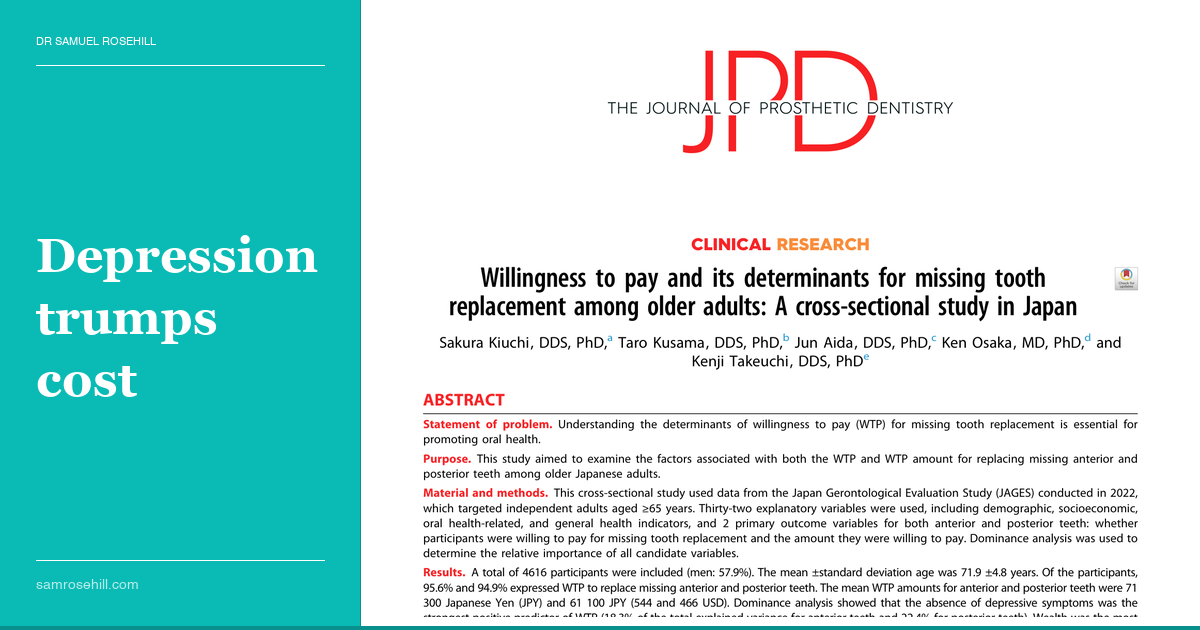
Source Paper
Willingness to pay and its determinants for missing tooth replacement among older adults: A cross-sectional study in Japan
There is an assumption so embedded in the treatment planning conversation for older patients that it rarely gets named: that prosthetic replacement of a missing tooth is, at bottom, a function of clinical need plus the fee estimate. “Willingness to pay and its determinants for missing tooth replacement among older adults: A cross-sectional study in Japan,” by Kiuchi, Kusama, Aida, Osaka, and Takeuchi, challenges that tidily. Neither clinical need nor cost sits at the top of the hierarchy.
The clinician assesses the space, the occlusion, the remaining dentition. They attach prices. The gap between what is indicated and what the patient chooses is then attributed, more or less automatically, to the gap between what treatment costs and what the patient can afford. The data suggest otherwise.
The Data Anchor
The study draws on the Japan Gerontological Evaluation Study (JAGES), a large ongoing cohort of independent adults aged 65 and over. The 2022 wave covered 308,333 recipients; after exclusions for missing data, limited function, and non-response to the oral health module, the analytic sample was 4,616 participants (mean age 71.9 years; 57.9% men).
Dominance analysis across 32 candidate variables ranked each predictor by its share of explained variance across all possible model combinations, which is considerably more revealing than a table of odds ratios.
Of the participants, 95.6% expressed willingness to pay (WTP) for anterior replacement and 94.9% for posterior. Mean WTP amounts were 71,300 JPY (approximately USD 544) for anterior teeth and 61,100 JPY (USD 466) for posterior — well below the uninsured cost of an implant-supported prosthesis in Japan, which runs 300,000 to 500,000 JPY.
Key Findings
- Depressive symptoms was the strongest predictor of whether someone expressed any WTP, accounting for 18.3% of explained variance for anterior teeth and 22.4% for posterior. The next-ranked predictors (preventive dental visits, sex, smoking status) each contributed roughly half that share.
- Wealth was the dominant predictor of WTP amount, contributing 21.3% of explained variance for anterior teeth and 19.2% for posterior. Educational level and preventive dental visits followed; income ranked fourth.
- Social connection mattered, particularly for anterior teeth. Frequency of meeting friends ranked sixth for anterior WTP amount; current working status ranked seventh. The authors note the greater social and aesthetic salience of the front dentition may explain this pattern.
- The depression effect is probably understated. Patients with depressive symptoms are disproportionately likely to have missing data, so complete-case analysis almost certainly underestimates the contribution of mental health.
- Limitations: Cross-sectional design precludes causal inference. Participants nominated an amount without specifying treatment type, so responses conflate implants, bridges, and dentures. Japan’s universal insurance covering basic prosthetics makes the cost thresholds context-specific.
💡 The Clinical Bottom Line
The treatment planning conversation for an older adult with a missing tooth is not primarily a fee negotiation. It is shaped, first, by the patient’s mental state and, second, by their accumulated wealth. Neither of those things tends to come up in the clinical exchange as a formal question.
A patient who disengages from the prosthetic conversation, who seems indifferent to the gap, who says they will think about it and does not return, may not be doing a cost calculation. They may be depressed.
Asking how the patient has been feeling belongs in the assessment as naturally as asking about their medical history. The referral pathways exist. The willingness to use them is the gap this study identifies.
Dr Samuel Rosehill is a general dentist with a prosthodontic focus, practising at Ethical Dental in Coffs Harbour, NSW. He holds a BDSc (Hons) from the University of Queensland, an MBA, an MMktg, and an MClinDent in Fixed & Removable Prosthodontics (Distinction) from King’s College London.
Clinical Relevance
When an older patient declines prosthetic replacement of a missing tooth, depressive symptoms are the strongest predictor of that refusal — outweighing tooth position, self-rated health, income, and most clinical variables. Wealth is the strongest predictor of how much patients will pay. These findings suggest that screening for depression and asking about social connectedness are as clinically relevant as fee discussions in the treatment planning conversation for older adults.
Disclosure: The author has no financial conflicts of interest related to the products or topics discussed in this review. This is an independent summary prepared for educational purposes.
Continue the conversation
This review is also published on Substack, where you can leave comments and join the discussion.
Read on Substack →