Two-Piece Zirconia Implants Are No Longer a Thought Experiment
Tartsch and colleagues report 98.2% effective survival for two-piece zirconia implants over a mean 39.1-month follow-up, offering useful mid-term evidence for metal-free implant therapy while keeping fracture risk and study design firmly in view.
98.2% survival
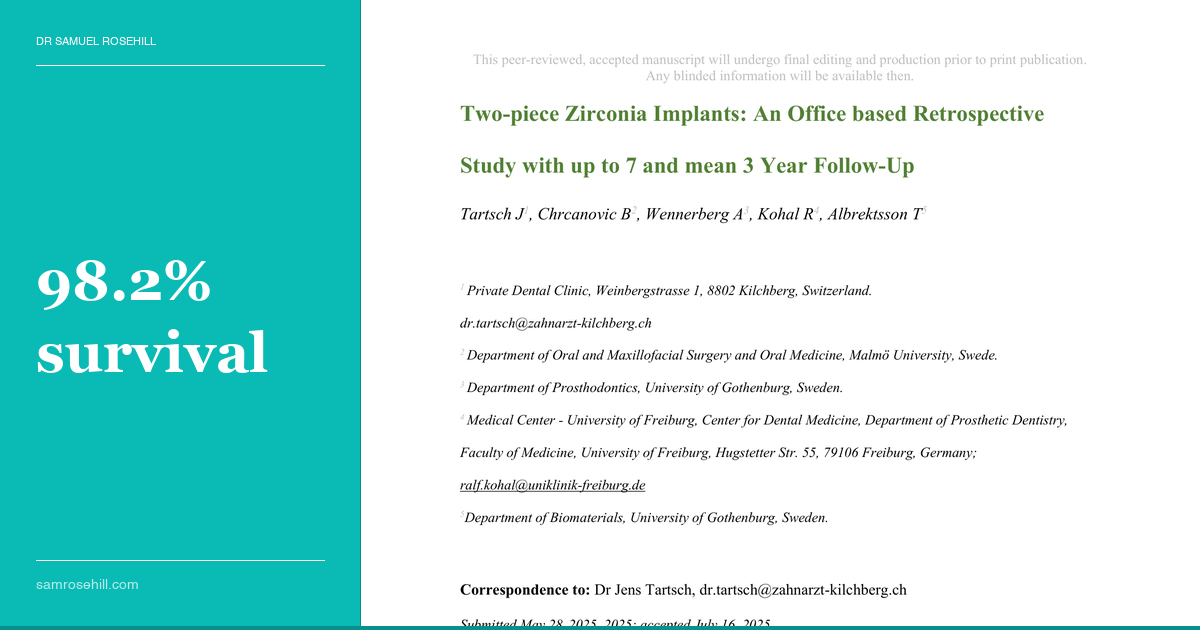
Source Paper
Two-piece Zirconia Implants: An Office based Retrospective Study with up to 7 and mean 3 Year Follow-Up
Ceramic implants have spent a long time in dentistry’s waiting room, dressed beautifully, speaking politely, and still being asked whether they are quite sure they belong in surgery. One-piece zirconia systems made the first argument; two-piece systems have to make the harder one, because restorative flexibility is useful only if the implant survives long enough to deserve it. Tartsch and colleagues’ Two-piece Zirconia Implants: An Office based Retrospective Study with up to 7 and mean 3 Year Follow-Up gives that question some mid-term clinical furniture.
The short answer is encouraging: in this retrospective private-practice series, two-piece zirconia implants delivered 98.2% effective survival over a mean 39.1 months. The more useful answer is that the failures were few but instructive, and the material still asks to be judged on its own terms.
The Data Anchor
The study followed 106 patients who received 167 two-piece zirconia implants between 2017 and 2024. The systems were NobelPearl and Zeramex XT, described as identically designed, screw-retained zirconia implants. Follow-up extended to 88.2 months, with a mean of 39.1 months.
Three implants were lost: two fractures and one failed osseointegration. That produced a 1.8% failure rate, 98.2% effective survival, and a 97.3% cumulative survival rate at seven years. Marginal bone loss was moderate, reported between 0.14 mm and 0.58 mm depending on follow-up interval. The surface roughness analysis placed the threaded portion around the minimally rough category, with Sa values close to 0.5 µm.
Key Findings
- The survival signal is strong, but not definitive. Three losses among 167 implants is reassuring, yet the study is retrospective and has no titanium control group.
- Fracture remains the ceramic caveat. Two of the three losses were fractures, which keeps the material conversation from becoming a simple survival-rate victory lap.
- Bone levels were not alarming. Marginal bone loss sat within ranges the authors compare favourably with previous systematic reviews.
- Surface design is not a side issue. Zirconia cannot simply borrow titanium’s roughening playbook; surface processing may improve biology while potentially weakening the material.
💡 The Clinical Bottom Line
This paper makes two-piece zirconia implants look clinically plausible, especially for patients seeking a metal-free option where one-piece restorative constraints are unattractive. It does not make them interchangeable with titanium.
The practical lesson is material humility. Zirconia may be ready for more ordinary conversations, but it still wants careful case selection, occlusal respect, and a clinician who remembers that a beautiful white implant is still an implant with mechanical obligations.
Dr Samuel Rosehill is a general dentist with a prosthodontic focus, practising at Ethical Dental in Coffs Harbour, NSW. He holds a BDSc (Hons) from the University of Queensland, an MBA, an MMktg, and an MClinDent in Fixed & Removable Prosthodontics (Distinction) from King’s College London.
Clinical Relevance
Two-piece zirconia implants may offer a more restorative-flexible metal-free option than one-piece ceramic systems, with this private-practice series reporting high mid-term survival and moderate marginal bone loss. The result is clinically encouraging, but the evidence remains retrospective and uncontrolled. Clinicians should treat zirconia implant selection as a material-specific decision, not a simple substitution for titanium.
Disclosure: The author has no financial conflicts of interest related to the products or topics discussed in this review. This is an independent summary prepared for educational purposes.
Continue the conversation
This review is also published on Substack, where you can leave comments and join the discussion.
Read on Substack →