Peri-Implantitis Refuses Simple Stories.
An umbrella review in IJOMI identified ten patient-related peri-implantitis risk factors and makes the uncomfortable point that clinicians keep getting into trouble when they interpret one variable in isolation and ignore the rest of the clinical cast.
Single-cause thinking fails
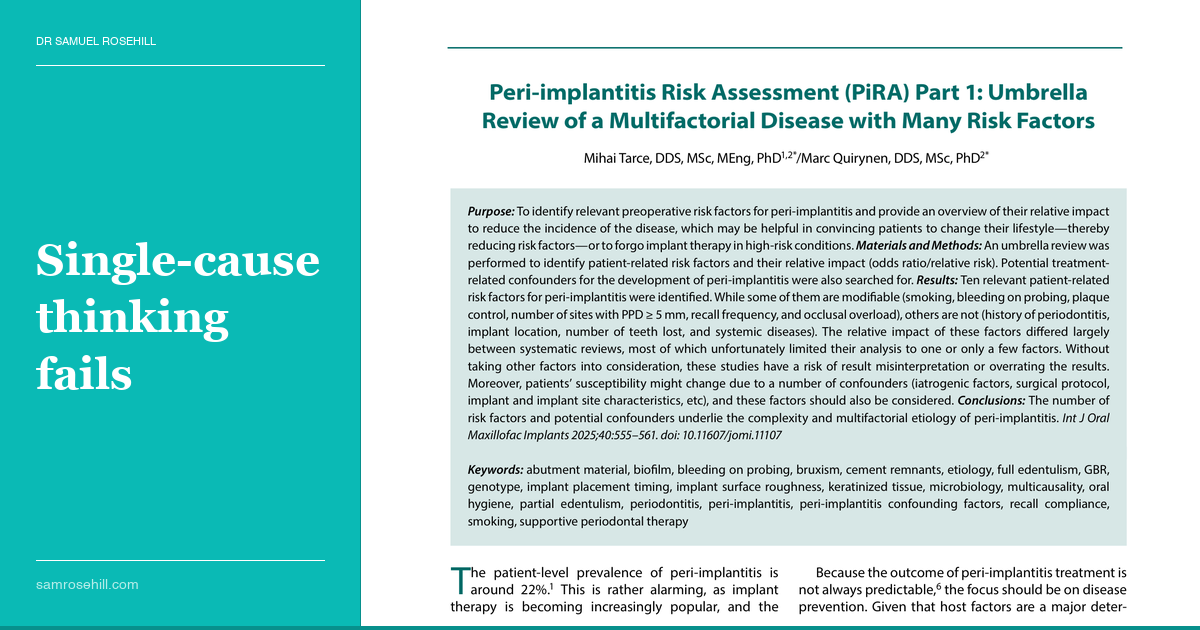
Source Paper
Peri-implantitis Risk Assessment (PiRA) Part 1: Umbrella Review of a Multifactorial Disease with Many Risk Factors
A disease that can be shaped by smoking, plaque control, deep pockets, diabetes, recall compliance, implant location, previous periodontitis, teeth lost, occlusal overload, and whatever the clinician did to the site is still routinely discussed as though it were the work of a single villain. Tarce and Quirynen, in “Peri-implantitis Risk Assessment (PiRA) Part 1: Umbrella Review of a Multifactorial Disease with Many Risk Factors,” make the opposite case. Peri-implantitis is not a single-cause melodrama. It is an ensemble cast, and several members are troublemakers.
That matters because prevention is much more realistic than treatment once peri-implantitis has arrived and made itself comfortable. If the profession wants better patient selection and better consent conversations before implant placement, it needs a risk discussion that sounds less like fortune-telling and more like multivariable reasoning.
The Data Anchor
This umbrella review followed PRISMA 2020 principles and searched PubMed and Embase for English-language literature published before August 2021. The search began with 4,724 publications. After duplicate removal, 2,865 papers remained; 103 systematic reviews were assessed for eligibility, and 49 systematic reviews were ultimately included after manual searching and selection.
Within that body of evidence, the authors summarised 30 systematic reviews (15 with meta-analyses) on patient-related risk factors and 19 systematic reviews (9 with meta-analyses) on treatment-related factors and confounders. Their aim was not to coronate one supreme predictor, but to identify which variables repeatedly surfaced and why single-factor interpretations so often produce false confidence.
Key Findings
- The review identified ten relevant patient-related risk factors. Some were modifiable, including smoking, bleeding on probing, plaque control, number of sites with probing pocket depth ≥ 5 mm, recall frequency, and occlusal overload. Others were not, including history of periodontitis, implant location, number of teeth lost, and systemic disease.
- Several factors were significant in at least one meta-analysis. These included history of periodontitis, implant location, smoking, number of teeth lost, compliance with follow-up appointments, and diabetes.
- Some clinically familiar warnings had weaker quantitative support. Bleeding on probing, poor oral hygiene, sites with PPD ≥ 5 mm, and occlusal overload were reported in systematic reviews, but not always with meta-analytic confirmation.
- The paper’s most useful contribution is methodological rather than dramatic. Many source reviews examined only one or a few risk factors at a time, which means the literature itself can accidentally encourage overrating whichever variable happened to be measured.
- Treatment-related confounders never really leave the room. Implant surface, restorative design, keratinized tissue, cement remnants, surgical protocol, and site characteristics can all modify how those patient-related risks are expressed clinically.
- The limitation is the familiar umbrella-review one. This paper depends on heterogeneous source reviews, varying peri-implantitis definitions, and literature searches that stop at 2021, so it is best read as a map of the terrain rather than a precision instrument.
💡 The Clinical Bottom Line
This paper supports a more grown-up version of implant risk assessment. If a patient has a history of periodontitis, still smokes, misses maintenance, and presents with residual pocketing, it is not especially useful to ask which one factor matters most. The answer is probably “yes”.
That should change the tone of the preoperative conversation. Peri-implantitis risk is not a single checkbox to tick and forget; it is a bundle of probabilities that travels with the patient, and sometimes with the treatment plan we chose for them.
Dr Samuel Rosehill is a general dentist with a prosthodontic focus, practising at Ethical Dental in Coffs Harbour, NSW. He holds a BDSc (Hons) from the University of Queensland, an MBA, an MMktg, and an MClinDent in Fixed & Removable Prosthodontics (Distinction) from King’s College London.
Clinical Relevance
This review supports preoperative risk discussions that stack factors together rather than fixating on a single culprit. A history of periodontitis, smoking, poor maintenance, deep residual pockets, diabetes, and broader treatment-related confounders should be read as a cluster, because that is how peri-implantitis behaves in real life.
Disclosure: The author has no financial conflicts of interest related to the products or topics discussed in this review. This is an independent summary prepared for educational purposes.
Continue the conversation
This review is also published on Substack, where you can leave comments and join the discussion.
Read on Substack →