Smoking and Dental Implant Failure: The Numbers Are Worse Than You Think
A major systematic review and meta-analysis of 44 studies finds cigarette smokers face 60% lower odds of implant survival and 0.64 mm additional crestal bone loss, while evidence on e-cigarettes and vaping remains virtually nonexistent.
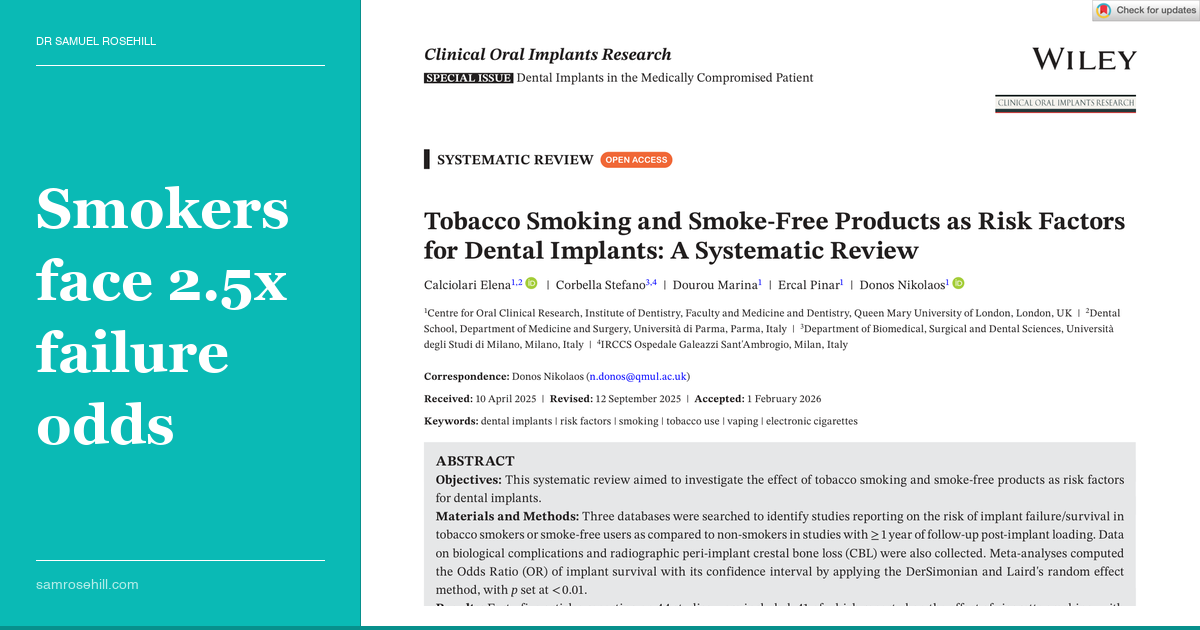
Smokers face 2.5x failure odds
Source Paper
Tobacco Smoking and Smoke-Free Products as Risk Factors for Dental Implants: A Systematic Review
Most of us have a version of the smoking conversation we deliver on autopilot. The patient is sitting in the chair, the CBCT is on screen, and somewhere between discussing the bone graft and the provisional you mention that smoking is, you know, not ideal for implants. The patient nods. You nod. Everyone moves on.
What neither of you quite acknowledges is that you are both operating on vibes rather than numbers, because until recently the numbers were scattered across decades of heterogeneous studies with wildly inconsistent definitions of what “smoker” even means. Calciolari and colleagues, in “Tobacco Smoking and Smoke-Free Products as Risk Factors for Dental Implants” (Clinical Oral Implants Research, 2026), have now gathered those numbers into one place, and they are considerably more sobering than the autopilot conversation suggests.
The Data Anchor
This PROSPERO-registered systematic review searched three databases (MEDLINE, EMBASE, Cochrane) and included 45 articles reporting on 44 studies, 41 of which addressed cigarette smoking specifically. Follow-up ranged from 1 to 17 years post-loading. Meta-analyses used DerSimonian and Laird’s random effects model with significance set at P < 0.01, and quality was assessed using ROBINS-E for prospective studies and Newcastle-Ottawa for retrospective designs. The GRADE framework was applied to appraise the certainty of evidence.
The headline finding: smokers had significantly reduced implant survival at both the implant level (OR = 0.40, 95% CI 0.27–0.61, P < 0.001) and the patient level (OR = 0.43, 95% CI 0.20–0.90, P = 0.02). To translate that into clinic-speak: the odds of a smoker’s implant surviving are roughly 60% lower than a non-smoker’s, or equivalently, smokers face approximately 2.5 times the odds of failure.
Key Findings
- Crestal bone loss was 0.64 mm greater in smokers (95% CI 0.29–0.99, P < 0.001), a clinically meaningful additional loss on top of physiological remodelling.
- Peri-implantitis incidence was higher in smokers across the majority of included studies, though heterogeneity in case definitions prevented formal meta-analysis of this outcome.
- The effect was consistent across time: subgroup analyses at 1 year, 1–5 years, 5–10 years, and beyond 10 years all trended in the same direction, suggesting smoking is not merely an early-healing risk but a persistent long-term burden.
- Evidence on smoke-free products is essentially nonexistent. Only two studies examined non-cigarette products (one on e-cigarettes, one on waterpipes), and the data were too sparse to permit any meta-analytic conclusions about implant survival in these groups.
- 14% of included studies enrolled only male participants, and none validated self-reported smoking status with biochemical measures (cotinine, exhaled CO), raising questions about exposure misclassification across the entire evidence base.
The absence of data on e-cigarettes is not reassurance; it is a gap shaped exactly like the question every patient under forty is now asking you.
💡 The Clinical Bottom Line
This is the largest and most methodologically rigorous meta-analysis to date on smoking and implant outcomes, and it leaves nowhere to hide. An OR of 0.40 is not a marginal effect buried in statistical noise; it is a halving of survival odds that should recalibrate how we consent smokers, how we schedule their maintenance, and how urgently we recommend cessation. The EFP already recommends integrating behavioural counselling into implant treatment plans; this review supplies the numbers to make that recommendation feel less like a suggestion and more like a clinical obligation. And for the patient who vapes and wants to know whether they are in the clear, the honest answer, backed by this review’s empty evidence table, is that nobody knows yet.
Dr Samuel Rosehill is a general dentist with a prosthodontic focus, practising at Ethical Dental in Coffs Harbour, NSW. He holds a BDSc (Hons) from the University of Queensland, an MBA, an MMktg, and an MClinDent in Fixed & Removable Prosthodontics (Distinction) from King’s College London.
Reference: Calciolari Elena et al. “Tobacco Smoking and Smoke-Free Products as Risk Factors for Dental Implants: A Systematic Review.” Clinical Oral Implants Research 37 (2026): 262–286. DOI: 10.1111/clr.70108
Clinical Relevance
Smokers have 2.5 times the odds of implant failure compared to non-smokers, with significantly more crestal bone loss. No reliable data exists on e-cigarettes. Smoking cessation counselling should be a standard part of every implant treatment plan.
Disclosure: The author has no financial conflicts of interest related to the products or topics discussed in this review. This is an independent summary prepared for educational purposes.
Continue the conversation
This review is also published on Substack, where you can leave comments and join the discussion.
Read on Substack →