Photogrammetry Is Ahead. The Rigid Try-In Stays.
A systematic review and meta-analysis of 13 studies found stereophotogrammetry more reliable than intraoral scanning for complete-arch implant impressions, while also reminding clinicians that the in vivo evidence is still thin and the rigid prototype try-in remains sensible.
Prototype try-in stays
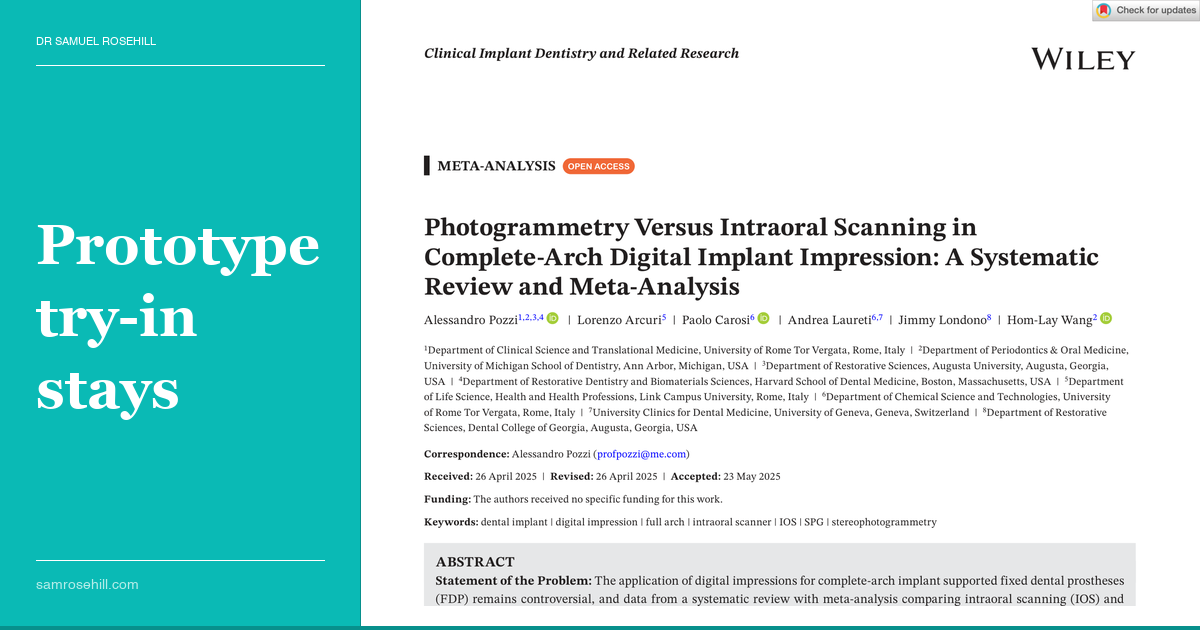
Source Paper
Photogrammetry Versus Intraoral Scanning in Complete-Arch Digital Implant Impression: A Systematic Review and Meta-Analysis
A complete-arch implant impression asks an intraoral scanner to do something unfair: find stable reference points among scan bodies, saliva, soft tissue, and a long edentulous span that gives the stitching algorithm very little to hold.
Pozzi and colleagues, in “Photogrammetry Versus Intraoral Scanning in Complete-Arch Digital Implant Impression: A Systematic Review and Meta-Analysis,” pull together the evidence on whether IOS can really manage that task as well as photogrammetry. The answer is useful because it is restrained. Photogrammetry looks more reliable. IOS still has a role. And the rigid prototype try-in has not been retired.
The Data Anchor
This PRISMA-style systematic review and meta-analysis was registered on PROSPERO (CRD42024490844) and searched the literature for studies comparing stereophotogrammetry (SPG) with intraoral scanning (IOS) in complete-arch implant impressions. Thirteen studies met inclusion criteria: 3 in vivo and 10 in vitro. They covered 7 IOS systems, 2 SPG systems, and arches restored on 4 to 8 implants. Risk of bias was assessed with QUADAS-2.
The authors then pooled in vitro data where possible, running random-effects meta-analyses for angular trueness, surface trueness, and surface precision. Heterogeneity was very high (I2 96.7% for surface trueness, 99.7% for angular trueness, and 98.0% for surface precision), so direction of effect matters more here than pretending one precise number can settle every workflow argument.
Key Findings
- Most of the included literature leaned the same way. Ten of the 13 studies found SPG more accurate than IOS for complete-arch implant impression capture.
- The pooled analyses all favoured photogrammetry. Meta-analysis showed significant differences in favour of SPG for surface trueness, surface precision, and angular trueness (
p < 0.05), with reported effect sizes of 3.426, 4.893, and 1.199 respectively. - The raw ranges are hard to ignore. SPG reported mean surface trueness of 5.18-48.74 um, surface precision of 0.10-5.46 um, and angular trueness of 0.24-0.80 degrees. IOS ranged from 14.8-67.72 um, 3.90-37.07 um, and 0.28-1.74 degrees.
- The passive-fit warning is the practical headline. Some IOS angular values crossed the 1-degree threshold often cited as a concern for passive fit, while SPG remained below that ceiling across the reported ranges.
- A useful caveat is what this review did not isolate. It did not specifically analyse horizontal scan bodies. For conventional vertical scan bodies, photogrammetry has the clearer accuracy case; the more interesting question now is whether newer horizontal or aided systems can narrow that gap.
- Clinical evidence is still the weak flank. Only 3 included studies were in vivo, and one of those reported comparable trueness, so this is not a licence to pretend the question is clinically settled in every arch, scanner, or operator’s hands.
- Photogrammetry is not a total replacement for IOS. SPG captures implant coordinates, not full soft tissue anatomy, so the sensible workflow may still combine technologies rather than stage a winner-takes-all referendum.
💡 The Clinical Bottom Line
If passive fit matters, this paper nudges the workflow toward photogrammetry for the implant-position record. IOS remains useful for soft tissues and complementary digital data, but the evidence does not support blind confidence in it as the sole coordinate capture method across a whole arch.
That said, this is not the whole modern story. The paper did not specifically look at horizontal scan bodies. Early work there is more encouraging than the old vertical-scan-body literature: some horizontal or aided systems are outperforming standard scan bodies, and one aided comparison in this review reported clinically comparable trueness to photogrammetry. Until that evidence matures, a rigid prototype try-in is not old-fashioned caution. It is good judgement.
Dr Samuel Rosehill is a general dentist with a prosthodontic focus, practising at Ethical Dental in Coffs Harbour, NSW. He holds a BDSc (Hons) from the University of Queensland, an MBA, an MMktg, and an MClinDent in Fixed & Removable Prosthodontics (Distinction) from King’s College London.
Reference: Pozzi A, Arcuri L, Carosi P et al. Photogrammetry Versus Intraoral Scanning in Complete-Arch Digital Implant Impression: A Systematic Review and Meta-Analysis. Clinical Implant Dentistry and Related Research. 2025;27:e70059. DOI: 10.1111/cid.70059
Clinical Relevance
For complete-arch implant prostheses, photogrammetry currently appears more reliable than intraoral scanning alone for implant coordinate capture. IOS still has a role for soft tissue and opposing arch data, but this review supports caution before using it as the sole record for passive-fit full-arch frameworks.
Disclosure: The author has no financial conflicts of interest related to the products or topics discussed in this review. This is an independent summary prepared for educational purposes.
Continue the conversation
This review is also published on Substack, where you can leave comments and join the discussion.
Read on Substack →