Photogrammetry Beats Intraoral Scanning for Full-Arch Implant Accuracy — and It Is Not Close
A systematic review and meta-analysis of 11 studies finds that stereophotogrammetry significantly outperforms intraoral scanning for full-arch implant impressions in precision, trueness, and angular accuracy.
Photogrammetry pulls ahead
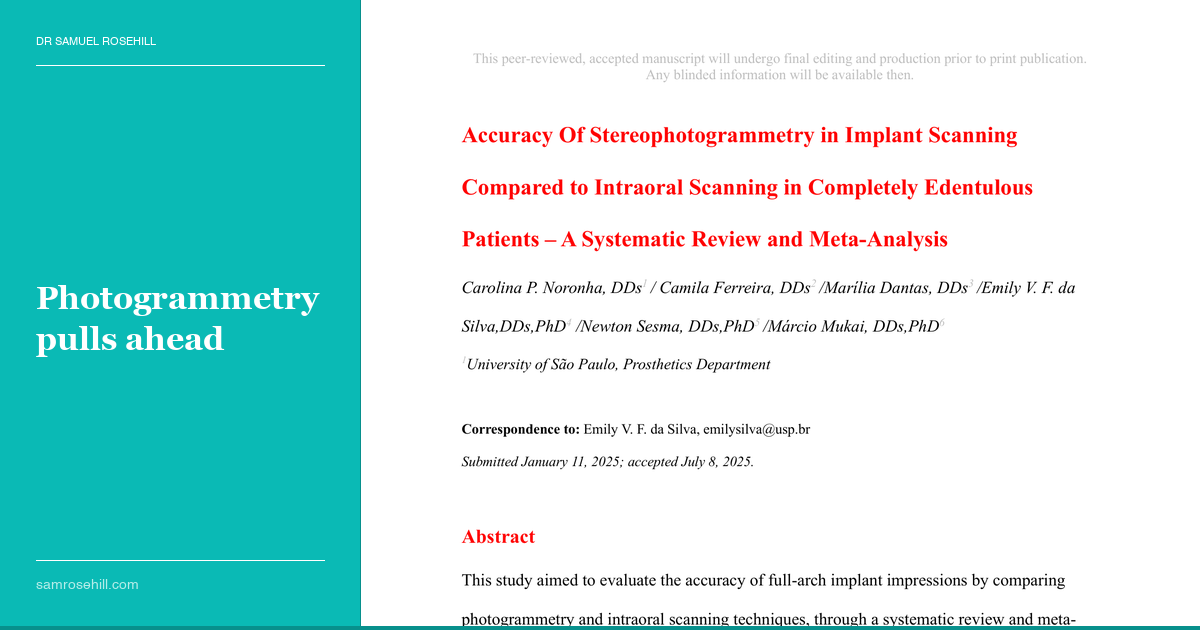
Source Paper
Accuracy Of Stereophotogrammetry in Implant Scanning Compared to Intraoral Scanning in Completely Edentulous Patients – A Systematic Review and Meta-Analysis
Digital dentistry has spent the better part of a decade promising that the intraoral scanner would eventually replace every impression tray in the building. For single crowns and short-span bridges, it has largely delivered. But ask any prosthodontist who has attempted to scan six implant positions across a fully edentulous mandible, with nothing but pink mucosa and scan bodies for the software to stitch together, and you will hear a rather different story. Noronha and colleagues from the University of São Paulo, in “Accuracy Of Stereophotogrammetry in Implant Scanning Compared to Intraoral Scanning in Completely Edentulous Patients” (The International Journal of Prosthodontics, 2025), have now quantified what many clinicians suspected: for full-arch implant work, photogrammetry is not merely competitive with intraoral scanning; it is significantly and consistently more accurate.
The Data Anchor
This systematic review and meta-analysis followed PRISMA 2020 guidelines and was registered on PROSPERO (CRD42024550336). Comprehensive searches of PubMed, Scopus, and Web of Science identified 6,348 studies, of which 11 met eligibility criteria and 7 provided sufficient quantitative data for meta-analysis. All included studies were in vitro, published between 2021 and 2024, comparing photogrammetry with intraoral scanning on full-arch implant models (4–6 implants). Accuracy was assessed across three subgroups: precision (repeatability of measurements), trueness (deviation from the reference), and angle deviation. Risk of bias was evaluated using the Quin Tool Method, with all studies rated low risk (> 75% criteria met).
Key Findings
- Photogrammetry was significantly more precise than intraoral scanning, with a mean difference of -0.03 (95% CI: -0.04, -0.02) and a commanding weight of 94.2% in the pooled analysis, indicating highly consistent evidence
- Angular accuracy also favoured photogrammetry: MD = -0.12° (95% CI: -0.16, -0.08, p < 0.00001), meaning implant position registration had less rotational error
- Trueness showed the largest absolute difference (MD = -0.16, 95% CI: -0.19, -0.13, p < 0.00001), though this subgroup carried lower overall weight (5.8%) due to fewer contributing studies
- All included studies were in vitro, conducted on PMMA, acrylic resin, or cast models rather than in the oral environment, where saliva, tongue movement, and mobile mucosa would likely amplify the intraoral scanner’s disadvantages
- Photogrammetry captures implant positions only, not soft tissue anatomy. It must be combined with an intraoral scan to obtain gingival contours, meaning it is a complementary tool rather than a standalone replacement
- The IOS accuracy limitation is structural: edentulous arches provide few unique data points for image stitching, and the greater the span, the more cumulative error compounds
- Limitation: no clinical outcome data. The meta-analysis establishes dimensional superiority, but does not link this to prosthesis fit or complication rates
The fundamental problem with scanning an edentulous arch is that there is almost nothing there to scan. Photogrammetry sidesteps this entirely by capturing discrete optical markers rather than continuous surface geometry, which is why it thrives exactly where intraoral scanners struggle.
💡 The Clinical Bottom Line
For clinicians delivering full-arch implant prostheses, this meta-analysis provides the clearest evidence yet that photogrammetry should be the primary method for registering implant positions in edentulous arches. The precision advantage is statistically significant and clinically meaningful: cumulative stitching errors across a full arch can be the difference between a passively fitting framework and one that induces strain on every screw. The practical workflow combines a photogrammetric scan for implant positions with an intraoral scan for soft tissue and opposing arch; the two datasets merge in CAD software. It is one extra step, but for the case type where accuracy matters most, the evidence now says it is worth taking.
Dr Samuel Rosehill is a general dentist with a prosthodontic focus, practising at Ethical Dental in Coffs Harbour, NSW. He holds a BDSc (Hons) from the University of Queensland, an MBA, an MMktg, and an MClinDent in Fixed & Removable Prosthodontics (Distinction) from King’s College London.
Reference: Noronha CP, Ferreira C, Dantas M, et al. Accuracy Of Stereophotogrammetry in Implant Scanning Compared to Intraoral Scanning in Completely Edentulous Patients – A Systematic Review and Meta-Analysis. Int J Prosthodont. 2025. doi:10.11607/ijp.9358
Clinical Relevance
For full-arch implant cases in edentulous patients, photogrammetry should be considered the more accurate digital impression method — intraoral scanners remain useful for soft tissue capture but should not be relied upon alone for implant position registration.
Disclosure: The author has no financial conflicts of interest related to the products or topics discussed in this review. This is an independent summary prepared for educational purposes.
Continue the conversation
This review is also published on Substack, where you can leave comments and join the discussion.
Read on Substack →