Preheating Composite for Bonding: The Assumption the Evidence Doesn't Support
A 2025 systematic review of nine laboratory studies finds that preheating composite resin for adhesive bonding consistently worsens marginal adaptation — the very property it was expected to improve — while offering no consensus benefit across microhardness, shear strength, film thickness, or viscosity.
Evidence doesn't support it
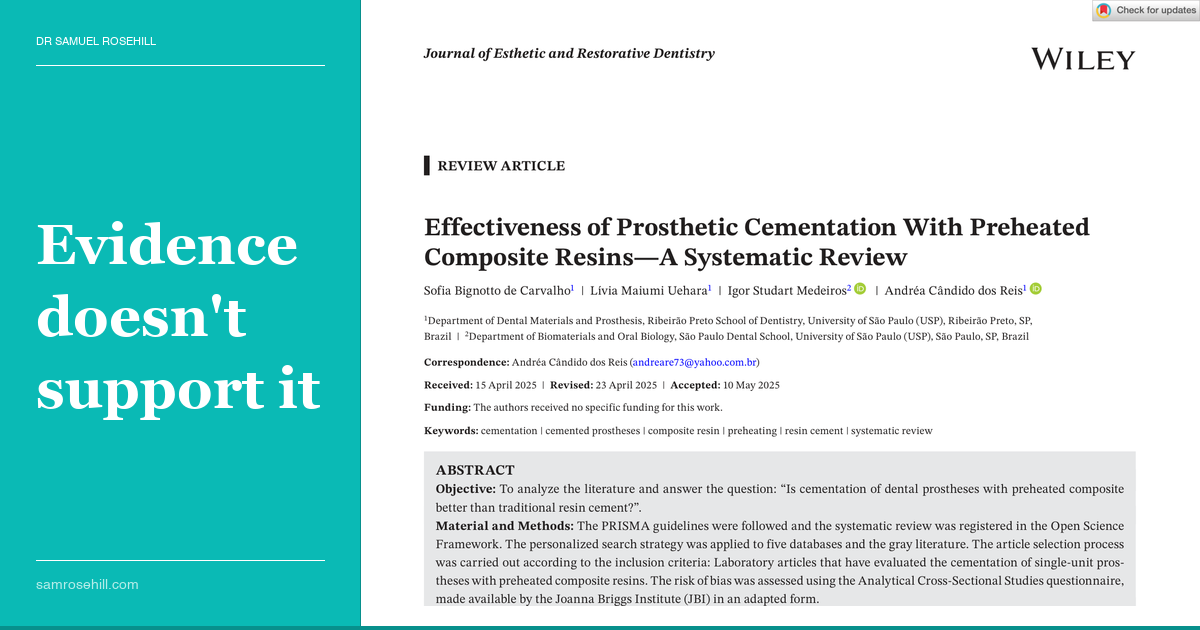
Source Paper
Effectiveness of Prosthetic Cementation With Preheated Composite Resins—A Systematic Review
Preheating composite resin before bonding a crown is, by now, a settled clinical habit. The logic sells itself: heat the material, lower its viscosity, thin the film, improve the marginal seal. Clinicians adopted it; courses promoted it. “Effectiveness of Prosthetic Cementation With Preheated Composite Resins — A Systematic Review,” published in the Journal of Esthetic and Restorative Dentistry in 2025 by de Carvalho, Uehara, Medeiros, and dos Reis (University of São Paulo), asks whether any of that holds up. The answer, offered with academic politeness but genuine inconvenience, is: not particularly.
The most pointed finding involves marginal adaptation — the single outcome that most directly justifies the technique. Every study that measured it found the opposite of what was predicted. Preheated composite produced significantly worse margins. That is not a nuanced result. It is the central argument, politely excused as “further research is required.”
The Data Anchor
The review followed PRISMA 2020 guidelines across five databases (Embase, LILACS, PubMed, Science Direct, Scopus) plus grey literature. From 1,549 candidates, nine met eligibility: all laboratory studies evaluating single-unit prosthetic cementation with preheated composite resins. Risk of bias was assessed using the Joanna Briggs Institute’s Analytical Cross-Sectional Studies checklist; all nine presented low overall risk. Meta-analysis was not conducted, given heterogeneity in materials, protocols, and preheating temperatures (55°C to 69°C).
The synthesis covered eight outcome domains: marginal adaptation, film thickness, viscosity, degree of conversion, microhardness, shear and tensile strength, failure load, and colour stability.
Key Findings
- Marginal adaptation: consistently impaired. Both studies that measured it (Alajrash & Kassim, 2020; Mounajjed et al., 2018) found significantly greater discrepancy with preheated composite. Alajrash & Kassim: 87.82 ± 1.26 μm preheated versus 38.53 ± 0.63 μm for fluid composite. Mounajjed et al.: 116 ± 47 μm preheated versus 42 ± 11 μm and 45 ± 29 μm for two resin cements. Both gaps exceed the clinically acceptable range.
- Viscosity: no reliable reduction. Coelho et al. (2019) observed decreases of 42–94% by brand; Ferreira et al. (2022) found no reduction at all. Same intervention, opposite results, different resins.
- Film thickness: mixed. Two studies found no significant change; Tomaselli et al. (2019) found preheating reduced thickness in conventional composite. The mechanism did not operate consistently.
- Mechanical properties: no clear pattern. Microhardness and shear strength were unchanged in the studies that measured them. Tensile strength improved for some preheated resins; failure load was material-dependent and heterogeneous across three studies.
- Colour stability: the one clear advantage. Two of three studies found less colour change with preheated composites, attributed to lower tertiary amine content in thinner films.
- Degree of conversion: maintained. Four studies found no significant change; the material polymerises adequately.
- Limitation: all nine studies are in vitro, with heterogeneous protocols and no standardised preheating method.
“Preheating the composite resin resulted in significantly greater marginal discrepancy” — Mounajjed et al., 2018; confirmed independently by Alajrash & Kassim, 2020.
💡 The Clinical Bottom Line
The theoretical chain (heat, flow, seal) reads better than it performs. Marginal adaptation, the property that most directly determines bonded-crown longevity, was worse in every study that measured it. The colour stability and degree-of-conversion findings are reassuring; they are not the reason anyone adopted this technique.
This does not mean preheating is useless. Some materials respond; some clinicians use products designed for it. What the review makes clear is that “preheated composite” is not a category with predictable properties; responses vary by brand, filler composition, temperature, and protocol in ways the current evidence cannot untangle.
The warm syringe is not the problem. The premise is.
Dr Samuel Rosehill is a general dentist with a prosthodontic focus, practising at Ethical Dental in Coffs Harbour, NSW. He holds a BDSc (Hons) from the University of Queensland, an MBA, an MMktg, and an MClinDent in Fixed & Removable Prosthodontics (Distinction) from King’s College London.
Clinical Relevance
Every study that measured marginal adaptation found significantly greater marginal discrepancy with preheated composite resin compared to conventional resin cement — in one study, the preheated group produced gaps of 87.82 μm against 38.53 μm for fluid composite. The rationale for preheating (lower viscosity → thinner film → better fit) was not borne out. Viscosity, film thickness, shear strength, and failure load results were inconsistent across studies. Preheated composites may offer colour stability advantages, and degree of conversion was not impaired. Until standardised protocols and materials designed for preheating exist, the routine substitution of preheated composite for conventional resin cement in single-unit cementation is not supported by the available evidence.
Disclosure: The author has no financial conflicts of interest related to the products or topics discussed in this review. This is an independent summary prepared for educational purposes.
Continue the conversation
This review is also published on Substack, where you can leave comments and join the discussion.
Read on Substack →