The $2 Fix for Scanning Edentulous Arches
Flowable composite resin markers placed between scan bodies significantly improve intraoral scanning accuracy for edentulous mandibular arches, offering a simple, low-cost enhancement to digital implant workflows.
Flowable composite fixes scanning
Source Paper
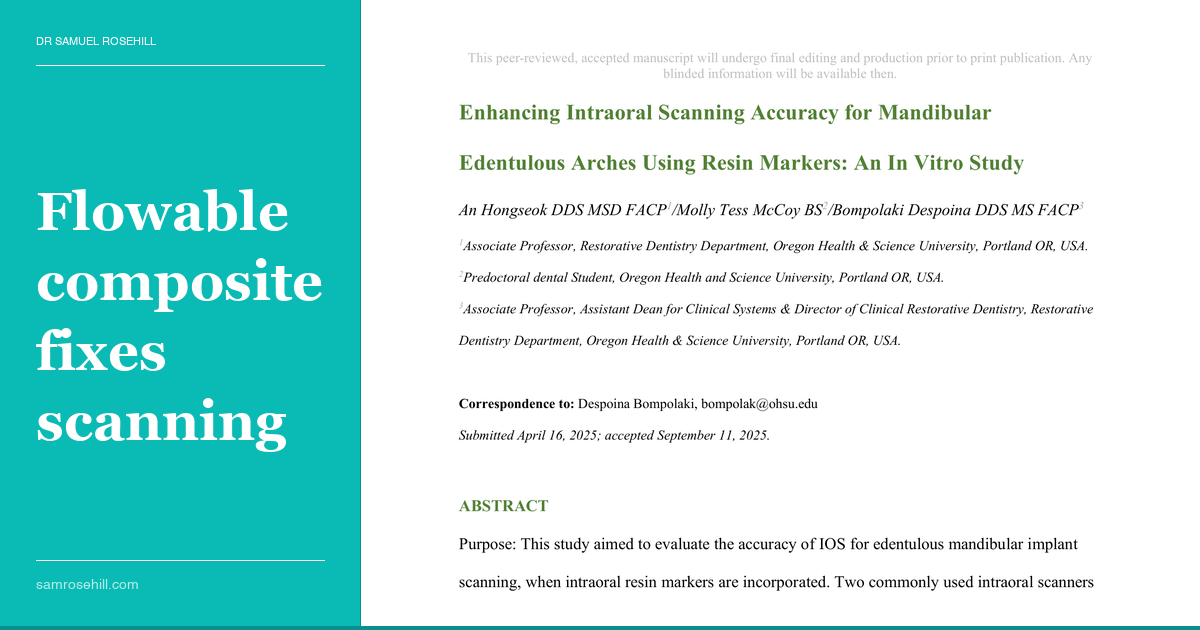
Enhancing Intraoral Scanning Accuracy for Mandibular Edentulous Arches Using Resin Markers: An In Vitro Study
“I just squirt a bit of flowable on the ridge before I scan. Honestly, it’s the best trick nobody taught me.”
The remark came from a prosthodontist at a conference registration desk, coffee in one hand, Trios4 tip cap in the other, and it turns out the intuition has data behind it. Hongseok, McCoy, and Bompolaki from Oregon Health & Science University have tested exactly this idea in Enhancing Intraoral Scanning Accuracy for Mandibular Edentulous Arches Using Resin Markers: An In Vitro Study, published in the International Journal of Oral and Maxillofacial Implants. The paper lands squarely on a problem every clinician scanning an edentulous mandible has felt in their bones: the scanner stalls, the stitching drifts, and the final file looks like it was assembled by committee.
The Data Anchor
The team fabricated a mandibular study model housing four Straumann multi-unit abutments (canine and first molar positions bilaterally), complete with a rubber-dam-and-metal-frame arrangement designed to simulate movable, unattached mucosa. That last detail matters; most bench studies use rigid stone models that flatter digital workflows by removing the very tissue behaviour that causes registration errors in vivo.
Sixty intraoral scans were captured: 30 with Trios4 (3Shape) and 30 with Primescan (Dentsply Sirona), split evenly into 15 scans without markers and 15 with S-shaped flowable composite resin markers (Filtek Supreme Flowable, 3M) light-cured onto the ridge crest between scan bodies. A further 15 indirect digitisations (splinted open-tray impressions, stone models, laboratory-scanned on a 3Shape E4) served as control. All STL files were superimposed against a high-accuracy reference scan in Geomagic Control (alpha = 0.05).
Key Findings
- Indirect digitisation still wins on trueness. The conventional splinted-impression pathway returned the lowest RMS (23.2 um), confirming its status as the accuracy benchmark for complete-arch implant scanning.
- Resin markers transformed Trios4 accuracy. Trueness RMS dropped from 165.5 um to 52.1 um, and precision RMS plummeted from 215.4 um to 52.5 um, making the improved Trios4 statistically indistinguishable from Primescan and from indirect digitisation on precision.
- Primescan benefited too, but less dramatically. Precision improved significantly (85.2 um to 53.0 um), though trueness remained statistically unchanged (64.3 um vs 53.8 um), likely because Primescan’s larger tip already captures sufficient anatomical data for reliable stitching.
- The markers are trivially simple. Flowable composite squirted and light-cured in S-shapes between scan bodies on dried, attached mucosa. No special equipment; no lab-fabricated aids.
- The honest limitation: this is an in vitro study on a single model, with a rubber-dam mucosa simulation that (while cleverer than most) does not replicate saliva, tongue movement, or patient compliance. No prosthesis fit was assessed, so improved scan accuracy does not yet equal improved clinical outcomes.
The edentulous mandible is the scanner’s nightmare: featureless mucosa, mobile tissue, and nothing for the stitching algorithm to grab onto. Giving it something to grab, even a squiggle of flowable composite, turns out to be remarkably effective.
💡 The Clinical Bottom Line
If you are scanning edentulous mandibular arches with a Trios4, adding flowable composite markers between scan bodies is close to a free lunch; it costs pennies, takes seconds, and in this model reduced scanning error by roughly two-thirds. Primescan users will see a smaller but still meaningful improvement in scan consistency. Conventional splinted impressions remain the gold standard for now, but the gap just got a good deal narrower — and the bridge was built with a syringe of flowable composite you already have in your drawer.
Dr Samuel Rosehill is a general dentist with a prosthodontic focus, practising at Ethical Dental in Coffs Harbour, NSW. He holds a BDSc (Hons) from the University of Queensland, an MBA, an MMktg, and an MClinDent in Fixed & Removable Prosthodontics (Distinction) from King’s College London.
Reference: Hongseok A, McCoy MT, Bompolaki D. Enhancing Intraoral Scanning Accuracy for Mandibular Edentulous Arches Using Resin Markers: An In Vitro Study. Int J Oral Maxillofac Implants. 2025. DOI: 10.11607/jomi.11396
Clinical Relevance
Simple flowable composite resin markers placed between scan bodies on the edentulous mandibular ridge can significantly improve intraoral scanning trueness and precision, particularly for Trios4, narrowing the accuracy gap with conventional splinted impressions.
Disclosure: The author has no financial conflicts of interest related to the products or topics discussed in this review. This is an independent summary prepared for educational purposes.
Continue the conversation
This review is also published on Substack, where you can leave comments and join the discussion.
Read on Substack →