Your Metal Sleeves Might Be Making Your Surgical Guides Worse
Ballesteros et al. compare 3D-printed and milled surgical guides with and without metal sleeves — and find that sleeveless guides consistently outperform sleeved ones for implant placement accuracy.
Ditch the metal sleeves
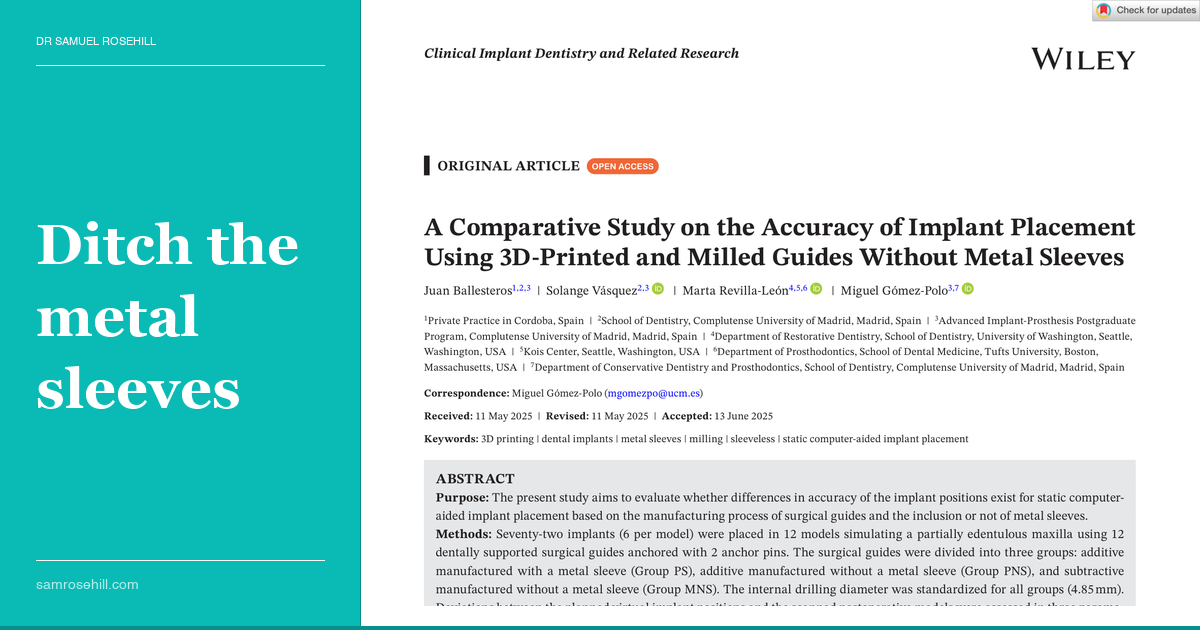
Source Paper
A Comparative Study on the Accuracy of Implant Placement Using 3D-Printed and Milled Guides Without Metal Sleeves
If you have spent any time with static computer-aided implant surgery, you will have encountered the metal sleeve — that small, reassuringly solid cylinder pressed into the guide hole, through which the drill passes with what feels like mechanical certainty. The sleeve is there to control the drill trajectory, to provide a hard interface between resin and tungsten carbide, and to generally make everyone in the room feel that precision is being taken seriously.
Ballesteros and colleagues, in a study published in Clinical Implant Dentistry and Related Research, tested whether that feeling is warranted — and the answer is, to put it gently, awkward for the sleeve.
The Data Anchor
Seventy-two implants (Alpha Bio, 3.75 × 11.5 mm) were placed across 12 3D-printed models simulating a partially edentulous maxilla, using three types of surgical guides: 3D-printed with metal sleeves (PS, n = 24), 3D-printed without metal sleeves (PNS, n = 24), and milled without metal sleeves (MNS, n = 24). All guides were designed in the same planning software (Implant Studio, 3Shape) with identical implant positions.
The internal drilling diameter was standardised at 4.85 mm across all groups. After placement, implant positions were digitised via desktop scanner and scan bodies, then superimposed on the virtual reference model using best-fit alignment in ExoCAD and SolidWorks to calculate 3D deviations at the crest, apex, and angular deviations.
Key Findings
- Sleeveless guides were more accurate across the board: The milled sleeveless group (MNS) recorded the smallest median crestal 3D deviation (0.498 mm) and apical 3D deviation (0.544 mm), while the sleeved group (PS) recorded the largest — 1.028 mm and 1.360 mm respectively (p = 0.000 for both).
- Metal sleeves worsened angular accuracy: The 3D-printed sleeveless guides (PNS) achieved a median angular deviation of just 1.44°, significantly better than both the milled sleeveless (2.90°, p = 0.022) and sleeved (3.88°, p = 0.000) groups. Removing the sleeve appears to eliminate a tolerance stack-up between drill, sleeve, and guide.
- 3D-printed vs milled was largely a draw: No significant differences were found between PNS and MNS for 3D deviations at either crest or apex. The only divergence was angular deviation, where the printed sleeveless guides outperformed the milled ones.
- The lateral axis was the problem child: The PS group showed its greatest deviations in the lateral (X) axis at both crestal (median 0.533 mm) and apical (median 0.884 mm) levels — roughly double the sleeveless groups — suggesting the sleeve introduces lateral play rather than eliminating it.
- Limitation: This is an in vitro study on resin models with a single implant system and a single operator. The standardised drilling diameter across groups means the results reflect the sleeve’s geometric contribution specifically, but clinical variables (bone density, guide stability, flap vs flapless) remain untested.
💡 The Clinical Bottom Line
The metal sleeve has been treated as a necessary component of guided implant surgery for so long that questioning it feels faintly heretical. But the physics here is straightforward:
Every interface between drill and bone is a potential source of deviation — and the sleeve adds an interface.
When the guide body itself — whether printed or milled — can control the drill path with a standardised hole diameter, the sleeve becomes not a precision enhancer but a precision liability. This does not mean you should bin your sleeved kits tomorrow (the authors are careful to note that in vitro models lack the chaos of real anatomy), but it does mean the next time you are designing a guide, the option to go sleeveless deserves more than a dismissive click past.
Dr Samuel Rosehill is a general dentist with a prosthodontic focus, practising at Ethical Dental in Coffs Harbour, NSW. He holds a BDSc (Hons) from the University of Queensland, an MBA, an MMktg, and an MClinDent in Fixed & Removable Prosthodontics (Distinction) from King’s College London.
Reference: https://doi.org/10.1111/cid.70072
Clinical Relevance
Sleeveless surgical guides — whether 3D-printed or milled — delivered more accurate implant placement than guides with metal sleeves in this in vitro model. Clinicians using static guided surgery may achieve better outcomes by eliminating metal sleeves and relying on the guide body alone for drill guidance.
Disclosure: The author has no financial conflicts of interest related to the products or topics discussed in this review. This is an independent summary prepared for educational purposes.
Continue the conversation
This review is also published on Substack, where you can leave comments and join the discussion.
Read on Substack →