The Healing Abutment You've Already Used Three Times Is Harbouring Bacteria
Reused healing abutments develop surface roughness, protein contamination, and microgaps averaging 43 µm — creating conditions for bacterial leakage that sterile components avoid entirely. A tightening torque of 15 N·cm largely eliminates the gap, but the fundamental case for single-use remains.
Reuse raises infection risk
Source Paper
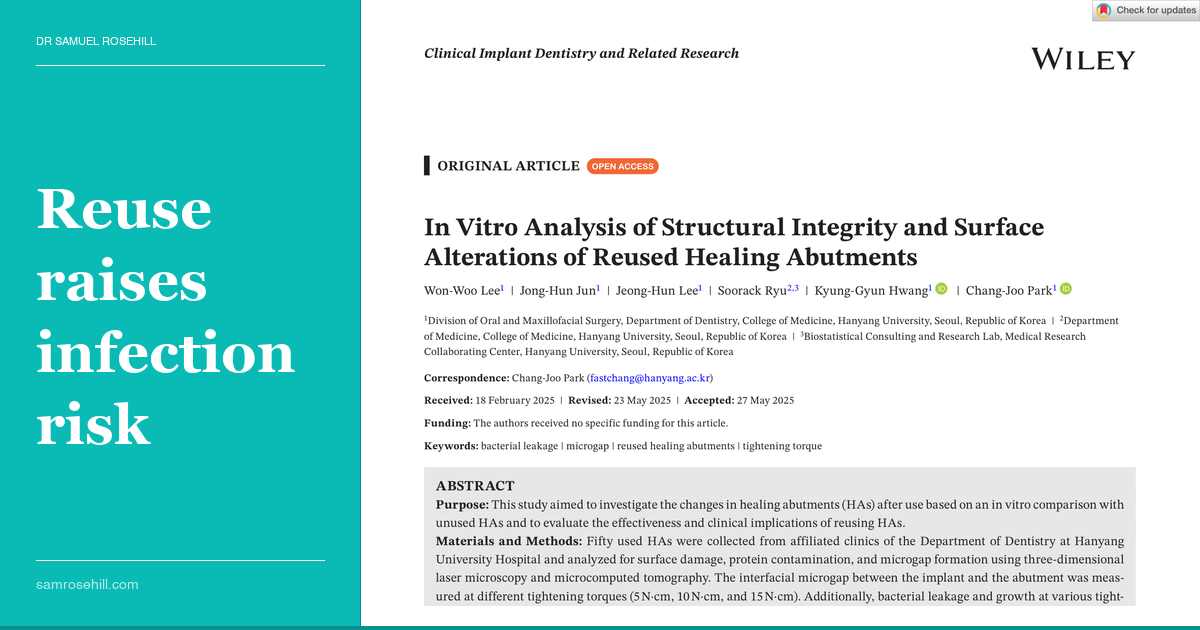
In Vitro Analysis of Structural Integrity and Surface Alterations of Reused Healing Abutments
Somewhere in most dental practices there is a small container holding a healing abutment that has been used, autoclaved, and is waiting to go back in. Considered routine. Lee, Jun, Lee, Ryu, Hwang and Park from Hanyang University in Seoul looked inside that container with three-dimensional laser microscopy and microcomputed tomography. Their paper “In Vitro Analysis of Structural Integrity and Surface Alterations of Reused Healing Abutments” does not produce a surprising conclusion so much as a documented one. The distinction matters.
The Data Anchor
Fifty used healing abutments (all Osstem TSHA505R) were collected from affiliated clinics, each having undergone up to three sterilisation cycles over approximately one year following 3-6 months of intraoral use. They were cleaned in 70% ethanol in an ultrasonic bath, sealed in sterilisation pouches, and autoclaved in a Class A autoclave at 121°C (the standard protocol). Microgap at the implant-abutment interface was measured at three tightening torques (5 N·cm, 10 N·cm, and 15 N·cm), and bacterial leakage assessed over 96 hours using Escherichia coli.
Surface roughness in reused abutments averaged 0.477 µm against 0.209 µm in unused ones. Protein contamination ranged from 51 to 1,471 µg/mL on reused components; unused abutments showed none. The average microgap for reused healing abutments was 43 µm; unused abutments showed no detectable microgap. Reused abutments demonstrated significantly higher bacterial leakage over time (p < 0.001), and the number of tightening-loosening cycles correlated directly with leakage extent (p = 0.002).
Key Findings
- Surface damage was widespread: of 50 reused abutments, 32 showed scratches, 8 showed breakage, 35 showed corrosion, and 17 had organic remnants (several exhibiting multiple damage types). Unused abutments were pristine.
- Protein contamination survived the autoclave, ranging from 51 to 1,471 µg/mL. Sterilisation eliminates viable organisms but cannot remove residual biological material; this protein load is a plausible driver of peri-implant inflammation even in the absence of live bacteria.
- The microgap-torque relationship is clinically actionable: at 5 N·cm the average gap was 20.5 µm; at 10 N·cm it fell to 13.4 µm; at 15 N·cm it was essentially eliminated. Bacterial growth in the 5 N·cm group peaked at 10⁴ × 10⁶ CFU/implant; the 15 N·cm group showed minimal leakage (p < 0.001).
- Two tightening-loosening cycles is the inflection point: one cycle produced leakage comparable to the negative control. Beyond two, leakage escalated significantly. This matters for one-stage implant protocols, where at least two cycles are standard.
- Limitation: only E. coli was tested; the oral microbiome is polymicrobial. Usage histories varied across the 50 abutments, and the small sample limits generalisability.
The 43 µm average microgap in reused abutments is not a measurement artefact — it is a channel. Scarano et al., in a 16-year study of 272 loaded human titanium implants, recorded a mean microgap of 61.3 µm in screw-retained abutments. The gap found here in unloaded healing abutments, after nothing more dramatic than repeated sterilisation, sits in the same order of magnitude.
💡 The Clinical Bottom Line
If you are reusing healing abutments, torque them to at least 15 N·cm with a mechanical device rather than hand-tightening, where interindividual variability is high and the resulting force is almost certainly less than you think. This eliminates the microgap and reduces bacterial leakage, even if it cannot undo what the autoclave leaves behind.
The more direct message is that the case for single-use has now been measured in microns and colony-forming units. The 43 µm gap, the protein load surviving the autoclave, the leakage that climbs after two cycles — none of these are hypothetical. They are in vitro findings with the usual caveats, but they describe what happens to a real component in a real clinic when the economics of dentistry nudge us toward a decision the biology does not endorse.
Dr Samuel Rosehill is a general dentist with a prosthodontic focus, practising at Ethical Dental in Coffs Harbour, NSW. He holds a BDSc (Hons) from the University of Queensland, an MBA, an MMktg, and an MClinDent in Fixed & Removable Prosthodontics (Distinction) from King’s College London.
Clinical Relevance
Fifty reused healing abutments collected from real clinical settings showed surface roughness nearly double that of unused components, protein contamination up to 1,471 µg/mL, and an average microgap of 43 µm — enough to permit significant bacterial leakage. Tightening to 15 N·cm eliminated the gap and substantially reduced contamination, but could not reverse surface damage or protein load. Clinicians should limit healing abutment reuse and, when reuse is unavoidable, torque to at least 15 N·cm with a mechanical device.
Disclosure: The author has no financial conflicts of interest related to the products or topics discussed in this review. This is an independent summary prepared for educational purposes.
Continue the conversation
This review is also published on Substack, where you can leave comments and join the discussion.
Read on Substack →