The Pontic Was Planned Before the Socket Collapsed
Couso-Queiruga and colleagues compared alveolar ridge preservation with unassisted socket healing for pontic site development, finding less pontic modification and less horizontal ridge reduction after preservation.
Preserve the pontic site
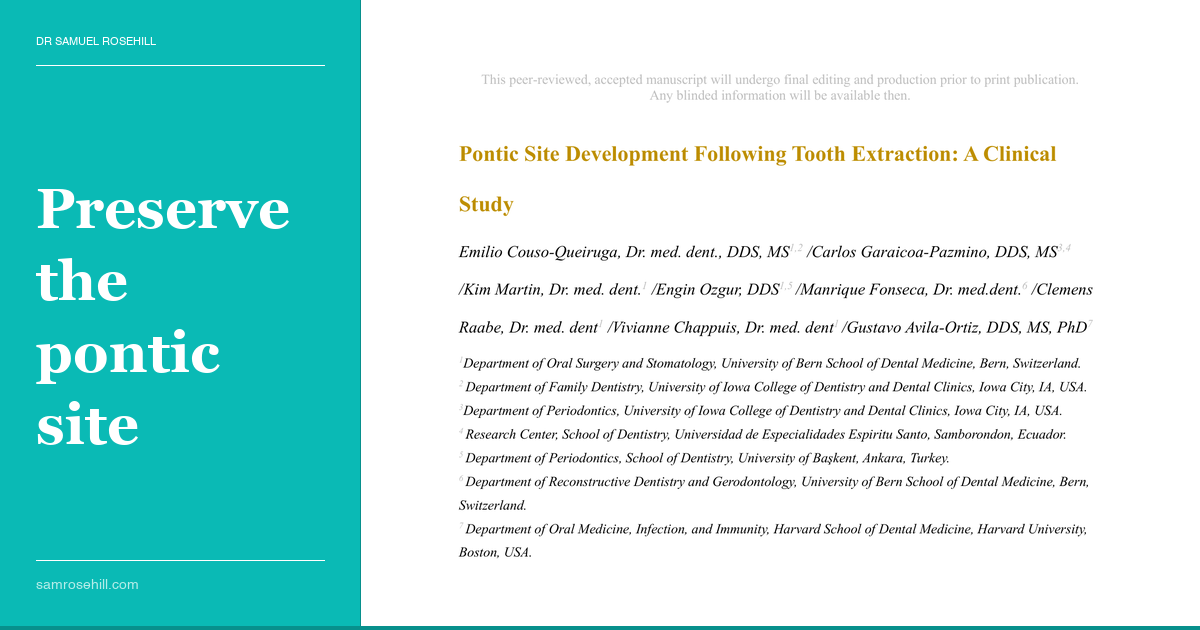
Source Paper
Pontic Site Development Following Tooth Extraction: A Clinical Study
A pontic is one of dentistry’s more optimistic acts of imagination. We design a tidy oval form, ask the soft tissue to behave like architecture, and then extract the tooth from underneath it, which is not usually how architecture prefers to be treated. Couso-Queiruga and colleagues’ Pontic Site Development Following Tooth Extraction: A Clinical Study asks whether alveolar ridge preservation helps that original pontic design survive the biological reality show that follows extraction.
The answer is useful because it is not grand. Preservation did not make every ridge look untouched, nor did it abolish the need for soft tissue augmentation. But it did mean less collapse, less redesign, and less horizontal loss than unassisted socket healing.
The Data Anchor
The study compared 88 non-molar maxillary extraction sites, split evenly between alveolar ridge preservation (ARP, n = 44) and unassisted socket healing (USH, n = 44). Baseline facial bone thickness was measured by CBCT, and the investigators digitally designed an ideal pontic before extraction using a surface scan. Final scans were then superimposed to measure how much the real ridge forced that ideal pontic to be modified.
In the ARP group, vertical pontic collapse measured 1.14 ± 0.50 mm mesially, 1.47 ± 0.53 mm mid-facially, and 1.24 ± 0.59 mm distally. In the USH group, collapse was greater: 2.27 ± 1.07 mm, 2.20 ± 0.73 mm, and 2.17 ± 0.83 mm, respectively (P < .001).
Horizontal ridge reduction was also smaller after ARP: -1.42 ± 0.68 mm at 2 mm apical and -0.95 ± 0.52 mm at 4 mm apical, compared with -1.87 ± 0.63 mm and -1.26 ± 0.58 mm after USH.
Key Findings
- ARP protected the original restorative plan. Sites that healed without preservation required significantly more vertical pontic modification in the mesial, mid-facial, and distal regions.
- Horizontal ridge loss was reduced, not eliminated. The ARP group still lost contour, but less than the USH group at both 2 mm and 4 mm apical landmarks.
- Soft tissue grafting remained on the table. Soft tissue augmentation was deemed necessary in 46.5% of ARP sites and 70.5% of USH sites (P = .06).
- Facial bone thickness was the spoiler. Thinner baseline facial bone was strongly associated with more pontic modification, greater ridge reduction, and higher soft tissue augmentation need.
- The caveat is study design. This was a comparative clinical study, not a randomised trial, so the findings guide planning rather than proving a universal treatment rule.
💡 The Clinical Bottom Line
For anterior and premolar pontic sites, alveolar ridge preservation is not only an implant conversation. It is a restorative conversation conducted before the ridge starts negotiating with physics.
The practical lesson is to design the pontic before extraction, measure the facial bone, and treat thin facial bone as a warning sign. Socket preservation may not give you the final contour for free, but it can keep the restorative problem smaller, neater, and less theatrical.
Dr Samuel Rosehill is a general dentist with a prosthodontic focus, practising at Ethical Dental in Coffs Harbour, NSW. He holds a BDSc (Hons) from the University of Queensland, an MBA, an MMktg, and an MClinDent in Fixed & Removable Prosthodontics (Distinction) from King’s College London.
Clinical Relevance
For non-molar maxillary pontic sites, alveolar ridge preservation reduced the amount of post-extraction pontic redesign and horizontal ridge contour loss compared with unassisted socket healing. Thin facial bone thickness remained a strong predictor of collapse and soft tissue augmentation need. Preservation helps the restorative plan survive extraction, but it does not remove the possible need for later soft tissue grafting.
Disclosure: The author has no financial conflicts of interest related to the products or topics discussed in this review. This is an independent summary prepared for educational purposes.
Continue the conversation
This review is also published on Substack, where you can leave comments and join the discussion.
Read on Substack →