Four Ways to Hide What a Tooth Is Hiding: CAD-CAM Ceramics for Discoloured Teeth
Hongseok An at Oregon Health & Science University outlines four distinct shade-masking strategies for CAD-CAM ceramic restorations on discoloured teeth, from opaque monolithic zirconia with external staining to a bi-layered zirconia-lithium disilicate 'CAD-on' construction, each balancing masking power against the illusion of translucency.
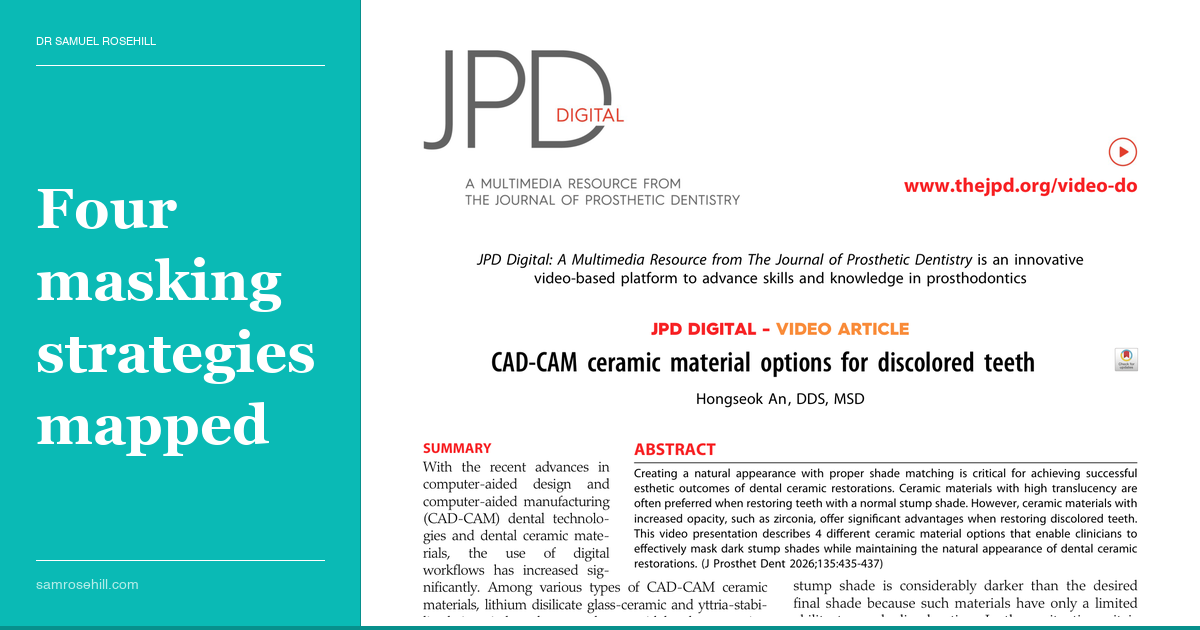
Four masking strategies mapped
Source Paper
CAD-CAM ceramic material options for discolored teeth
The word “enamel” traces back through Old French esmail to a Germanic root meaning “to smelt” — borrowed by medieval jewellers for the vitreous coatings they fused onto metal. Dentistry inherited the term for the hardest biological tissue in the human body, then spent three decades working out how to replicate it in a milled ceramic block.
The problem is that real enamel is translucent; it picks up and transmits the colour of the dentine beneath it. When that dentine is dark (stained by tetracycline, old amalgam seepage, or root canal treatment), translucency becomes a liability rather than an asset.
Hongseok An, Associate Professor at Oregon Health & Science University, addresses this directly in “CAD-CAM ceramic material options for discolored teeth,” published in The Journal of Prosthetic Dentistry in 2026. The article presents four distinct shade-masking strategies for CAD-CAM ceramic restorations on discoloured teeth, each illustrated with a clinical case. No randomised trial, no pooled data; just a systematic walk through the material options. The value is in the taxonomy.
The Data Anchor
The four strategies sit on a spectrum from maximal masking to maximal aesthetics, and the choice turns on how far the stump shade departs from the desired final shade.
The first uses a monolithic zirconia restoration from 3Y-ZR or 3/4Y-ZR combined with opaque resin cement: the most powerful masking option in the CAD-CAM toolkit. Meticulous external staining and glazing are needed to simulate translucency, and patient selection is essential given the material’s opacity.
The second addresses the middle ground: a monolithic crown from more translucent 5Y-ZR, with an opaque liquid colouring agent applied to the intaglio surface before sintering. The material’s translucency is preserved facially; the dark stump is neutralised from within.
The intaglio opaque technique is the kind of engineering compromise that looks obvious in retrospect and requires a journal article to properly appreciate.
The third moves to the implant context, where the restoration must contend with a titanium or gold-hued custom abutment. An’s approach: an opaque 3Y-ZR framework with facial cutback, with veneering ceramic hand-layered to build the desired shade. More technique-sensitive; more control.
The fourth is a bi-layered “CAD-on” construction: a 0.5–0.7 mm opaque 3Y-ZR coping over which a milled lithium disilicate crown is precisely fitted and bonded after external staining. Published data cited by An suggests this delivers acceptable marginal accuracy, improved mechanical strength, and superior masking compared with lithium disilicate alone.
Key Findings
- Translucency and masking exist in direct tension. The more translucent the ceramic, the better the aesthetic potential on a normal stump; the more opaque, the greater the masking capacity. Material selection is a triage decision.
- 3Y-ZR with opaque resin cement is the maximum masking option. External staining can simulate translucency, but careful patient selection is a prerequisite.
- The internal opaque technique preserves 5Y-ZR’s optical character, masking from within without overriding the material’s natural appearance.
- The CAD-on bi-layer combines zirconia’s masking with lithium disilicate’s surface aesthetics. Supporting literature documents acceptable marginal fit and load-bearing capacity.
- Limitation: This is a video article presenting clinical cases, not a comparative trial. The strategies are evidence-informed but not evidence-ranked; no quantitative shade outcome data are reported.
💡 The Clinical Bottom Line
The real question when restoring a discoloured tooth is not “what shade should I prescribe?” but “how much light am I willing to let through?” An’s framework is a practical decision tree: assess the severity of discolouration, work through the material options, and select the masking approach the situation requires.
For most cases, the internal opaque technique on 5Y-ZR will be the workable middle ground. The full opaque zirconia option and the CAD-on bi-layer are reserved for substrates where the stump shade has exhausted the alternatives. The medieval jewellers who named enamel understood the core principle: fire can transform a surface, but it cannot change what lies beneath.
Dr Samuel Rosehill is a general dentist with a prosthodontic focus, practising at Ethical Dental in Coffs Harbour, NSW. He holds a BDSc (Hons) from the University of Queensland, an MBA, an MMktg, and an MClinDent in Fixed & Removable Prosthodontics (Distinction) from King’s College London.
Clinical Relevance
An describes four CAD-CAM ceramic strategies for masking dark stump shades: monolithic 3Y-ZR with external staining; translucent 5Y-ZR with an internal opaque colouring agent; an opaque 3Y-ZR framework with facial veneering on implant restorations; and a bi-layered CAD-on construction pairing an opaque zirconia coping with a milled lithium disilicate crown. Material selection should be guided by the degree of stump shade discolouration, with opaque zirconia frameworks reserved for the most demanding masking situations.
Disclosure: The author has no financial conflicts of interest related to the products or topics discussed in this review. This is an independent summary prepared for educational purposes.
Continue the conversation
This review is also published on Substack, where you can leave comments and join the discussion.
Read on Substack →