Digital Impressions Outperform Conventional for RPD Frameworks — Especially Where It Counts
A clinical study from Yonsei University comparing removable partial denture frameworks fabricated via intraoral scanning versus conventional impression methods finds intraoral scanning delivers significantly better rest-seat accuracy, with the advantage most pronounced at the terminal abutments of distal-extension cases.
Digital edges ahead clinically
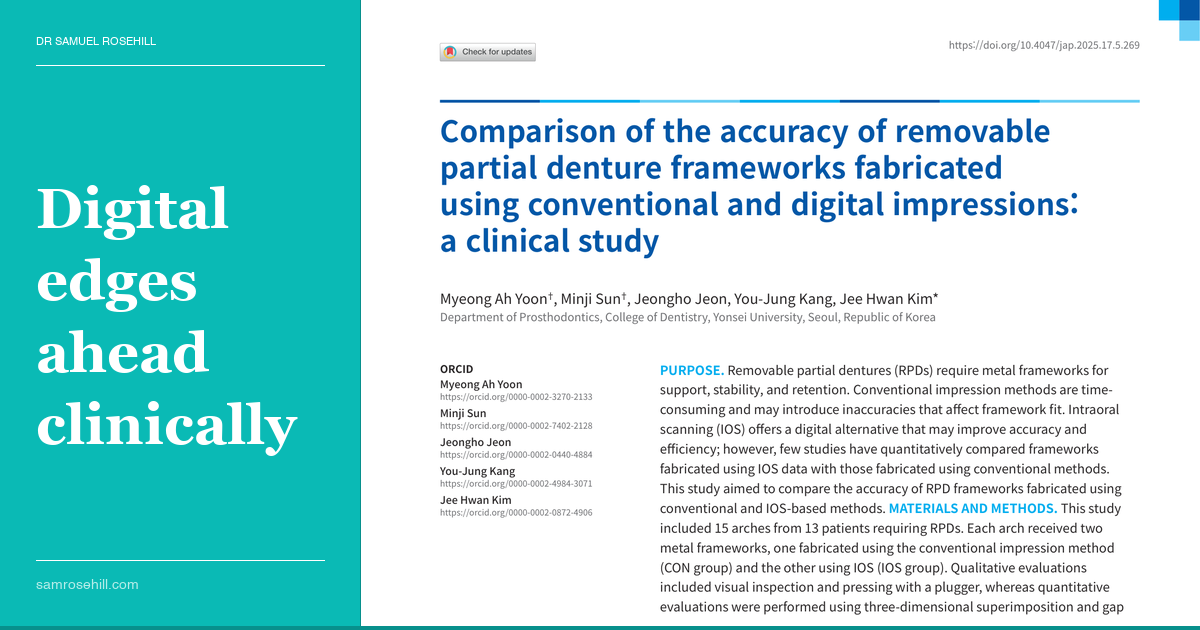
Source Paper
Comparison of the accuracy of removable partial denture frameworks fabricated using conventional and digital impressions: a clinical study
“‘Just take a conventional impression,’ said the senior prosthodontist, with the serenity of someone who has never tried to border-mould a gagging eighty-year-old with limited mouth opening.” That offhand conference coffee-queue remark contains, compressed like a spring, the entire argument that Yoon and colleagues from the Department of Prosthodontics at Yonsei University College of Dentistry have taken the trouble to quantify. Their paper, “Comparison of the accuracy of removable partial denture frameworks fabricated using conventional and digital impressions: a clinical study” (Journal of Advanced Prosthodontics, 2025), is a head-to-head clinical trial asking whether intraoral scanning can challenge the conventional impression workflow where it matters most: the framework fit.
The Data Anchor
The study enrolled 13 patients (eight men, five women; mean age 75.7 years) contributing 15 arches, predominantly Kennedy Class I distal-extension cases (88%). In a paired design, each arch received two metal frameworks: one fabricated via conventional vinyl polysiloxane impression and stone cast scanning, and one via direct IOS using a Trios 3 scanner (3Shape). Both groups used identical selective laser melting (SLM) with cobalt-chromium alloy (Mediloy S-Cp, BEGO). Fit was assessed qualitatively by visual inspection and pressing test, then quantitatively using VPS impression material at the rest seats and three-dimensional superimposition via metrology software (GOM Inspect 2018, Carl Zeiss). Gap measurements spanned 54 rests, divided into central (Zone C) and peripheral (Zone P) regions.
Key Findings
- The IOS group achieved a significantly smaller mean rest-seat gap (201 ± 78 µm versus 239 ± 83 µm for the conventional group; P = .015), with the advantage holding across both central and peripheral zones
- The advantage was sharpest at terminal abutments of distal-extension RPDs: IOS returned 171 ± 68 µm versus 240 ± 96 µm conventionally (P < .05), a clinically meaningful difference at precisely the sites where fit determines stability
- Both groups met qualitative clinical acceptance criteria: all frameworks seated without major adjustment, confirming that conventional impressions are not failing; the IOS workflow is simply more precise
- The IOS group had 57% of rests in contact (gap ≤ 50 µm) versus 37% for conventional, suggesting the digital workflow achieves more intimate adaptation overall
- No significant arch-related differences were found between maxillary and mandibular cases, though the mandible trended in favour of IOS
- Limitations worth noting: evaluation was limited to rest seats rather than full framework adaptation (clasps, guide planes, connectors); soft-tissue surface accuracy was not objectively measured; and the two groups used different cast substrates (stone versus 3D-printed resin), which may have introduced minor confounding
The fact that conventional frameworks passed the qualitative pressing test every time, while IOS frameworks were measurably tighter at the terminal abutments, is a reminder that “clinically acceptable” and “optimally accurate” are not synonymous. The RPD does not rock. But it could fit better.
💡 The Clinical Bottom Line
This study provides the first comparative clinical evidence (not in vitro data) that IOS-based RPD frameworks fabricated by SLM are significantly more accurate than their conventionally impressed counterparts, with the advantage concentrated at the load-bearing terminal abutments. The conventional method remains entirely serviceable; no practitioner need feel they have been doing it wrong. But for patients with limited opening, active gag reflex, or mobile abutment teeth where impression distortion is a real concern, the IOS pathway now has meaningful clinical backing.
The RPD has long been dentistry’s slightly unglamorous workhorse, overlooked in favour of implants and occasionally regarded as a second-best solution. It is quietly satisfying when one of dentistry’s oldest prostheses turns out to be an excellent candidate for one of its newest workflows.
Dr Samuel Rosehill is a general dentist with a prosthodontic focus, practising at Ethical Dental in Coffs Harbour, NSW. He holds a BDSc (Hons) from the University of Queensland, an MBA, an MMktg, and an MClinDent in Fixed & Removable Prosthodontics (Distinction) from King’s College London.
Clinical Relevance
Intraoral scanning combined with selective laser melting produces RPD frameworks with significantly better rest-seat accuracy than conventional impression techniques, particularly at terminal abutments of distal-extension cases, supporting transition to fully digital RPD workflows for appropriate patients.
Disclosure: The author has no financial conflicts of interest related to the products or topics discussed in this review. This is an independent summary prepared for educational purposes.
Continue the conversation
This review is also published on Substack, where you can leave comments and join the discussion.
Read on Substack →