Short Implants Still Have to Obey Physics
Robles and colleagues test 4 mm short implants against longer implants and find that high crown-to-implant ratios increase micromotion and stress, while splinting makes the short option behave more respectably.
Splint the short ones
Source Paper
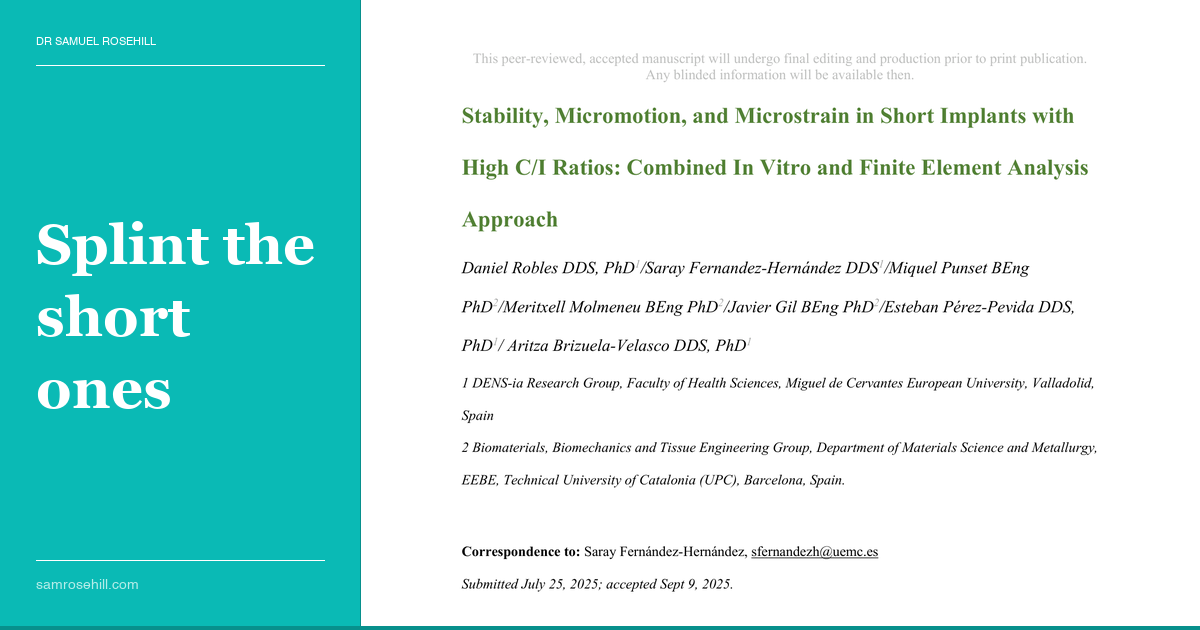
Stability, Micromotion, and Microstrain in Short Implants with High C/I Ratios: Combined In Vitro and Finite Element Analysis Approach
Short implants are dentistry’s tiny apartments: ingenious, space-saving, and absolutely dependent on the furniture being arranged sensibly. Stability, Micromotion, and Microstrain in Short Implants with High C/I Ratios: Combined In Vitro and Finite Element Analysis Approach asks the awkward mechanical question hiding behind the graftless dream. What happens when a 4 mm implant is asked to carry a tall prosthetic life?
The answer is not that short implants fail the audition. It is that they need choreography.
The Data Anchor
Robles and colleagues placed 50 internal-connection implants in nine fresh bovine ribs, comparing 4, 6, 8, and 10 mm lengths restored with standardised PMMA crowns. The crown-to-implant ratios ranged from 1.22 for the 10 mm implants to 4.55 for the 4 mm implants. They measured primary stability with resonance frequency analysis, then assessed micromotion under a 50 N load at 6 degrees and modelled microstrain and von Mises stress with finite element analysis.
The 4 mm implants were also tested in a splinted condition, which is where the paper becomes clinically interesting rather than merely a small engineering lecture with titanium in it.
Key Findings
- Longer implants were more stable at baseline. Mean ISQ values rose from 62 in the 4 mm group to 68.4 in the 10 mm group, with significant differences between the 10 mm implants and the other groups.
- Micromotion followed the crown-to-implant ratio. Shorter implants with taller prosthetic leverage showed more movement under load; the 4 mm group was the mechanical outlier.
- Splinting helped the 4 mm implants behave. The authors report statistically significant reduction in micromotion for splinted 4 mm implants, bringing values closer to the 6, 8, and 10 mm groups.
- Stress concentrated where clinicians would rather it did not. Finite element analysis found von Mises stress in bone rising from 9.115 MPa in the 10 mm model to 27.615 MPa in the 4 mm model.
- This is still laboratory evidence. Bovine ribs, PMMA crowns, finite element assumptions, and a controlled load are useful, but they are not a three-year clinical survival curve.
💡 The Clinical Bottom Line
For Monday morning, this paper supports a simple discipline: do not let the absence of grafting become the presence of wishful thinking. If a 4 mm implant is the sensible anatomical option, the prosthetic design has to earn its keep.
Splinting is not just a tidiness preference in this model; it is the thing that made the shortest implants look less lonely under load. Short implants may save surgical morbidity, but physics still sends the invoice.
Dr Samuel Rosehill is a general dentist with a prosthodontic focus, practising at Ethical Dental in Coffs Harbour, NSW. He holds a BDSc (Hons) from the University of Queensland, an MBA, an MMktg, and an MClinDent in Fixed & Removable Prosthodontics (Distinction) from King’s College London.
Clinical Relevance
Short implants may reduce the need for vertical augmentation, but this paper reinforces that they are not mechanically neutral substitutions for longer fixtures. When a very short implant is being considered, especially under immediate loading or a high crown-to-implant ratio, splinting should be part of the restorative risk conversation.
Disclosure: The author has no financial conflicts of interest related to the products or topics discussed in this review. This is an independent summary prepared for educational purposes.
Continue the conversation
This review is also published on Substack, where you can leave comments and join the discussion.
Read on Substack →