Short Implants Behaved Better in Pairs.
An analytical review of 18 clinical datasets found that splinted short implants failed less often than single short implants and approached the performance of longer implants, making the graftless option look much more defensible when splinting is possible.
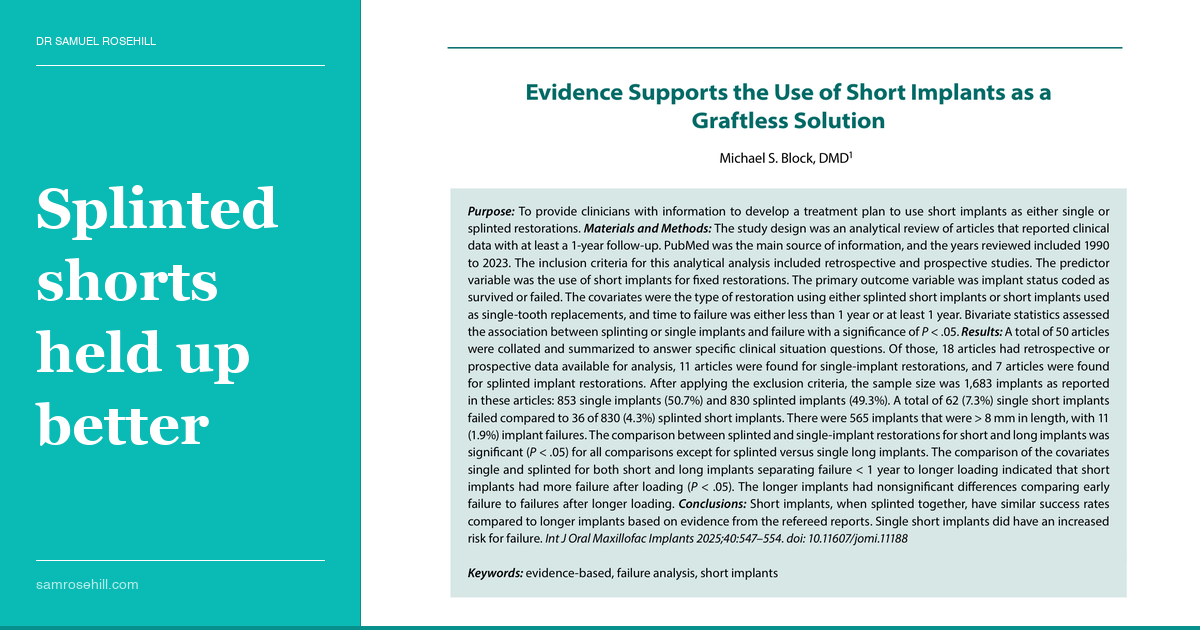
Splinted shorts held up better
Source Paper
Evidence Supports the Use of Short Implants as a Graftless Solution
Implant dentistry has spent a remarkable amount of time arguing about short implants as though length were a moral category. In Evidence Supports the Use of Short Implants as a Graftless Solution, Michael Block tries to make the discussion less theological and more numerical. His conclusion is straightforward enough to survive the conference coffee queue: short implants do better when they are splinted, and single short implants carry a distinctly higher failure burden.
This is the sort of finding clinicians like because it sounds both practical and faintly vindicating. Yes, you may sometimes avoid the graft. No, you do not get to ignore prosthetic design while doing so.
The Data Anchor
This was an analytical narrative review using PubMed literature from 1990 to 2023. Fifty articles were collated to answer common clinical questions about short implants, and 18 retrospective or prospective datasets were taken forward for analysis. After exclusions, the total sample comprised 1,683 implants: 853 single short implants, 830 splinted short implants, and a comparison group of 565 implants longer than 8 mm.
The paper is worth reading because it is trying to answer the real operatory question rather than merely admiring the concept of short implants from a tasteful distance. Not “can they work?” but “under what prosthetic circumstances do they stop becoming a brave little graftless compromise and start looking like a sound treatment plan?”
Key Findings
- Splinting changed the tone of the story. Of the 853 single short implants, 62 failed, which is a failure rate of 7.3%. Of the 830 splinted short implants, 36 failed, or 4.3%.
- Longer implants still performed better numerically. In the group of 565 implants longer than 8 mm, there were 11 failures, a rate of 1.9%.
- The key comparison was not flattering to single short implants. The paper reports significant differences for the short-versus-long and splinted-versus-single comparisons, except for the comparison between splinted and single long implants.
- Timing of failure mattered. Short implants showed more failures after loading, which is an awkward but important detail because it points the clinician back toward occlusion, prosthetic design, and force distribution rather than simply celebrating initial integration.
- The limitation sits in the method itself. This was a narrative analytical review, not a formal systematic review, and studies with no failures were excluded because of suspected reporting bias. That makes the conclusions useful, but not untouchable.
💡 The Clinical Bottom Line
If you are considering short implants as a graftless option, this paper supports them most convincingly when they can be splinted. That is the practical takeaway. A short implant in company looks much more comfortable than a short implant left to carry the load alone.
So the Monday-morning question is not merely whether the ridge is too shallow for a longer implant. It is whether the restorative plan can distribute the risk sensibly. Short implants may indeed save you a graft; the trick is not making them pay for that economy later.
Dr Samuel Rosehill is a general dentist with a prosthodontic focus, practising at Ethical Dental in Coffs Harbour, NSW. He holds a BDSc (Hons) from the University of Queensland, an MBA, an MMktg, and an MClinDent in Fixed & Removable Prosthodontics (Distinction) from King’s College London.
Clinical Relevance
This paper is useful when the real question is not whether a short implant can survive, but whether it should be left to fend for itself. If the anatomy and prosthetic plan allow splinting, the risk profile looks much more comfortable; if not, the graftless shortcut appears to carry a higher failure burden.
Disclosure: The author has no financial conflicts of interest related to the products or topics discussed in this review. This is an independent summary prepared for educational purposes.
Continue the conversation
This review is also published on Substack, where you can leave comments and join the discussion.
Read on Substack →