The Occlusion You Set Isn't the Occlusion They're Chewing On
A PRISMA-registered systematic review and meta-analysis of five prospective clinical trials finds that occlusal loading on single posterior implant crowns increases progressively from 5.91% at two weeks to 19.41% at 36 months — with statistically significant divergence from 12 months. The implication is clear: the occlusal scheme delivered at fit appointment is a starting point, not a destination.
Occlusion drifts from day one
Source Paper
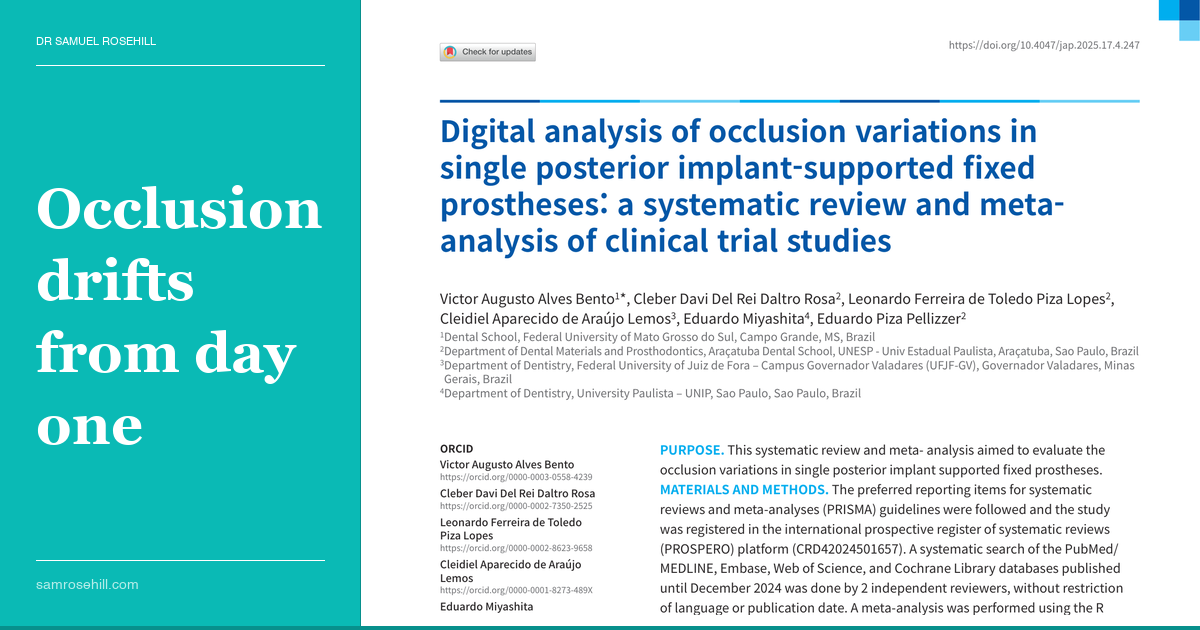
Digital analysis of occlusion variations in single posterior implant-supported fixed prostheses: a systematic review and meta-analysis of clinical trial studies
The difference between a single implant crown and the teeth surrounding it is not purely mechanical — it is temporal. Natural teeth keep moving: erupting, drifting, intruding fractionally under load, the periodontal ligament translating force into positional change across months and years. The implant sits exactly where the surgeon left it, ankylosed into bone with axial displacement of approximately 3 to 5 μm versus 25 to 100 μm for a natural tooth. This biological asymmetry means the occlusion the prosthodontist dialled in at delivery and the occlusion the patient is actually chewing on three years later are, measurably, different occlusions. “Digital analysis of occlusion variations in single posterior implant-supported fixed prostheses: a systematic review and meta-analysis of clinical trial studies,” published in the Journal of Advanced Prosthodontics by Victor Augusto Alves Bento and colleagues, quantifies the drift.
The Data Anchor
Bento et al. (PROSPERO-registered, CRD42024501657) searched five major databases and identified five prospective clinical trials from 2017 to 2023, covering 150 participants and 146 posterior single implant-supported fixed prostheses. Four studies used the T-Scan III digital system (Tekscan Inc., Boston) to measure occlusal force as a proportion of total arch loading; the fifth used a 3Shape TRIOS Color intraoral scanner and was excluded from the meta-analysis as its mm2 output was incommensurable with percentage data.
The pooled time-series is straightforward and a little uncomfortable: 5.91% at 0.5 months, 7.70% at 3 months, 8.29% at 6 months, 13.01% at 12 months, 14.31% at 24 months, and 19.41% at 36 months. Statistical significance appears at 12 months and persists (P < .05). Three studies carried moderate risk of bias on ROBINS-I, principally in domain D4.
Key Findings
- Occlusal loading more than triples over three years. The jump from 5.91% at two weeks to 19.41% at 36 months is not measurement drift; it is natural dentition catching up to an implant that cannot reciprocate.
- The clinically meaningful shift starts at 12 months, not on day one. Early changes (0.5 to 6 months) are present but non-significant; the divergence that should prompt action begins at the one-year review.
- Veneer fractures followed occlusal escalation. Luo et al. and Ding et al. reported complication rates of 16.2% and 8.1% respectively, with veneer fracture the leading technical failure (occurring in prostheses that had exceeded natural-tooth force proportions despite light-contact delivery).
- Overloading alone does not explain marginal bone loss. A 1% occlusal force increase corresponded to only 0.008 mm of additional bone loss, suggesting occlusion is one factor in a multifactorial process.
- Limitation: the studies did not examine screw loosening, settling effect, or prosthetic misfit as confounders, factors almost certainly interacting with the biological drift observed.
There is a particular irony in leaving 10 to 30 μm of deliberate light contact at delivery: a gap designed to protect the implant that the surrounding dentition will, reliably, close.
💡 The Clinical Bottom Line
The question this meta-analysis asks of clinical practice is blunt: does the current recall protocol include structured occlusal review? Not articulation paper and a visual check, but digital analysis, with documented force proportions and a decision point at 12 months.
Natural teeth have not read the treatment plan. They continue erupting at roughly 0.1 to 0.2 mm per year, converting light contact into early contact, then heavy contact, then fractured veneering ceramic — a progression this review has now mapped with reasonable precision. Annual occlusal adjustment is not an unusual intervention. The data suggest it should be the expected one.
Dr Samuel Rosehill is a general dentist with a prosthodontic focus, practising at Ethical Dental in Coffs Harbour, NSW. He holds a BDSc (Hons) from the University of Queensland, an MBA, an MMktg, and an MClinDent in Fixed & Removable Prosthodontics (Distinction) from King’s College London.
Clinical Relevance
Single posterior implant crowns show progressive occlusal loading increases over time, with 19.41% occlusal force proportion at 36 months versus 5.91% at two weeks — a statistically significant divergence appearing from 12 months onward. The driver is biological asymmetry: natural antagonist teeth continue passive eruption (approximately 0.1 to 0.2 mm annually) while osseointegrated implants remain essentially fixed in space (axial displacement 3 to 5 μm versus 25 to 100 μm for natural teeth). Structured long-term occlusal monitoring with digital analysis is warranted, with adjustment planned at the 12-month mark and beyond.
Disclosure: The author has no financial conflicts of interest related to the products or topics discussed in this review. This is an independent summary prepared for educational purposes.
Continue the conversation
This review is also published on Substack, where you can leave comments and join the discussion.
Read on Substack →