Endocrowns vs. Crowns — A Meta-Analysis Finds No Survival Difference
Niakou et al.'s systematic review and meta-analysis finds endocrowns offer comparable survival and complication rates to conventional crowns on structurally compromised teeth.
Endocrowns match crowns
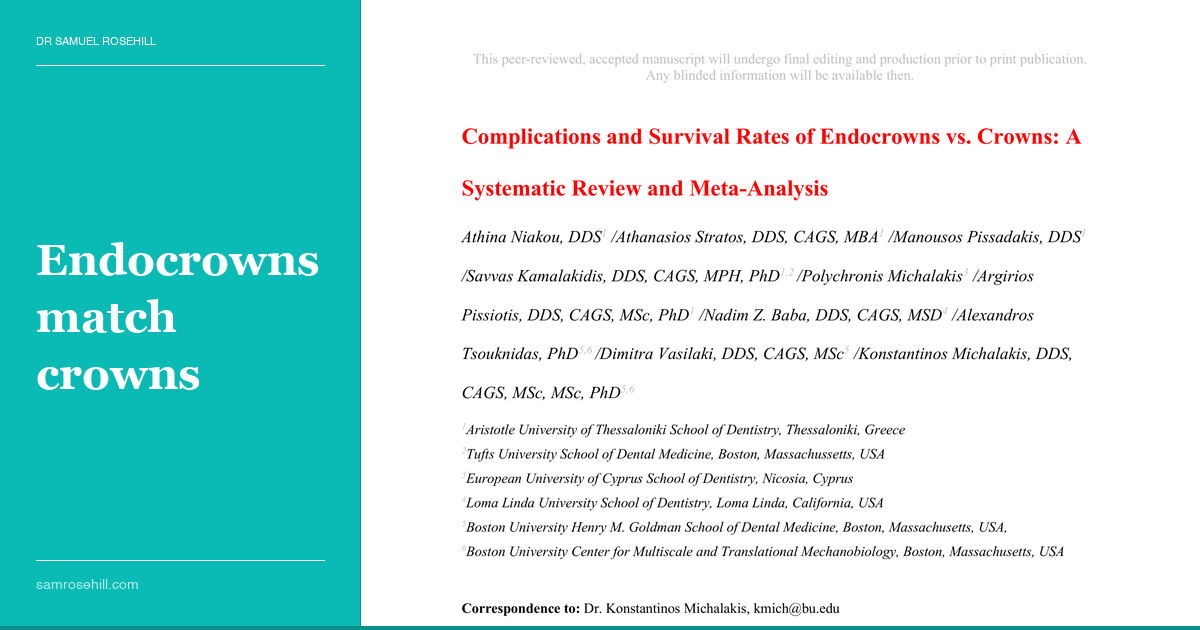
Source Paper
Complications and Survival Rates of Endocrowns vs. Crowns: A Systematic Review and Meta-Analysis
The endocrown has always had something to prove. Born in the mid-1990s as a monoblock ceramic upstart, it arrived with a quietly radical proposition: what if we stopped drilling into the root canal altogether and simply bonded a restoration into the pulp chamber instead? Niakou A et al.’s “Complications and Survival Rates of Endocrowns vs. Crowns: A Systematic Review and Meta-Analysis” (2025) puts this long-running clinical rivalry through the only test that matters — pooled survival data from real patients, tracked over real years.
The endocrown’s pitch has always been conservation. It preserves pericervical dentin (the structural backbone of the endodontically treated tooth), sidesteps the risks of post placement, and asks only for a well-bonded pulp chamber and a butt-joint margin. The conventional crown, meanwhile, has decades of incumbency and an enormous evidence base behind it. So who wins?
The Data Anchor
Niakou et al. screened 443 records, advanced 25 to full-text review, and included just 5 clinical studies that met their criteria: prospective, retrospective, or randomised controlled trials in adults with a minimum 3-year follow-up. Four of these contributed to two separate meta-analyses. The first pooled 277 endocrowns against 246 crowns followed for 7 years; the second assessed 420 endocrowns versus 458 crowns at 5 years. Follow-up across all studies ranged from 12 to 128 months.
At 7 years, the pooled risk ratio for success was 0.93 (95% CI: 0.69-1.27, P = 0.66) — no significant difference. At 5 years, the story was the same: RR 0.96 (95% CI: 0.67-1.39, P = 0.84). The overall success rate across all restorations was 91.21%, with a survival rate of 92.04% and an overall failure rate of just 3.73%. In short, the endocrown matched the crown at every measured time point.
Key Findings
- No statistically significant difference in success rates between endocrowns and conventional crowns at either 5 or 7 years of follow-up
- Endocrowns preserve pericervical dentin and avoid post placement entirely, offering a genuinely conservative alternative for structurally compromised posterior teeth
- Complication profiles were comparable but differed in character: loss of retention occurred exclusively in endocrowns (2.31%), while ceramic fractures were far more common in crowns (1.94% vs. 0.28%)
- Biological complications were rare across both groups (1.42% overall), with vertical root fracture the most frequent event
- Nearly all endocrown restorations in the included studies were placed on molars (96.96%), so the evidence for premolars remains thin
- Limitations are significant: only 5 studies met inclusion criteria, heterogeneity was moderate to high (I² = 65% and 97% in the two analyses), and all non-RCT studies were classified as high risk of bias
💡 The Clinical Bottom Line
For posterior endodontically treated teeth with substantial coronal loss, endocrowns now have meta-analytic backing as a legitimate alternative to conventional crowns with or without post and core. The trade-off is instructive: you swap the fracture risk of ceramics for the adhesive-failure risk of a bonded monoblock, and the numbers come out even. What the endocrown really wants is meticulous bonding protocol and appropriate case selection; give it those, and it will repay you with dentin preserved and outcomes matched.
Sometimes the most radical thing a restoration can do is simply refuse to be worse than what came before it.
Dr Samuel Rosehill is a general dentist with a prosthodontic focus, practising at Ethical Dental in Coffs Harbour, NSW. He holds a BDSc (Hons) from the University of Queensland, an MBA, an MMktg, and an MClinDent in Fixed & Removable Prosthodontics (Distinction) from King’s College London.
Reference: Niakou A et al. “Complications and Survival Rates of Endocrowns vs. Crowns: A Systematic Review and Meta-Analysis.” The International Journal of Prosthodontics (2025). DOI: 10.11607/ijp.9498
Clinical Relevance
Endocrowns demonstrate equivalent survival and complication rates to conventional crowns at 5 and 7 years, supporting their use as a conservative alternative for structurally compromised teeth
Disclosure: The author has no financial conflicts of interest related to the products or topics discussed in this review. This is an independent summary prepared for educational purposes.
Continue the conversation
This review is also published on Substack, where you can leave comments and join the discussion.
Read on Substack →