4 mm Is Where They Notice — VDO Increases and Facial Perception
Kim et al. quantify the vertical dimension threshold at which facial changes become perceptible, finding 4 mm is the tipping point for observer detection.
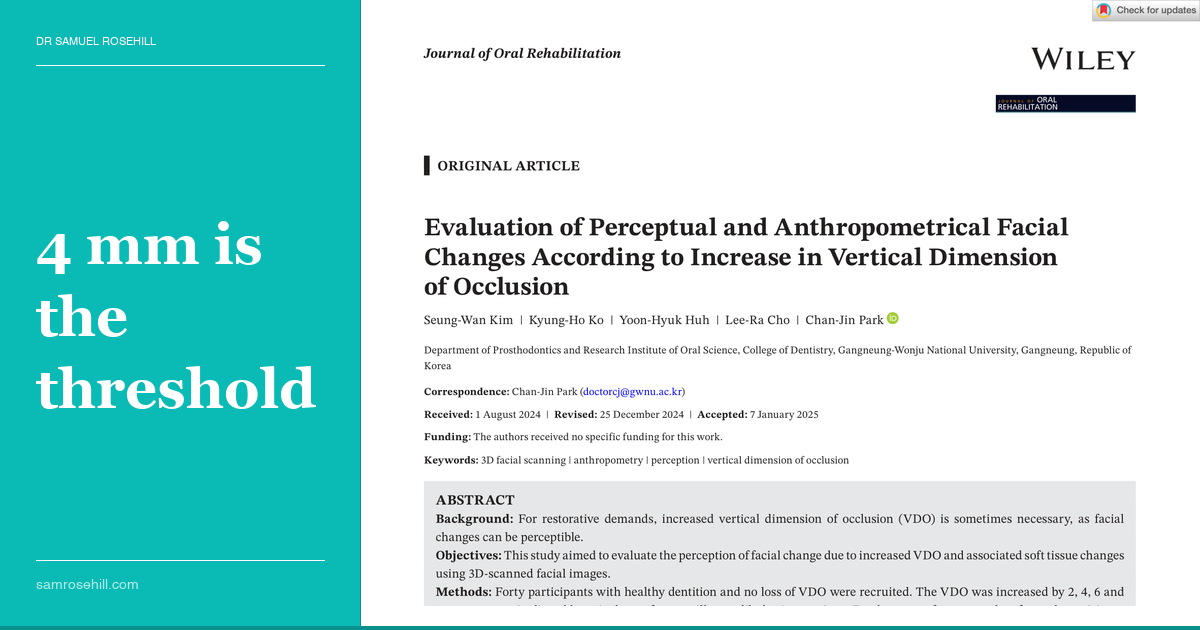
4 mm is the threshold
Source Paper
Evaluation of Perceptual and Anthropometrical Facial Changes According to Increase in Vertical Dimension of Occlusion
You raise a patient’s vertical dimension of occlusion by 6 mm and nobody in the waiting room blinks. Perfectly normal. The patient’s own spouse notices nothing over dinner. Also normal. But show a dentist the same face in a side-by-side photograph and suddenly the whole thing is a catastrophe. This is the strange perceptual world of VDO changes, and Kim S-W et al. have now mapped its borders with satisfying precision in “Evaluation of Perceptual and Anthropometrical Facial Changes According to Increase in Vertical Dimension of Occlusion,” published in the Journal of Oral Rehabilitation (2025). Their finding: 4 mm is where things start getting noticed.
The Data Anchor
The study recruited 40 participants (25 male, 15 female; mean age 25) with healthy, complete dentitions and no existing VDO loss. Each had their VDO systematically increased by 2, 4, 6 and 8 mm using custom mandibular occlusal devices fabricated on a semi-adjustable articulator after facebow transfer. The clever bit: the devices sat on posterior teeth only (second premolar to first molar), avoiding the anterior segment entirely so lip movement remained unimpeded. 3D facial scans were captured at each increment using a RAYFace scanner, then rendered in five orientations (frontal, left, right, 45-degree obliques).
Sixty evaluators — divided equally among dentists, dental students and laypersons (gender-balanced within each group) — compared baseline images against each VDO increment in an online survey. Anthropometric measurements of five soft tissue landmarks were taken three times each in CAD software, with all values calibrated against intercanthal distance to control for scan-to-scan size variation. Analysis used repeated-measures ANOVA with Bonferroni-corrected paired t-tests (alpha = 0.05).
Key Findings
- At 4 mm of VDO increase, 61.3% of all evaluators detected a facial change — making this the threshold where perceptibility crosses the majority line
- Dentists had the highest detection rate at every increment, followed by dental students, then laypersons; trained eyes see what untrained eyes forgive
- Total face height increased by roughly 3 mm and lower face height followed suit at a 4 mm VDO raise (all increments p < 0.05)
- Nasolabial angle opened progressively, gaining approximately 3 degrees at the 4 mm mark and nearly 5 degrees by 8 mm
- Lip width and lip height decreased with increasing VDO — the lips thin and narrow as the face elongates, a pattern driven by orbicularis oris contraction
- Lip height showed a significant decrease only at 4 mm (p < 0.05), suggesting this increment is a soft tissue inflection point
- Limitation: participants were young adults with healthy dentitions, not worn-dentition patients undergoing rehabilitation; the perceptual thresholds may differ when restoring lost VDO rather than adding to it
💡 The Clinical Bottom Line
When planning a full-mouth rehabilitation, 4 mm of VDO increase is your perceptual Rubicon: stay below it for patients who want function without visible change; cross it deliberately when facial rejuvenation is part of the treatment goal. The anthropometric data give you a framework for that conversation, not just clinical intuition.
It turns out the face has a remarkably generous tolerance for vertical tinkering — right up until it doesn’t. Four millimetres is not a lot of space on an articulator. It is, apparently, quite a lot of space on a human face.
Dr Samuel Rosehill is a general dentist with a prosthodontic focus, practising at Ethical Dental in Coffs Harbour, NSW. He holds a BDSc (Hons) from the University of Queensland, an MBA, an MMktg, and an MClinDent in Fixed & Removable Prosthodontics (Distinction) from King’s College London.
Reference: Kim S-W et al. “Evaluation of Perceptual and Anthropometrical Facial Changes According to Increase in Vertical Dimension of Occlusion.” Journal of Oral Rehabilitation (2025). DOI: 10.1111/joor.13937
Clinical Relevance
Quantifies the VDO increase threshold (4 mm) at which facial changes become noticeable to observers, providing evidence-based guidance for treatment planning
Disclosure: The author has no financial conflicts of interest related to the products or topics discussed in this review. This is an independent summary prepared for educational purposes.
Continue the conversation
This review is also published on Substack, where you can leave comments and join the discussion.
Read on Substack →