The Occlusion You Deliver Is Not the Occlusion They Keep
A 5-year retrospective study of posterior implant-supported fixed prostheses found that intentionally light occlusion did not remain stable over time and did not produce superior marginal bone, proximal contact, or technical-complication outcomes compared with non-light occlusion.
Light contact drifts
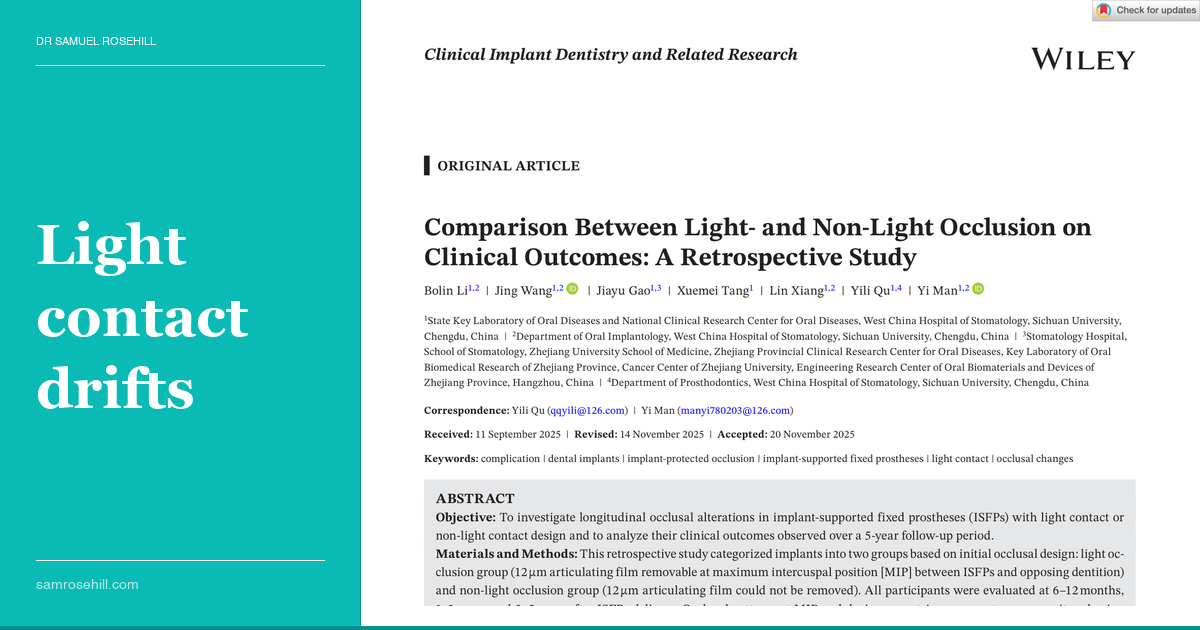
Source Paper
Comparison Between Light- and Non-Light Occlusion on Clinical Outcomes: A Retrospective Study
There is a tiny ceremonial moment in implant prosthodontics when the 12 micrometre articulating paper is asked to adjudicate an entire philosophy. A faint mark is tolerated, a stronger one is adjusted, and everyone behaves as though the crown has been given a long-term personality. In Comparison Between Light- and Non-Light Occlusion on Clinical Outcomes: A Retrospective Study, Li and colleagues offer the inconvenient follow-up: the occlusion you deliver is not necessarily the occlusion the patient keeps.
The question is not whether occlusion matters. Of course it does. The question is whether intentionally light contact on posterior implant-supported fixed prostheses remains light over time, and whether it buys the implant any measurable clinical protection.
The Data Anchor
This retrospective study from West China Hospital of Stomatology followed 46 patients with 63 posterior implant-supported fixed prostheses for up to 5 years. Thirty patients with 40 implants were placed in the light occlusion group, where 12 micrometre articulating film could be removed at maximum intercuspal position. Sixteen patients with 23 implants formed the non-light group, where it could not.
Occlusion was assessed at 6-12 months, 1-3 years, and 3-5 years using 12 micrometre and 100 micrometre articulating papers. The investigators also tracked eccentric contacts, marginal bone loss, proximal contact loss, and technical complications. It is very much a clinical-record study, not a digital-force-platform extravaganza, which makes it less glamorous but recognisably close to everyday practice.
Key Findings
- Light occlusion did not stay light. By 1-3 years, none of the light-contact prostheses remained in Scheme 1; by 3-5 years, 92.5% had shifted to widespread 12 micrometre contact.
- Both groups converged. At the final follow-up, there was no significant intergroup difference in occlusal scheme, suggesting that posterior implant prostheses gradually settle into a similar contact pattern regardless of the delivery design.
- Eccentric occlusion barely moved. The real drift occurred at maximum intercuspation, while protrusive and lateral contacts showed minimal alteration.
- Clinical outcomes were comparable. Median marginal bone loss was 0.00 mm in both groups, and technical-complication-free rates were 95.0% for light occlusion and 95.7% for non-light occlusion.
- Proximal contact loss still happened. Mesial PCL rose to 61.6% in the light group and 57.9% in the non-light group by 3-5 years, with no significant survival-curve difference.
- Limitation: this was a small retrospective study using articulating paper rather than digital occlusal analysis, and only bone-level posterior implants were included.
💡 The Clinical Bottom Line
The practical message is not to abandon occlusal care and let posterior implant crowns live recklessly. It is subtler, and therefore more useful: a carefully light contact at delivery may be a starting condition, not a stable state.
For Monday morning, keep checking occlusion, but be less bewitched by the idea that the initial absence of a 12 micrometre mark is a durable protective charm. Occlusion behaves less like a signed contract and more like a living arrangement. Everyone moves a little after settlement.
Dr Samuel Rosehill is a general dentist with a prosthodontic focus, practising at Ethical Dental in Coffs Harbour, NSW. He holds a BDSc (Hons) from the University of Queensland, an MBA, an MMktg, and an MClinDent in Fixed & Removable Prosthodontics (Distinction) from King’s College London.
Clinical Relevance
In posterior implant-supported fixed prostheses, the study found that a light-contact delivery scheme did not remain stable over 3 to 5 years and did not improve marginal bone loss, proximal contact loss, or technical complication rates. Clinicians should still avoid overload, but this paper argues against treating complete elimination of 12 micrometre articulating paper marks as a durable biological shield.
Disclosure: The author has no financial conflicts of interest related to the products or topics discussed in this review. This is an independent summary prepared for educational purposes.
Continue the conversation
This review is also published on Substack, where you can leave comments and join the discussion.
Read on Substack →