468,000 Implants Reveal What Actually Predicts Failure — and It's Not What You Think
Griffin and colleagues mine the US Veterans Affairs database — 132,675 patients, 468,496 implants, 21 years — and find that prior failure history, not smoking or diabetes, is the strongest predictor of future failure, with an 86% intraclass correlation at the patient level.
Prior failure predicts future failure
Source Paper
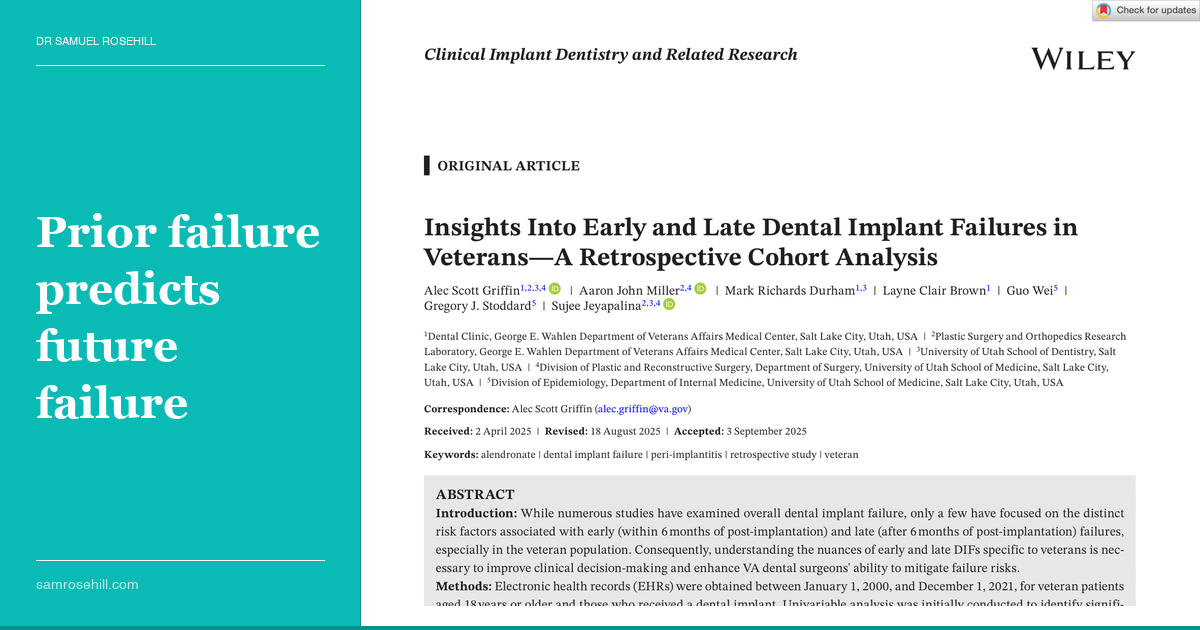
Insights Into Early and Late Dental Implant Failures in Veterans—A Retrospective Cohort Analysis
Implant dentistry has spent decades accumulating risk factor studies with sample sizes in the hundreds, occasionally the low thousands, and then extrapolating clinical guidelines from datasets that would make an epidemiologist wince. Griffin and colleagues have done something different. Their retrospective cohort analysis, published in Clinical Implant Dentistry and Related Research, draws on the United States Veterans Affairs electronic health records: 132,675 patients, 468,496 dental implants, and 21 years of follow-up data. It is, by a considerable margin, the largest study of dental implant failure ever published, and its central finding is both intuitive and profoundly underappreciated.
The Data Anchor
The cohort comprised US veterans aged 18 and older who received at least one dental implant between January 2000 and December 2021. Using CPT procedure codes for implant placement and failure, the authors identified 13,492 failures across 9,423 unique veterans, yielding an overall failure rate of 7.1%. Failures were classified as early (within 6 months of placement, n = 4,393) or late (after 6 months, n = 9,099). Mixed-effect logistic regression models with patient-level random effects were used to estimate adjusted odds ratios, and the intraclass correlation coefficient was calculated to quantify patient-level clustering.
Key Findings
- Active periodontitis was the strongest predictor of late failure (OR = 2.39, 95% CI: 2.02–2.83, p < 0.001), increasing the odds by approximately 139%.
- Alendronate use more than doubled the odds of late failure (OR = 2.14, 95% CI: 1.18–3.90, p = 0.012), a finding that challenges the reassuring consensus around bisphosphonate use and implant therapy.
- Age 70 or older at placement was associated with 257% increased odds of early failure (OR = 0.28 for late vs early, inverting to ~3.6x early failure risk).
- Reimplantation (placing an implant where one had previously failed) carried 89% increased odds of early failure, reinforcing that the site remembers its history.
- Smoking and diabetes, often cited as primary risk factors, lost statistical significance in the multivariable model after adjusting for periodontitis and other confounders.
- The intraclass correlation coefficient was 86%, meaning that patient-level factors explained the vast majority of outcome variance; the specific implant site was almost secondary.
The veteran population is predominantly male, older, and carries a higher burden of systemic comorbidities than the general population, which limits direct generalisability. The reliance on CPT codes for outcome ascertainment also introduces potential misclassification bias.
💡 The Clinical Bottom Line
The single most important number in this study is not an odds ratio; it is the ICC of 86%. It means that when an implant fails, the most reliable predictor of what happens next is not the bone quality at the next site, the implant system chosen, or the grafting protocol deployed. It is whether the patient has failed before. Risk assessment in implant dentistry, this dataset suggests, should begin with the patient’s history, not the CBCT.
Dr Samuel Rosehill is a general dentist with a prosthodontic focus, practising at Ethical Dental in Coffs Harbour, NSW. He holds a BDSc (Hons) from the University of Queensland, an MBA, an MMktg, and an MClinDent in Fixed & Removable Prosthodontics (Distinction) from King’s College London.
Reference: Griffin AS, Miller AJ, Durham MR, et al. Insights Into Early and Late Dental Implant Failures in Veterans—A Retrospective Cohort Analysis. Clin Implant Dent Relat Res. 2025;27:e70091. doi:10.1111/cid.70091
Clinical Relevance
The largest dental implant failure analysis ever published demonstrates that patient-level factors — particularly a history of prior failure — explain 86% of outcome variance, fundamentally reframing implant risk assessment from site-specific to patient-specific.
Disclosure: The author has no financial conflicts of interest related to the products or topics discussed in this review. This is an independent summary prepared for educational purposes.
Continue the conversation
This review is also published on Substack, where you can leave comments and join the discussion.
Read on Substack →