The Number That Should Make You Nervous About Anterior Implants
Dong and colleagues analyse 2,620 anterior implants across 2,023 patients and find that insertion torque below 30 N/cm carries a staggering 13-fold increase in early failure risk — dwarfing every other variable in the model.
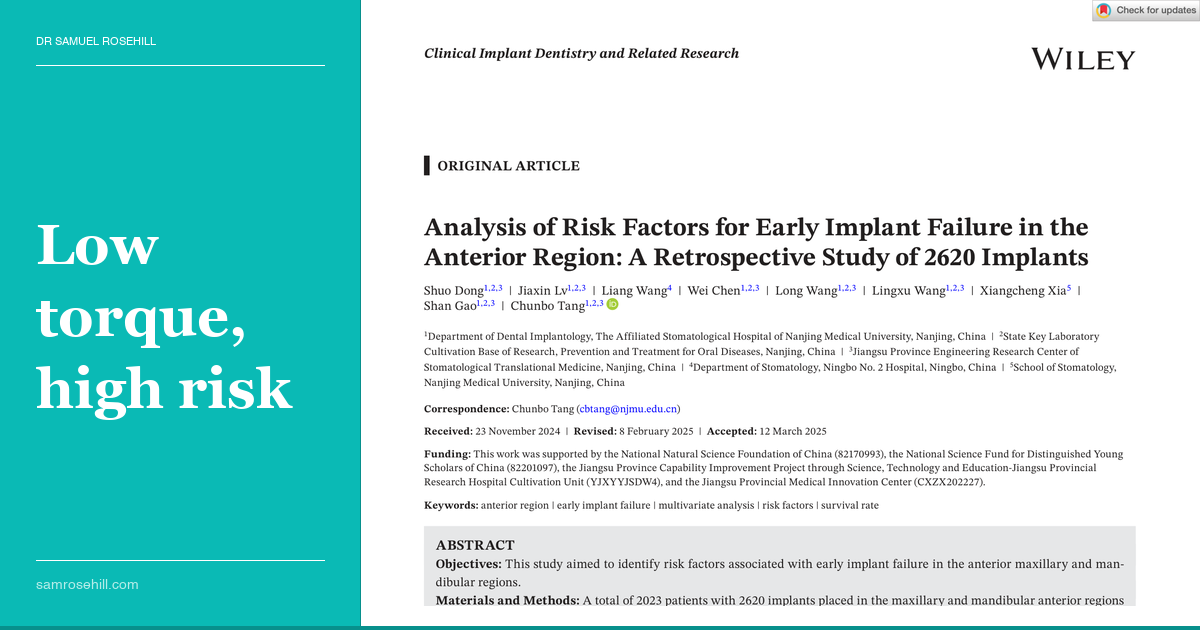
Low torque, high risk
Source Paper
Analysis of Risk Factors for Early Implant Failure in the Anterior Region: A Retrospective Study of 2620 Implants
There is a particular kind of clinical optimism that accompanies the moment you seat an anterior implant and the torque wrench tells you it went in smoothly. Smooth is good, we tell ourselves. Smooth means the bone accepted it. But Dong and colleagues, in a retrospective analysis of 2,620 anterior implants published in Clinical Implant Dentistry and Related Research, have produced a number that should give every implantologist pause: an insertion torque below 30 N/cm carries a hazard ratio of 13.2 for early failure. Not 1.3. Not 2. Thirteen.
The Data Anchor
The study drew on records from 2,023 patients who received anterior maxillary and mandibular implants at Nanjing Medical University between January 2020 and June 2023, using six implant systems (Straumann, Nobel Biocare, Osstem, ABT, Dentium, and Trausim). Nineteen variables were fed into univariate and multivariate Cox proportional hazards regression models with a gamma frailty correction for the clustering of multiple implants within individual patients. The cumulative survival rate across the cohort was 95.6% (95% CI: 94.8%–96.4%) over an observation period of up to 43 months, with the mean time to failure for lost implants sitting at 4.69 months.
Key Findings
- Insertion torque below 30 N/cm was the dominant independent risk factor for early failure (HR = 13.193, 95% CI: 8.439–20.626, p < 0.001), dwarfing all other variables in magnitude.
- Non-submerged healing tripled the odds of early failure (HR = 3.000, 95% CI: 1.712–5.256), suggesting that in the anterior region, burying the implant still confers a meaningful protective advantage.
- Type I (dense cortical) bone quality was, counterintuitively, an independent risk factor (HR = 3.220, 95% CI: 1.413–7.342); the authors propose that excessive cortical compression may compromise the periosteal blood supply.
- Bone compression or splitting surgery was protective (HR = 0.344, 95% CI: 0.186–0.634), likely by improving the mechanical engagement of the implant within expanded bone.
- No significant association was found for patient age, implant diameter, implant length, CGF use, or penicillin allergy after multivariate adjustment.
The torque finding is striking in its magnitude, but it is worth noting that this is a single-centre retrospective study with one surgeon performing all procedures. Whether the 30 N/cm threshold generalises across different implant macro-designs and bone preparation protocols remains an open question.
💡 The Clinical Bottom Line
If you are placing an anterior implant and the torque wrench reads below 30 N/cm, this study suggests you should treat that reading as a clinical alarm, not a reassurance. Consider submerged healing, bone compression techniques, and a candid conversation with the patient about the heightened risk of early failure. The anterior zone demands aesthetic perfection; it turns out it also demands mechanical honesty about what constitutes adequate primary stability.
Dr Samuel Rosehill is a general dentist with a prosthodontic focus, practising at Ethical Dental in Coffs Harbour, NSW. He holds a BDSc (Hons) from the University of Queensland, an MBA, an MMktg, and an MClinDent in Fixed & Removable Prosthodontics (Distinction) from King’s College London.
Reference: Dong S, Lv J, Wang L, et al. Analysis of Risk Factors for Early Implant Failure in the Anterior Region: A Retrospective Study of 2620 Implants. Clin Implant Dent Relat Res. 2025;27:e70027. doi:10.1111/cid.70027
Clinical Relevance
Insertion torque below 30 N/cm is the single strongest predictor of early anterior implant failure, with a hazard ratio of 13.2 — a finding that should recalibrate how clinicians assess primary stability in the aesthetic zone.
Disclosure: The author has no financial conflicts of interest related to the products or topics discussed in this review. This is an independent summary prepared for educational purposes.
Continue the conversation
This review is also published on Substack, where you can leave comments and join the discussion.
Read on Substack →