Your Patient's Tooth Had a Shape. Here's How to Reconstruct It.
A technique from the University of Iowa uses AI tooth segmentation and the CAD mirror-image feature to replicate a natural emergence profile for immediate anterior implant restorations, bypassing the geometric compromises of prefabricated healing abutments.
Mirror your way there
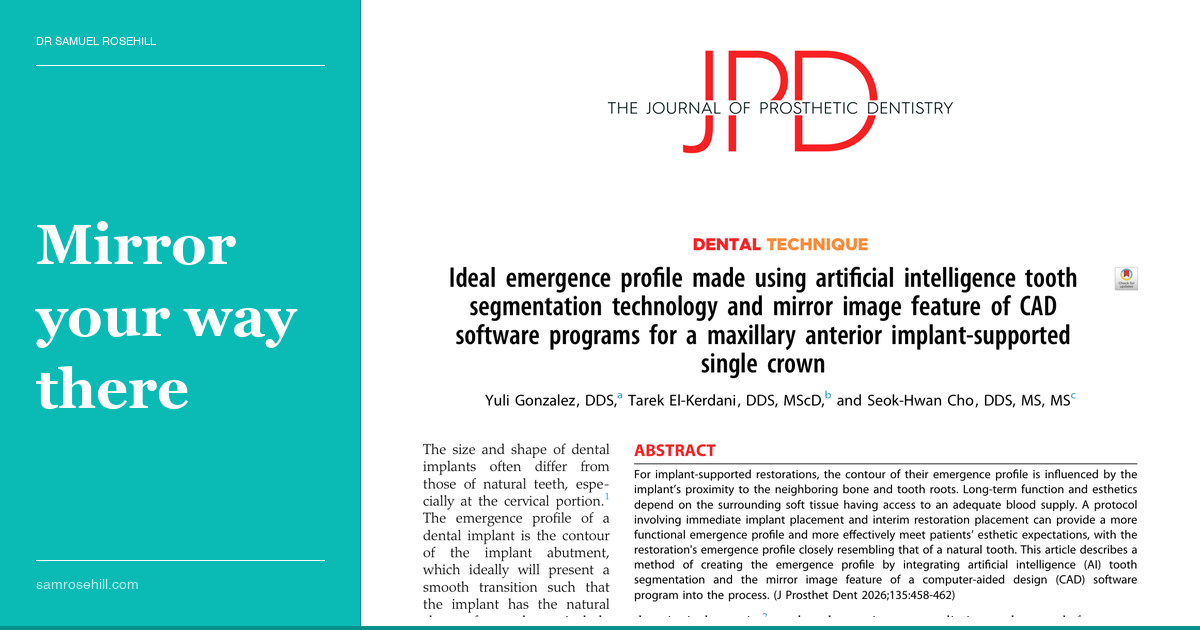
Source Paper
Ideal emergence profile made using artificial intelligence tooth segmentation technology and mirror image feature of CAD software programs for a maxillary anterior implant-supported single crown
The prefabricated healing abutment is a study in polite indifference. It arrives at a freshly extracted socket that held a root with its own cross-section, its own flare, its own relationship to surrounding bone and soft tissue. What it offers in return is a circle. Titanium, clean, standardised, shaped like no tooth that has ever grown in a human jaw.
“Ideal emergence profile made using artificial intelligence tooth segmentation technology and mirror image feature of CAD software programs for a maxillary anterior implant-supported single crown,” by Gonzalez, El-Kerdani, and Cho from the University of Iowa, is a technique paper with a more ambitious proposal: recover the actual shape before it disappears, and use that information to fabricate an interim crown with the correct emergence profile already built in.
The Data Anchor
This is a single-case technique description. The case involves a maxillary left central incisor requiring immediate implant placement. The workflow begins before extraction: an intraoral scan (Primescan; Dentsply Sirona) and CBCT are imported into BlueSky-Plan 4 (BlueSky Bio), where AI tooth segmentation generates individual tooth surfaces from the DICOM data.
The contralateral tooth (the right central incisor) is mirrored in Meshmixer 3.5 (Autodesk Inc) to produce a dimensionally accurate crown replica. The subgingival profile from the segmented extraction site is combined with that mirrored crown at the level of the interim abutment platform. A screw-access hole is created by Boolean subtraction of the virtual abutment cylinder.
Seating wings (0.2 mm offset, 2 mm extrusion) stabilise the restoration on adjacent teeth. The file is 3D-printed in Temporary CR resin on a Form 3B printer (Formlabs). Retrieval uses an interim cylinder and 3M Filtek Supreme Flowable composite resin. The definitive crown carries a mirror image of the contralateral tooth with a comparable subgingival contour.
Key Findings
- The AI segmentation step is the foundational move. CBCT-derived tooth segmentation captures the subgingival emergence geometry that an intraoral scan cannot; the root surface relationship to the osseous crest governs where Sharpey fibres insert, and that information lives below the gumline.
- Mirror imaging addresses the gap CAD-CAM has historically accepted in the aesthetic zone. Conventional methods approximate; this method copies.
- The limitations are real and the authors name them. There is a learning curve across multiple programs. Root morphology variation or atypical angulation can complicate design. All data must be captured before extraction, because once the tooth is gone, so is the reference geometry.
- Single case, single centre. No survival data, no pink aesthetic scores, no long-term follow-up. This is a method paper, not a proof.
💡 The Clinical Bottom Line
If you are planning immediate anterior implant placement and the contralateral tooth is intact, the information needed to reconstruct a biologically contoured emergence profile is already there. It just needs capturing before you extract.
The prefabricated abutment will always offer a circle. The question is whether the socket you are working in was ever circular in the first place, and for most anterior teeth, it was not.
The emergence profile that supports healthy gingival architecture is not an afterthought to be shaped by healing. It is a design decision, and this technique shows it can be made before the scalpel is lifted.
Dr Samuel Rosehill is a general dentist with a prosthodontic focus, practising at Ethical Dental in Coffs Harbour, NSW. He holds a BDSc (Hons) from the University of Queensland, an MBA, an MMktg, and an MClinDent in Fixed & Removable Prosthodontics (Distinction) from King’s College London.
Clinical Relevance
Prefabricated healing abutments cannot replicate patient-specific root morphology, leaving the emergence profile as a geometric approximation. This technique combines CBCT-derived AI tooth segmentation with CAD mirror-imaging of the contralateral tooth to produce a 3D-printed interim crown that maintains the natural subgingival contour from the time of extraction. Clinicians planning immediate anterior implants in the aesthetic zone should capture pre-extraction data and consider this digital workflow.
Disclosure: The author has no financial conflicts of interest related to the products or topics discussed in this review. This is an independent summary prepared for educational purposes.
Continue the conversation
This review is also published on Substack, where you can leave comments and join the discussion.
Read on Substack →