The Posterior Tooth Came Out. The Provisional Went Straight In.
A 12-patient proof-of-concept study using tissue-level Straumann TLX implants and a fully digital workflow reports 100% 6-month survival for immediate placement and immediate loading in posterior single-tooth sites, though the sample is tiny and the follow-up brief.
Feasible, not yet routine
Source Paper
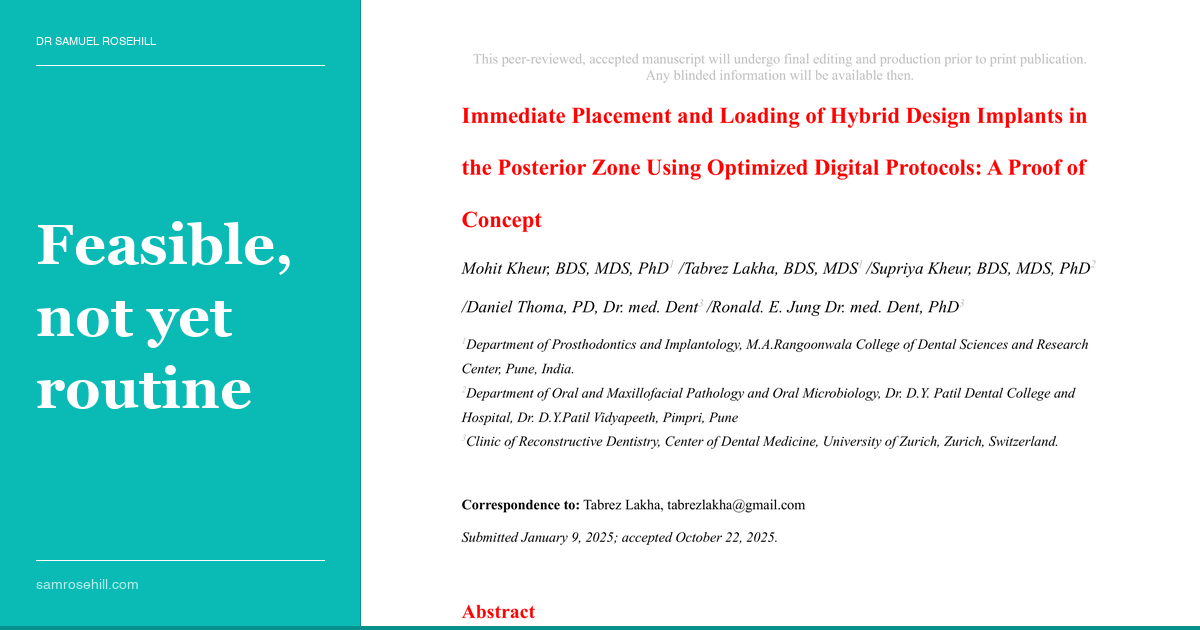
Immediate Placement and Loading of Hybrid Design Implants in the Posterior Zone Using Optimized Digital Protocols: A Proof of Concept
Posterior immediate loading has usually been treated like an attractive but slightly unreliable dinner guest: welcome in carefully managed company, never seated near anything fragile, and certainly not trusted without a mature chaperone in the form of delayed loading. Kheur and colleagues, in “Immediate Placement and Loading of Hybrid Design Implants in the Posterior Zone Using Optimized Digital Protocols: A Proof of Concept,” have a go at changing that mood. Their question is straightforward enough: if the socket is selected properly, the workflow is fully digital, and the implant is a tissue-level hybrid design with serious primary stability, can the provisional go in on the day the tooth comes out? In this tiny series, yes. Calm down, though.
The Data Anchor
The study followed 12 consecutively treated posterior single-tooth cases, 8 men and 4 women with a mean age of 41.8 ± 10.1 years. All sites had intact buccal and lingual plates and at least 3 mm of native bone apical to the root. Each tooth was extracted flaplessly, digitally planned with CBCT plus intraoral scan, and restored using a fully guided workflow. Straumann TLX tissue-level implants, 3.75 or 4.5 mm in diameter and 10 or 12 mm in length, were inserted with final torque values of 45-50 Ncm. A screw-retained provisional was delivered immediately in full occlusion; the definitive zirconia crown on Variobase followed after 8 weeks.
Follow-up ran for 6 months after definitive loading. Not a long time, in other words, but long enough to see whether the wheels came off quickly.
Key Findings
- Survival was 100%. None of the 12 implants failed, and no biologic, technical, or clinical complications were reported during the 6-month follow-up.
- Soft tissue parameters were stable enough to be reassuring. Mean probing depth changed from 2.79 ± 0.5 mm at baseline to 2.68 ± 0.4 mm at 6 months (P = .636), while bleeding on probing rose from 31.42% ± 22.31% to 41.15% ± 20.14% without statistical significance (P = .19).
- Plaque increased, which is not exactly shocking once people leave the operatory with a fresh posterior provisional. Mean plaque index rose from 4.85% ± 5.72% to 12.95% ± 12.26% (P = .002).
- Patient satisfaction started high and stayed there. PROM scores moved from 9.5 ± 0.4 at baseline to 9.7 ± 0.4 at 6 months (P = .438).
- The workflow logic is the real intervention here. Fully guided positioning, prefabricated shell provisionals, high insertion torque, and a tissue-level implant that shifts the microgap coronally were all asked to do their part.
- The limitation is the whole paper, really. Twelve cases, one surgeon, carefully selected sites, and only 6 months of follow-up make this a feasibility signal, not a practice standard.
💡 The Clinical Bottom Line
This paper says posterior immediate placement and immediate loading can work when the anatomy is favourable, the primary stability is high, and the operator is not improvising halfway through. It does not say the posterior socket has suddenly become a zone of carefree immediacy. The useful takeaway is narrower, and therefore more trustworthy: in selected cases, with a tissue-level implant and a disciplined digital workflow, you may not need to make the patient wait for a provisional.
Feasibility papers are the profession’s way of saying, very politely, “this is possible, but please don’t all sprint at once.”
Dr Samuel Rosehill is a general dentist with a prosthodontic focus, practising at Ethical Dental in Coffs Harbour, NSW. He holds a BDSc (Hons) from the University of Queensland, an MBA, an MMktg, and an MClinDent in Fixed & Removable Prosthodontics (Distinction) from King’s College London.
Reference: Kheur M, Lakha T, Kheur S et al. Immediate Placement and Loading of Hybrid Design Implants in the Posterior Zone Using Optimized Digital Protocols: A Proof of Concept. International Journal of Prosthodontics. 2025. DOI: 10.11607/ijp.9266
Clinical Relevance
In carefully selected posterior single-tooth sockets with intact plates and at least 3 mm of native apical bone, immediate placement and immediate loading on a tissue-level implant proved feasible over 6 months. The paper supports a cautious expert-hand workflow, not a general invitation to skip staged healing in every posterior extraction case.
Disclosure: The author has no financial conflicts of interest related to the products or topics discussed in this review. This is an independent summary prepared for educational purposes.
Continue the conversation
This review is also published on Substack, where you can leave comments and join the discussion.
Read on Substack →