The Healing Abutment Taxonomy Nobody Knew They Needed
Manfredini et al. wade through 1,961 records to propose a unified three-tier healing abutment classification — and discover that the field has been arguing about things nobody agreed to define in the first place.
Design shapes soft tissue
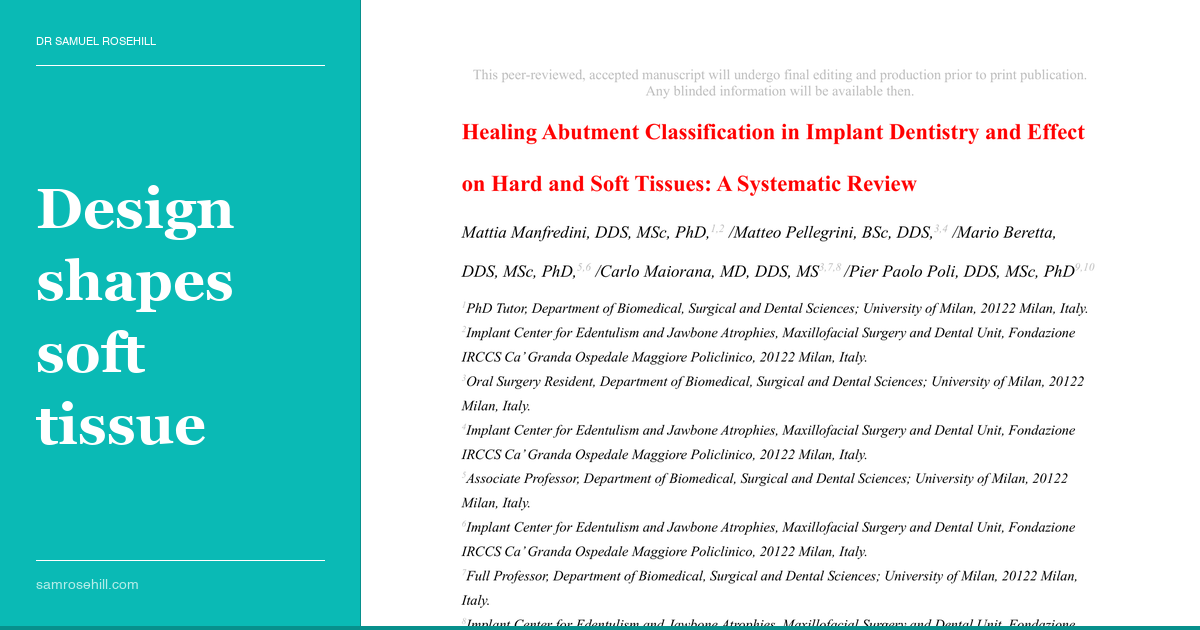
Source Paper
Healing Abutment Classification in Implant Dentistry: A Systematic Review
You know that moment in a clinical huddle when someone mentions their “anatomical healing abutment” and everyone nods knowingly, ninety percent certain you’re all talking about different things? Dentistry does this rather often — we bump along in a shared fog of confidence, until a paper lands on your desk with the title Healing Abutment Classification in Implant Dentistry: A Systematic Review and you realise nobody actually codified what the words mean.
Manfredini et al. (University of Milan, International Journal of Prosthodontics 2026) have done what the field clearly needed: waded through 1,961 records, distilled them to 11 surviving studies, and proposed something rather radical. A unified classification system. Three discrete categories emerge. The standard (prefabricated cylindrical or conical — the workhorse, the forgettable). The anatomical (prefabricated but contoured to emergence-profile logic, fancier in name than concept). And the customised (patient-specific, CAD/CAM or chairside-modified — dentistry’s answer to haute couture).
The Data Anchor
Manfredini’s team followed PRISMA guidelines through a screening funnel that winnowed 1961 records down to just 11 surviving studies — a dropout rate that rather tells its own story about the quality of the existing literature. Inclusion criteria swept broadly across observational studies, case series, RCTs, and quasi-experimental designs from 2010 to 2023, measuring soft tissue morphology (papilla fill, emergence profile), marginal bone loss, and patient satisfaction.
The uncomfortable truth: most included studies were small (median n < 30), short-term (< 12 months), and observational. Head-to-head RCT comparisons across all three abutment categories are vanishingly rare. The field has opinions. It does not yet have evidence.
Key Findings
- Terminological chaos confirmed — nobody agrees what these terms mean across publications. The authors diplomatically call this “inconsistent nomenclature.” It is an absolute dogs’ breakfast.
- Customised abutments show measurable soft tissue advantages — better papilla fill (p < 0.05), superior emergence profiles, visibly improved mucosa architecture. The evidence base, however, is observational, not experimental.
- High-quality comparative evidence simply doesn’t exist — the literature bristles with case reports and small observational series. This is a field built on confidence rather than controlled trials.
- Soft tissue conditioning during healing predicts final prosthetic outcome — the abutment you select doesn’t sit there passively; it actively shapes the tissue envelope around it.
- Customisation carries real cost — fabrication time, lab coordination, material expense — and current evidence doesn’t yet demonstrate that aesthetic gain is proportional to operational burden for most routine anterior cases.
💡 The Clinical Bottom Line
Healing abutment design genuinely influences soft tissue remodelling — this much is now evidenced. The three-tier classification Manfredini proposes gives the field a shared language it has been conspicuously lacking. For routine cases, standard or anatomical abutments remain entirely defensible; reserve patient-specific designs for aesthetic-anterior zones where the patient is invested, the stakes are high, and your schedule has room for the coordination. The taxonomy is useful. The evidence base it describes is, candidly, still growing up.
Dr Samuel Rosehill is a general dentist with a prosthodontic focus, practising at Ethical Dental in Coffs Harbour, NSW. He holds a BDSc (Hons) from the University of Queensland, an MBA, an MMktg, and an MClinDent in Fixed & Removable Prosthodontics (Distinction) from King’s College London.
Reference: Manfredini et al. Healing Abutment Classification in Implant Dentistry: A Systematic Review. Int J Prosthodont. 2026;39. https://doi.org/10.11607/ijp.9443
Clinical Relevance
Healing abutment design genuinely influences soft tissue remodelling — customised geometries favour better emergence profile and papilla fill. The evidence remains thin, short-term, and observational. For routine cases, standard or anatomical abutments suffice; reserve patient-specific designs for aesthetic-anterior zones where motivated patients afford the coordination time and your schedule permits.
Disclosure: The author has no financial conflicts of interest related to the products or topics discussed in this review. This is an independent summary prepared for educational purposes.
Continue the conversation
This review is also published on Substack, where you can leave comments and join the discussion.
Read on Substack →