3D-Printed Zirconia Crowns on Ti-Bases: The 30 µm Sweet Spot
An in vitro study of 135 additively manufactured zirconia crowns finds that a 30 µm cement gap combined with Panavia 21 produces the best fit and highest pull-out resistance when bonding AM-Z crowns to Ti-base abutments — a clinically actionable finding for digital implant workflows.
30 µm gap wins
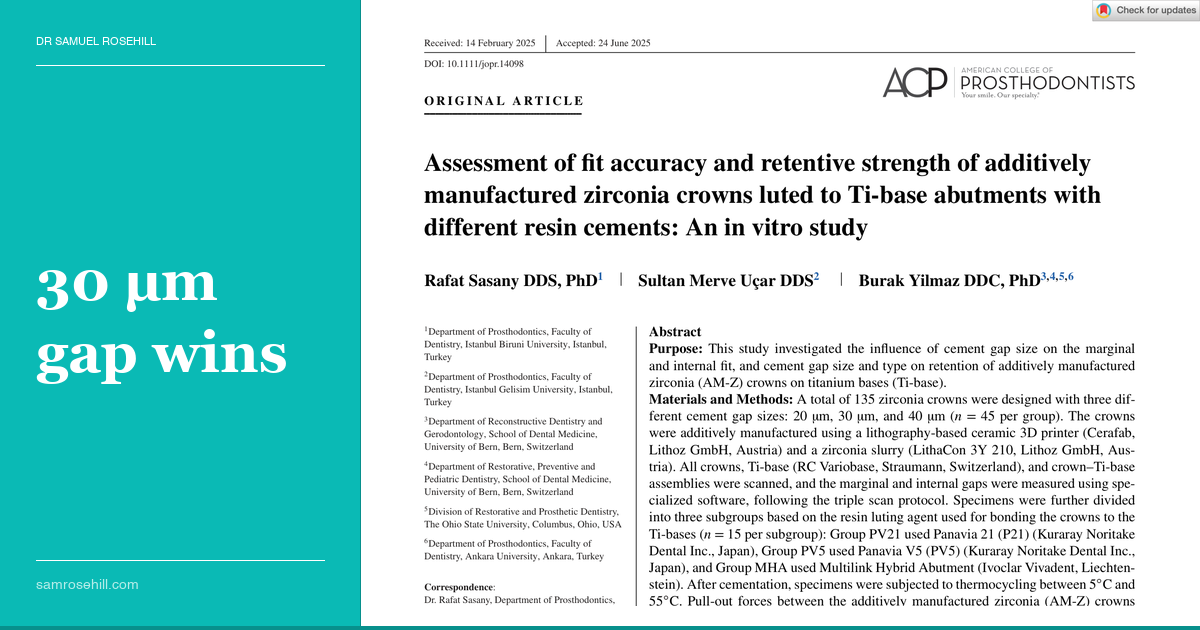
Source Paper
Assessment of fit accuracy and retentive strength of additively manufactured zirconia crowns luted to Ti-base abutments with different resin cements: An in vitro study
Zirconia has always had a reputation to manage. It arrived trailing promises: tougher than porcelain, kinder than metal, white enough to satisfy the most demanding patients. For a material with that billing, it has spent a remarkable amount of time being quietly difficult — difficult to bond, difficult to characterise, and now, in its printed form, difficult to cement properly. Whether additive manufacturing resolves the cementing question is what Sasany, Uçar, and Yilmaz set out to answer.
Their 2025 paper, “Assessment of fit accuracy and retentive strength of additively manufactured zirconia crowns luted to Ti-base abutments with different resin cements: An in vitro study” (Journal of Prosthodontics), addresses a gap that is, appropriately, about gaps: how much virtual clearance should the intaglio surface carry when designing a 3D-printed zirconia crown for a Ti-base abutment, and once that is settled, which cement?
The Data Anchor
One hundred and thirty-five molar crowns were fabricated via lithography-based ceramic manufacturing on a Lithoz CeraFab 7500, split into three cement gap groups: 20 µm, 30 µm, and 40 µm (n = 45 each). Each group was subdivided into three cementation subgroups (n = 15): Panavia 21 (P21), Panavia V5 (PV5), and Multilink Hybrid Abutment (MHA). Fit was measured via the triple scan protocol with a 3Shape TRIOS; pull-out forces followed five million chewing simulator cycles at 5–55°C, approximating 20 years of function.
Marginal discrepancy RMS: 45.9 µm at 20 µm, 28.9 µm at 30 µm, 40.8 µm at 40 µm. Internal discrepancy followed suit: 50.6 µm, 30.2 µm, and 48.6 µm. The 30 µm group produced significantly lower discrepancy on both measures (p < 0.01); 20 µm and 40 µm were statistically equivalent (p = 0.113). All values fell below 60 µm, well within the clinically accepted ceiling of 120 µm.
Key Findings
- The 30 µm cement gap delivered the best fit on both metrics. Marginal discrepancy at 30 µm (28.9 µm) was significantly lower than the 20 µm (45.9 µm) and 40 µm (40.8 µm) groups (p < 0.01). Internal discrepancy followed the same pattern.
- Panavia 21 dominated on pull-out resistance. P21 at 30 µm produced 785 N, significantly higher than P21 at 20 µm (626 N, p = 0.008) and P21 at 40 µm (724 N, p = 0.004). PV5 returned the lowest values across all gap sizes (484–559 N, p = 0.02).
- Cement type and gap size interact. Two-way ANOVA confirmed both variables and their interaction shaped retention (p < 0.01). The 30 µm gap provides sufficient space for cement flow without the void formation and shrinkage stress of thicker films.
- PV5’s underperformance reflects formulation. Both cements contain MDP, but PV21 incorporates it directly in the cement; PV5 delivers it via a separate primer. On LCM zirconia’s rougher layered surface, that distinction proved consequential.
- Limitations: Single AM technology; other printing systems may behave differently. In vitro design; pull-out values are not direct clinical equivalents.
💡 The Clinical Bottom Line
The message is admirably direct: specify 30 µm cement gap in your AM-Z crown designs, and use Panavia 21. Twenty µm is too tight (hydraulic back-pressure raises internal misfit); 40 µm introduces excessive bulk and the mechanical penalties that follow. Thirty is the Goldilocks figure.
This is, crucially, a design-stage decision. The cement gap is set in CAD software before the crown is ever printed. Getting it right costs nothing. Getting it wrong costs a re-make.
Zirconia has always demanded more than its competitors seem to require. The printed version is no exception. But now, at least, the number is in the literature.
Dr Samuel Rosehill is a general dentist with a prosthodontic focus, practising at Ethical Dental in Coffs Harbour, NSW. He holds a BDSc (Hons) from the University of Queensland, an MBA, an MMktg, and an MClinDent in Fixed & Removable Prosthodontics (Distinction) from King’s College London.
Clinical Relevance
When bonding additively manufactured zirconia crowns to Ti-base abutments, a 30 µm cement gap setting outperforms both 20 µm and 40 µm for marginal and internal fit. Panavia 21 consistently delivered the highest pull-out forces across all gap sizes tested. Both variables are controllable at the design stage — meaning this is a decision made in CAD software, not at the cementation appointment.
Disclosure: The author has no financial conflicts of interest related to the products or topics discussed in this review. This is an independent summary prepared for educational purposes.
Continue the conversation
This review is also published on Substack, where you can leave comments and join the discussion.
Read on Substack →