A Field Takes Stock: What Six Issues of IJP Reveal About Where Prosthodontics Is Heading
In her annual digest editorial, IJP Editor-in-Chief Irena Sailer surveys all six 2025 issues and identifies four converging themes: digital workflows now meeting standard-of-care criteria, ceramics confidence anchored by long-term data, 3D printing maturing with important caveats, and a shift toward biopsychosocial patient care.
Digesting where the field stands
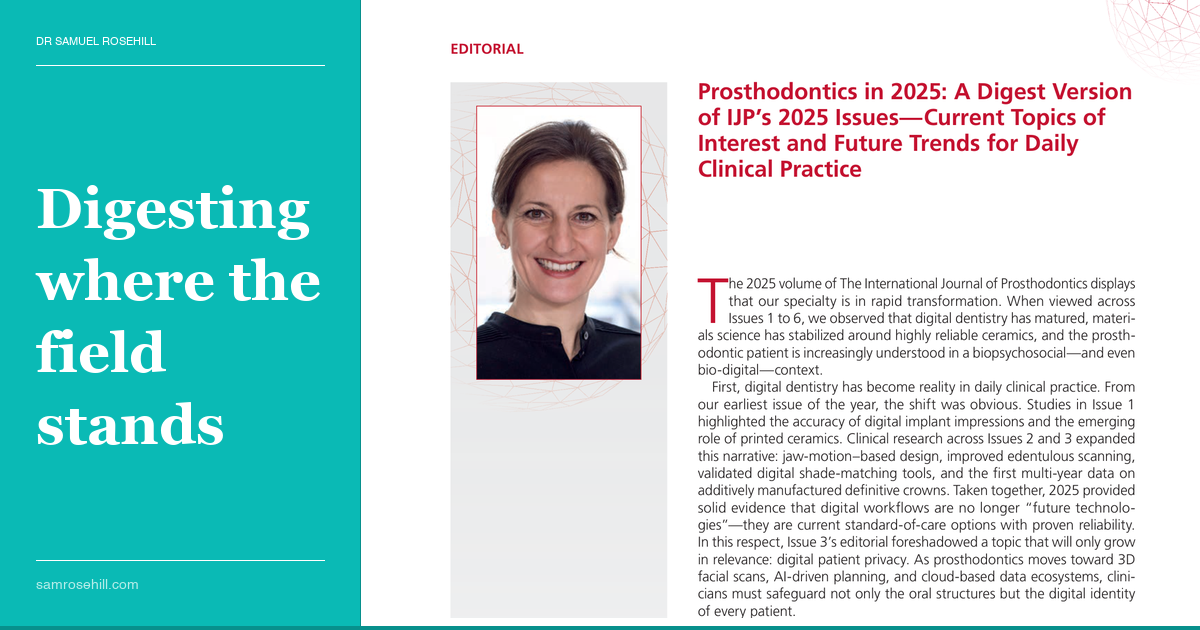
Source Paper
Prosthodontics in 2025: A Digest Version of IJP's 2025 Issues—Current Topics of Interest and Future Trends for Daily Clinical Practice
Once a year, the International Journal of Prosthodontics (IJP) pauses. Not literally — manuscripts keep arriving, reviewers keep grumbling, production keeps turning. But once a year the Editor-in-Chief sits down with the full volume in hand and asks a question most practising clinicians never quite find time to ask: taken together, what did this year’s research mean?
Irena Sailer’s 2026 editorial, “Prosthodontics in 2025: A Digest Version of IJP’s 2025 Issues — Current Topics of Interest and Future Trends for Daily Clinical Practice,” is the product of that reckoning. It is not primary research; no patients were enrolled, no controls were randomised. What it offers is something rarer: a senior clinician-researcher reading across 52 weeks of the specialty’s most watched journal and identifying the patterns that individual papers, read in isolation, make invisible.
The Data Anchor
Sailer synthesises all six issues of the 2025 IJP volume, from Issue 1 through Issue 6, spanning fixed and removable prosthodontics, implant prosthodontics, digital dentistry, ceramics science, additive manufacturing, and patient-centred outcomes. Readers should calibrate accordingly: this is expert synthesis, not new primary evidence. The value is in cross-issue pattern recognition, not in any single sample size.
The editorial does not rank these themes by importance. It presents them as converging; that convergence is its own argument.
Key Findings
- Digital workflows have earned standard-of-care status. Research across Issues 1 to 3 documented accurate digital implant impressions, jaw-motion-based crown design, validated digital shade-matching, and first multi-year data on additively manufactured definitive crowns. These are “current standard-of-care options with proven reliability,” per the editorial. Digital patient privacy is flagged as the next challenge: three-dimensional facial scans and artificial intelligence (AI)-driven planning require clinicians to protect patients’ digital identity, not just their oral structures.
- Zirconia and chairside ceramics are long-term evidence-based choices. A four-year randomised controlled trial (RCT) showed zero chipping events in posterior monolithic or semi-monolithic fixed dental prostheses (FDPs); a 10-year chairside lithium disilicate study adds further support. Both same-day and long-term ceramic restorations now carry substantive evidence.
- 3D printing is conditionally ready. Mid-term performance for printed definitive crowns was acceptable, but build-angle-dependent mechanical behaviour, sensitivity to oral acids, and post-processing effects on fit were documented. Additive manufacturing (AM) is appropriate for provisionals, surgical guides, splints, and selected definitive applications — protocol discipline and patient-level indication selection are non-negotiable.
- Psychology and systemic health materially affect prosthodontic outcomes. Evidence linked bruxism to stress, bowel symptoms, and masticatory pain; personality profiles predicted prosthodontic satisfaction; patient-centred aesthetic workflows appeared throughout multiple manuscripts. Today’s prosthodontics must be biologically informed, psychologically informed, and digitally informed.
- Limitation (scope): A digest editorial is interpretive. These themes reflect what IJP published and accepted, not the totality of 2025 prosthodontic evidence. Selection bias toward novel and positive findings is a structural feature of academic publishing.
💡 The Clinical Bottom Line
For the clinician who read some of these papers as they appeared, the digest names the shape of what they were reading. Digital workflows are no longer a research context; they are a clinical expectation. Ceramic selection for both same-day and multi-year cases has the evidence to support confident recommendation.
The biopsychosocial framing is the most consequential signal in the piece. A personality profile predicting prosthodontic satisfaction is not a curiosity; it is a clinical variable that most practices do not yet systematically assess.
Editorial judgements from a full year of immersion are precisely what a digest is for.
Dr Samuel Rosehill is a general dentist with a prosthodontic focus, practising at Ethical Dental in Coffs Harbour, NSW. He holds a BDSc (Hons) from the University of Queensland, an MBA, an MMktg, and an MClinDent in Fixed & Removable Prosthodontics (Distinction) from King’s College London.
Clinical Relevance
This editorial synthesis by IJP Editor-in-Chief Irena Sailer distils all six 2025 issues into four actionable themes: digital workflows have earned standard-of-care status, monolithic zirconia and chairside ceramics are backed by long-term evidence, 3D-printed definitive restorations require protocol discipline and careful indication selection, and prosthodontic outcomes are materially shaped by patient psychology and systemic health. The piece is expert synthesis, not primary research, but the patterns it identifies across a full year of publications give clinicians a reliable compass for 2026 practice decisions.
Disclosure: The author has no financial conflicts of interest related to the products or topics discussed in this review. This is an independent summary prepared for educational purposes.
Continue the conversation
This review is also published on Substack, where you can leave comments and join the discussion.
Read on Substack →